Documents & Ressources - Résultat de la recherche
Résultats de la recherche
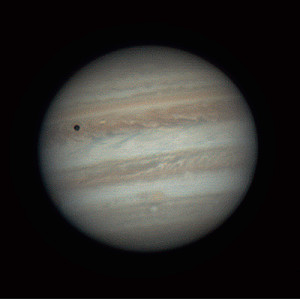
Jupiter, Io and its shadow, by Ralf Burkart, Germany
vidéo
Créé pour l'OAE
Légende : First place in the 2021 IAU OAE Astrophotography Contest, category Galilean moons.
This time-lapse of Jupiter taken in 2017 from Germany beautifully illustrates the transit of one of the Galilean moons, Io, in front of Jupiter. As this is simply a moon casting a shadow on a planet it is equivalent to a lunar eclipse on Earth observed from further away. While the shadow of the moon is clearly visible from the beginning, it might be difficult to spot the moon itself against the background of the beautiful atmospheric bands of Jupiter the first time the video is seen. Watching it repeatedly allows appreciating the rapid motion and rotation in this fantastic observation.
Crédit : Ralf Burkart/IAU OAE
Termes du glossaire:
Satellites galiléens , Géantes gazeuses , Io , Jupiter , Lunes , Orbite , Planètes extérieures , Planète , Transit
Catégories :
Système solaire
Licence : Creative Commons (CC) Attribution 4.0 International (CC BY 4.0) Creative Commons (CC) Attribution 4.0 International (CC BY 4.0) Icônes
Ce fichier est sur Zenodo ( vidéo 12.64 MB)
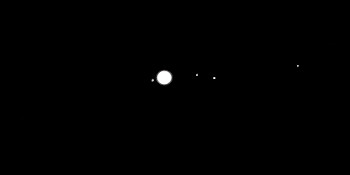
Jupiter Moons Movie2, par Nicolas Hurez, Paul-Antoine Matrangolo, et Carl Pennypacker, États-Unis d'Amérique
vidéo
Créé pour l'OAE
Légende : Deuxième place au concours d'astrophotographie 2021 de l'UAI OAE, catégorie Lunes galiléennes.
Cette séquence montre l'orbite des quatre lunes galiléennes autour de la planète Jupiter. Les images ont été obtenues en 2018 avec l'observatoire mondial Las Cumbres à différents endroits de la Terre, ce qui a permis une séquence continue d'images sur environ une demi-semaine, sans interruption pendant la journée. Avec un ciel clair et au cours de plusieurs nuits, le mouvement des lunes galiléennes peut également être observé avec des jumelles (idéalement en stabilisant vos coudes sur une surface).
Crédit : Nicolas Hurez, Paul-Antoine Matrangolo et Carl Pennypacker/IAU OAE
Termes du glossaire:
Satellites galiléens , Géantes gazeuses , Io , Jupiter , Lunes , Orbite , Planètes extérieures , Planète
Catégories :
Système solaire
Licence : Creative Commons (CC) Attribution 4.0 International (CC BY 4.0) Creative Commons (CC) Attribution 4.0 International (CC BY 4.0) Icônes
Ce fichier est sur Zenodo ( vidéo 890.47 kB)
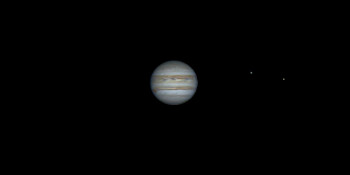
La rotation de Jupiter, par Vishal Sharma, Inde
vidéo
Créé pour l'OAE
Légende : Troisième place au concours d'astrophotographie 2021 de l'AIU OAE, catégorie Lunes galiléennes : Jupiter's Rotation, par Vishal Sharma, Inde.
Ce timelapse montre magnifiquement la rotation de Jupiter et le passage de deux lunes galiléennes sur le côté droit de l'image. Jupiter effectue une rotation en un peu moins de 10 heures et nous voyons la Grande Tache rouge se déplacer de gauche à droite. Les deux lunes parcourent une fraction notable de leur orbite en ce court laps de temps. Cette image a été prise en 2020 dans le nord de l'Inde.
Crédit : Vishal Sharma/IAU OAE
Termes du glossaire:
Satellites galiléens , Géantes gazeuses , Jupiter , Lunes , Orbite , Planètes extérieures , Planète
Catégories :
Système solaire
Licence : Creative Commons (CC) Attribution 4.0 International (CC BY 4.0) Creative Commons (CC) Attribution 4.0 International (CC BY 4.0) Icônes
Ce fichier est sur Zenodo ( vidéo 1.54 MB)

Detailed View of Charon, Moon of Pluto
image
Légende : Charon is the largest natural moon of the dwarf planet Pluto. This detailed image was taken by NASA’s New Horizons spacecraft in 2015 during its historic mission through the outer Solar System. Charon’s surface shows a fascinating mix of light and dark regions, including vast canyons, broad plains, and impact crater. With a diameter of about 1,200 kilometers, Charon is more than half the diameter of Pluto, making it unusually large compared to its parent body. Charon's mass is roughly 12% of that of Pluto.
Because Pluto and Charon are so close in mass, the center of mass of the system (the point both Pluto and Charon orbit) is not within Pluto but between Pluto and Charon. This is in contrast to systems like the Earth and its Moon where the center of mass lies within the larger body, the Earth in this case. Scientists think the Pluto-Charon system may have formed by a collision of two objects that then separated and began to orbit each other. By studying Charon and the smaller moons that circle Pluto, astronomers gain insight into how moons form and how distant icy bodies evolve over billions of years.
Crédit : NASA/Johns Hopkins University Applied Physics Laboratory/Southwest Research Institute/Alex Parker
Lien du crédit
Termes du glossaire:
Lunes , Pluto
Licence : Domaine Public Domaine Public Icônes
Fichier
( image
2.88 MB)

Transit of Phobos from Mars
vidéo
Légende : This video shows the Sun viewed from Mars as Mars’ moon Phobos transits across the solar disk. This video is composed of images taken from the Martian surface on the 30th of September 2024 by the Mastcam-Z camera of NASA’s Perseverance Mars rover. While our Moon is perfectly sized to eclipse the Sun when seen from the Earth’s surface, Phobos’s size and orbit mean that it cannot cover the solar disk completely. This means that this event is a transit and not an eclipse.
This video is in real time, with the entire transit lasting just 32 seconds. This compares with the several hours a solar eclipse on Earth takes from the Moon first obscuring part of the Sun to the Sun being completely visible again. This is due to Phobos’ much shorter orbital period of just over seven and a half hours compared to the Moon’s orbital period of 27 days as well as the solar disk appearing slightly smaller from Mars than it does from Earth. Note the non-spherical shape of Phobos as it crosses the solar disk.
Crédit : NASA/JPL-Caltech/ASU/MSSS
Lien du crédit
Termes du glossaire:
Mars , Lunes , Eclipse solaire , Transit
Catégories :
Système solaire
Licence : Domaine Public Domaine Public Icônes
Fichier
( vidéo
111.64 kB)



- Ressources
- Moteur de recherche des ressources pédagogiques
- Parcourir les ressources pédagogiques par Sujet
- Parcourir les images
- AstroEdu - Activités en classe
- Grandes Idées - Littéracie en astronomie
- Glossaire
- Rapports de l'OAE
- L'astronomie pour l'Education à travers le monde
- Sélection de ressources externes