Documents & Ressources - Résultat de la recherche
Résultats de la recherche
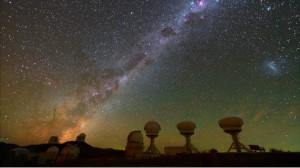
Southern Sky Over La Silla
vidéo
Créé pour l'OAE
Légende : First place winner in the 2023 IAU OAE Astrophotography Contest, category of Time-lapses of rotation of Big Dipper or Southern Cross.
This video shows the Milky Way’s sprawling brilliance across the celestial expanse. Among the stars’ grand theatre, the Southern Cross constellation claims its place in the scene, distinguished by its distinctive cross shape as seen in the top of this video and slightly to the right just over the Milky Way, slowly disappearing as the video progresses. This celestial marker, a prominent feature in the southern hemisphere, holds cultural and navigational significance, having served as a navigational guidepost for centuries. Accompanying the Milky Way’s grandeur are the two Magellanic clouds, celestial companions seen dancing in the distant sky. The Carina Nebula adds its ethereal glow to the cosmic panorama, painting a radiant hue against the darkness. In the midst of this celestial ballet, a gentle green hue envelops the atmosphere, a phenomenon known as airglow, adding a touch of subtle luminescence to the night sky. The terrestrial also makes an appearance, with planes flying overhead and vehicles driving between observatory buildings. This time-lapse, taken from the La Silla Observatory in Chile, is a window to the captivating dance of stars, offering a glimpse into the awe-inspiring beauty of our galaxy and the celestial landmarks that grace the southern sky.
Crédit : José Rodrigues/IAU OAE (CC BY 4.0)
Termes du glossaire:
Pôle céleste , Sphère Céleste , La rotation de la Terre , Observation , Ciel , Croix du Sud
Catégories :
Astronomie à l'œil nu
Mots clés :
astrophotography
Licence : Creative Commons (CC) Attribution 4.0 International (CC BY 4.0) Creative Commons (CC) Attribution 4.0 International (CC BY 4.0) Icônes
Ce fichier est sur Zenodo ( vidéo 1.07 GB)
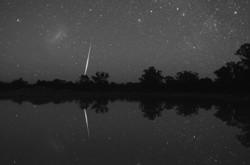
Between Two Skies
image
Créé pour l'OAE
Légende : Honourable mention in the 2022 IAU OAE Astrophotography Contest, category Still images of celestial patterns.
Taken from Narrabri, Australia, in April 2014, this photograph shows a meteor next to the Large Magellanic Cloud and the reflection of all this in the water.
The Magellanic Clouds are named after the Portuguese explorer Ferdinand Magellan, who made the first maps of the southern part of South America in the early 16th century but did not survive his expedition voyage. His shipmates called the two nebulae after him, and it was only in the 20th century that astronomy research discovered that they are in fact dwarf galaxies accompanying our own.
In the 18th century, the French mathematician J-N. Lacaille, who lived in South Africa for some years in order to draw maps of the sky and the land, invented some new constellations. He measured the positions of some faint stars and listed them in his star catalogue, but did not try to overlay beautiful drawings of real-world objects on the star patterns, so he could name them however he wanted. He was based in the trade station that is now the city of Cape Town and, from this bay, Table Mountain is visible. Lacaille learned from the navigators that they used the clouds around this mountain to predict whether or not the wind would blow in the correct direction and allow for sailing. Normally, there is a huge white cloud at the top of Table Mountain, so Lacaille considered the larger one of the two dwarf galaxies not a “Magellanic Cloud”, but the cloud at Table Mountain. Consequently, he invented the constellation “Mensa”, Table Mountain, in the small area of faint stars directly attached to this dwarf galaxy.
Crédit : Fabrizio Melandri/IAU OAE
Termes du glossaire:
Constellation , Étoile filante , Grand nuage de Magellan (LMC) , Petit Nuage de Magellan (SMC)
Catégories :
Galaxies
, Astronomie à l'œil nu
Licence : Creative Commons (CC) Attribution 4.0 International (CC BY 4.0) Creative Commons (CC) Attribution 4.0 International (CC BY 4.0) Icônes
Ce fichier est sur Zenodo ( image 1.82 MB)

La voie lactée au-dessus de Anglers Reach
image
Créé pour l'OAE
Légende : Gagnant du concours d'astrophotographie 2022 de l'AIU OAE, catégorie Images fixes de motifs célestes.
La Voie lactée et plusieurs objets astronomiques sont visibles sur cette image prise depuis l'hémisphère sud, à Anglers Reach, en Australie, en avril 2022.
En bas à gauche, on peut identifier la constellation du Scorpion avec son étoile la plus brillante, Antarès, la tache rougeâtre juste au-dessus de l'arc. Quelques constellations australes importantes mais de petite taille sont également visibles : les étoiles brillantes dominantes au milieu gauche de l'image dans la Voie lactée sont les quatre étoiles brillantes de Crux (la Croix du Sud) et, à sa gauche, les deux étoiles-pointeurs, alpha et bêta Centauri. Crux pointe vers le pôle céleste sud, qui n'est pas marqué par une étoile brillante, et les étoiles indicatrices pointent vers Crux, ce qui la distingue de l'astérisme de la Fausse Croix dans la constellation d'Argo.
Crux figure sur les drapeaux nationaux de l'Australie, du Brésil, de la Papouasie-Nouvelle-Guinée, de Samoa et de la Nouvelle-Zélande. Comme Crux se trouve dans les parties les plus lumineuses de la Voie lactée, le nuage sombre de la célèbre nébuleuse du Coalsack est proéminent à côté des étoiles brillantes. Elle constitue l'une des constellations sombres dans les cultures indigènes d'Amérique du Sud, d'Afrique du Sud et d'Australie. L'énorme constellation sombre australienne de l'émeu est presque entièrement au-dessus de l'horizon sur cette image, étirant sa tête depuis le Sac à Charbon jusqu'à l'horizon.
Dans l'Antiquité grecque, les étoiles de Crux appartenaient également à la constellation du Centaure, une créature hybride avec un torse et une tête humains attachés à un corps de cheval à quatre pattes. Le centaure grec représente Chiron, le sage professeur de tous les héros grecs. Son étoile la plus brillante est Rigil Kentaurus (Alpha Centauri), le sabot avant du centaure. Juste en dessous, on trouve la petite constellation Triangulum Australe. Le système stellaire triple d'Alpha du Centaure est le plus proche voisin stellaire de notre Soleil.
Le long de la Voie lactée, au milieu à droite de l'image, se trouve l'immense constellation Argo, le navire. L'ancienne constellation Argo, plus petite, a été élargie par les navigateurs néerlandais vers 1600. Le nombre d'étoiles de cette constellation était alors si important que le mathématicien français du XVIIIe siècle, Lacaille, a dû introduire des sous-titres pour Argo dans son catalogue d'étoiles. C'est ainsi qu'il a inventé les constellations Puppis, Carina et Vela. Dans Carina, la quille du navire, cette photographie rougeâtre montre clairement la nébuleuse de Carina.
Sur le bord droit de l'image, on peut apercevoir l'étoile la plus brillante du ciel nocturne, Sirius, tandis que la deuxième étoile la plus brillante, Canopus, le gouvernail d'Argo, le navire, domine la zone située sous l'arche de la Voie lactée.
Sous l'arc de la Voie lactée, on peut également voir le Grand Nuage de Magellan et le Petit Nuage de Magellan, qui sont de petites galaxies satellites de notre propre galaxie.
Crédit : Lucy Yunxi Hu/IAU OAU
Termes du glossaire:
Couleur , Poussière , Voie lactée , Scorpius , Croix du Sud , Nuage de poussière , L'extinction interstellaire , Grand nuage de Magellan (LMC) , Petit Nuage de Magellan (SMC) , Alpha du Centaure
Catégories :
Galaxies
, Voie lactée et milieu interstellaire
, Astronomie à l'œil nu
Licence : Creative Commons (CC) Attribution 4.0 International (CC BY 4.0) Creative Commons (CC) Attribution 4.0 International (CC BY 4.0) Icônes
Ce fichier est sur Zenodo ( image 9.39 MB)

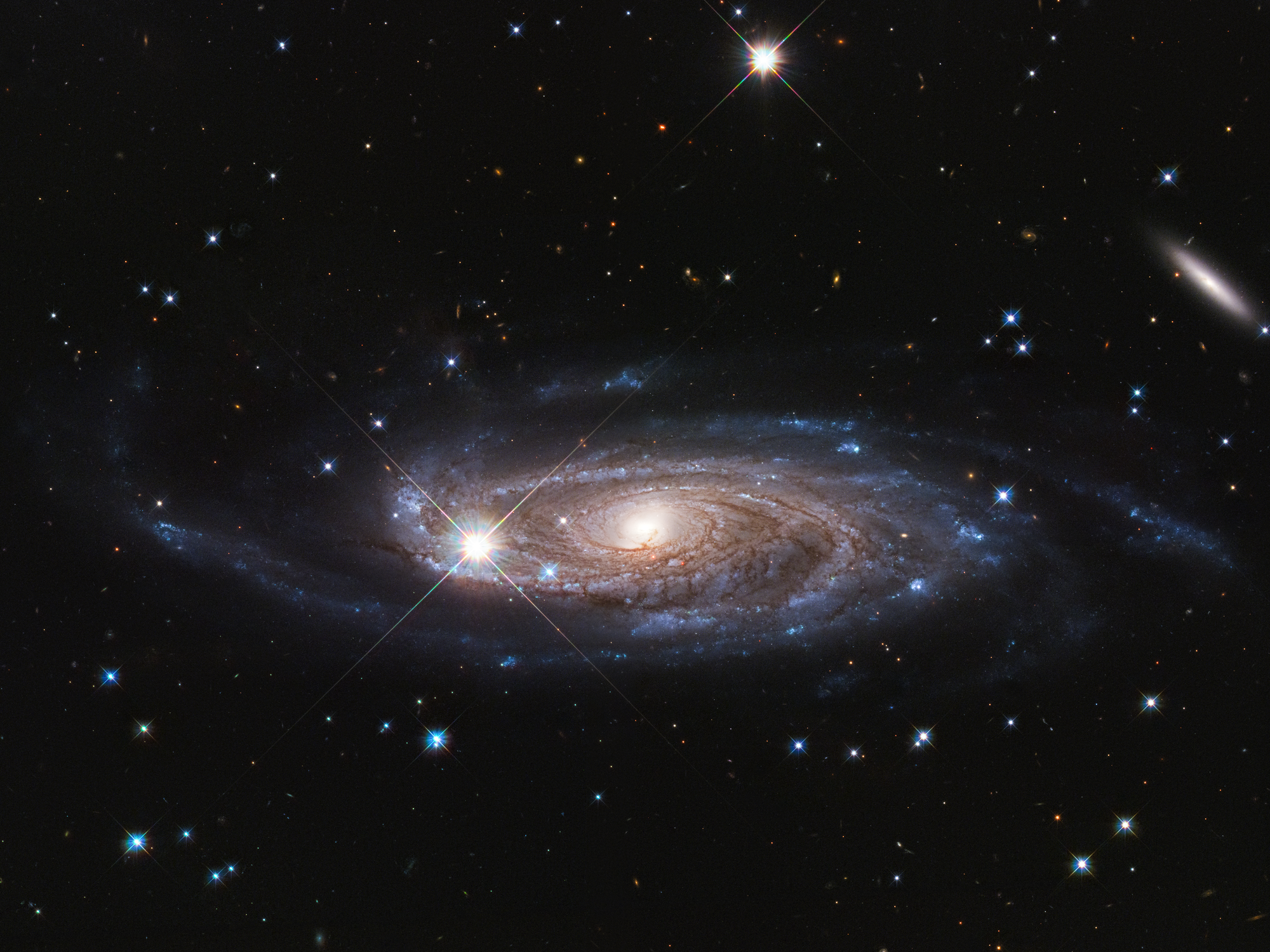
Spiral Galaxy UGC 2885
image
Légende : This image shows UGC 2885, a spiral galaxy located in the constellation Perseus, about 230 million light-years from Earth. Spiral galaxies have rotating disks of stars, gas, and dust, with spiral arms extending outward from the central region. In UGC 2885, these arms are very broad and faint, revealing the galaxy’s large size. This galaxy is tilted at an angle to the observer on Earth, meaning it does not appear as the circular "grand design" spiral it would look like if viewed face-on, nor as the thin line with a central bulge it would appear as if viewed edge-on.
UGC 2885 is remarkable because it is roughly twice the diameter of the Milky Way. It was studied by astronomer Vera Rubin, whose observations of how galaxies rotate — including systems like this one — played a key role in the search for dark matter.
The bright star which appears to the left of the galaxy's center is a foreground object not related to the galaxy.
Crédit : NASA, ESA, Benne Holwerda (University of Louisville)
Lien du crédit
Termes du glossaire:
Galaxie à disque , Galaxie spirale
Licence : Domaine Public Domaine Public Icônes
Fichier
( image
4.87 MB)

3D Universe: the Milky Way and friends Activités pédagogiques de astroEDU (liens vers le site astroEDU) Origin: astroEDU Description : Use tactile models printed in 3D to explore our galactic neighborhood.
Termes du glossaire:
Galaxie d'Andromède , Galaxie , Nuages de Magellan , Grand nuage de Magellan (LMC) , Petit Nuage de Magellan (SMC)
Catégories :
Galaxies
, Physique
Tranches d'âge :
10-12
, 12-14
, 14-16
, 16-19
, 19+
Niveau scolaire :
Collège
, Secondaire
, Université
Domaines d'apprentissage :
Apprentissage par découverte guidée
, Cours interactif
, Modélisation
Coûts :
Moyen
Durée :
1h
Taille du groupe :
Par groupe
Compétences :
Analyser et interpréter des données
, Développer et utiliser des modèles
Auteurs : Amelia Ortiz-Gil, Emilio Terol, Alberto Fernández-So
Licence : Creative Commons (CC) Attribution 4.0 International (CC BY 4.0) Creative Commons (CC) Attribution 4.0 International (CC BY 4.0) Icônes






- Ressources
- Moteur de recherche des ressources pédagogiques
- Parcourir les ressources pédagogiques par Sujet
- Parcourir les images
- AstroEdu - Activités en classe
- Grandes Idées - Littéracie en astronomie
- Glossaire
- Rapports de l'OAE
- L'astronomie pour l'Education à travers le monde
- Sélection de ressources externes