Documents & Ressources - Résultat de la recherche
Résultats de la recherche
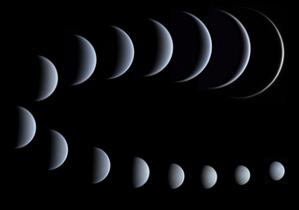
Une question de perspective
image
Créé pour l'OAE
Légende : Second prix du concours d'astrophotographie 2023 de l'UAI OAE, catégorie Images fixes des phases de Vénus : Une question de perspective, par Christofer Baez
La deuxième place dans la catégorie Images fixes des phases de Vénus revient à cette exquise série d'images, photographiées depuis Saint-Domingue, en République dominicaine, entre le 17 décembre 2019 et le 25 mai 2020. Alors que Vénus et la Terre gravitent autour du Soleil, nous observons différentes portions de la moitié ensoleillée de Vénus, similaires aux phases de la Lune. La séquence montre clairement que Vénus est lointaine, petite, brillante et gibbeuse dans les images du bas, et se termine par Vénus atteignant la plus grande taille apparente de toutes les planètes (images du haut), très proche du Soleil avec une petite élongation, et apparaissant comme un mince croissant. Dans la dernière image, seulement 2,8 % de la surface de la planète est éclairée.
Crédit : Christofer Baez/UAI OAE (CC BY 4.0)
Termes du glossaire:
Phase , Vénus
Catégories :
Système solaire
Mots clés :
astrophotography
Licence : Creative Commons (CC) Attribution 4.0 International (CC BY 4.0) Creative Commons (CC) Attribution 4.0 International (CC BY 4.0) Icônes
Ce fichier est sur Zenodo ( image 339.56 kB)
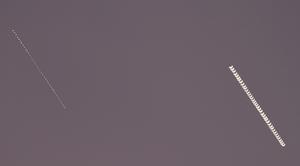
Venus and Mercury Trails
image
Créé pour l'OAE
Légende : Honorable mention in the 2023 IAU OAE Astrophotography Contest, category of Still images of phases of Venus.
In this composite image, both Mercury (left) and Venus (right) can be seen heading into the sunset. The phases of each are beautifully captured as they descend. Not all planets or moons in the Solar System show phases as viewed from Earth. This phenomenon occurs because the orbits of Venus and Mercury are positioned between Earth’s orbit and the Sun, sometimes allowing us to see only part of the illuminated portion of each planet. These phases are similar to the phases we see of our own Moon.
Crédit : Marcella Giulia Pace (CC BY 4.0)
Termes du glossaire:
Mercure , Phase , Vénus
Catégories :
Système solaire
Mots clés :
astrophotography
Licence : Creative Commons (CC) Attribution 4.0 International (CC BY 4.0) Creative Commons (CC) Attribution 4.0 International (CC BY 4.0) Icônes
Ce fichier est sur Zenodo ( image 4.86 MB)
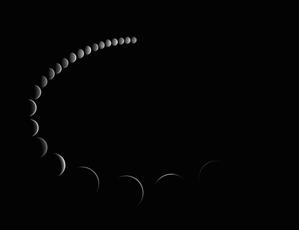
Phases of Venus
image
Créé pour l'OAE
Légende : First place winner in the 2023 IAU OAE Astrophotography Contest, category of Still images of phases of Venus.
This is a mesmerising series of images of Venus captured from Surgères, Charente-Maritime, France, over a period of six months in 2015. The phases appear similar to the phases we see of our own Moon and occur for similar reasons. Only half of Venus is illuminated by the Sun and, from Earth, we can sometimes only see part of that illuminated half, depending on the relative positions of the Sun, Earth and Venus. Both Mercury and Venus exhibit phases because their orbit is between the Sun and the orbit of Earth. Depending on the position of Venus relative to the Sun and Earth, Venus goes through its phases over a period of time. This sequence of images beautifully showcases the transition from the ‘gibbous’ to the slender crescents. The use of infrared filters helped to capture Venus's dense perpetual cloud cover during daylight in sharp detail, providing a glimpse into the mysterious nature of the planet’s atmosphere.
Crédit : Stephane Gonzales/IAU OAE (CC BY 4.0)
Termes du glossaire:
Phase , Vénus
Catégories :
Système solaire
Mots clés :
astrophotography
Licence : Creative Commons (CC) Attribution 4.0 International (CC BY 4.0) Creative Commons (CC) Attribution 4.0 International (CC BY 4.0) Icônes
Ce fichier est sur Zenodo ( image 1.43 MB)
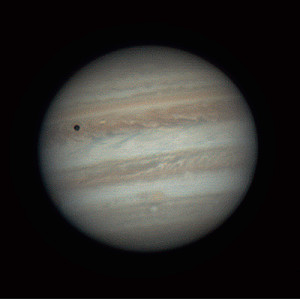
Jupiter, Io and its shadow, by Ralf Burkart, Germany
vidéo
Créé pour l'OAE
Légende : First place in the 2021 IAU OAE Astrophotography Contest, category Galilean moons.
This time-lapse of Jupiter taken in 2017 from Germany beautifully illustrates the transit of one of the Galilean moons, Io, in front of Jupiter. As this is simply a moon casting a shadow on a planet it is equivalent to a lunar eclipse on Earth observed from further away. While the shadow of the moon is clearly visible from the beginning, it might be difficult to spot the moon itself against the background of the beautiful atmospheric bands of Jupiter the first time the video is seen. Watching it repeatedly allows appreciating the rapid motion and rotation in this fantastic observation.
Crédit : Ralf Burkart/IAU OAE
Termes du glossaire:
Satellites galiléens , Géantes gazeuses , Io , Jupiter , Lunes , Orbite , Planètes extérieures , Planète , Transit
Catégories :
Système solaire
Licence : Creative Commons (CC) Attribution 4.0 International (CC BY 4.0) Creative Commons (CC) Attribution 4.0 International (CC BY 4.0) Icônes
Ce fichier est sur Zenodo ( vidéo 12.64 MB)
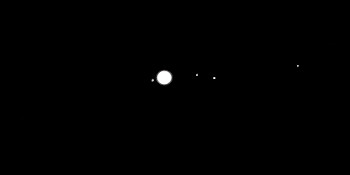
Jupiter Moons Movie2, par Nicolas Hurez, Paul-Antoine Matrangolo, et Carl Pennypacker, États-Unis d'Amérique
vidéo
Créé pour l'OAE
Légende : Deuxième place au concours d'astrophotographie 2021 de l'UAI OAE, catégorie Lunes galiléennes.
Cette séquence montre l'orbite des quatre lunes galiléennes autour de la planète Jupiter. Les images ont été obtenues en 2018 avec l'observatoire mondial Las Cumbres à différents endroits de la Terre, ce qui a permis une séquence continue d'images sur environ une demi-semaine, sans interruption pendant la journée. Avec un ciel clair et au cours de plusieurs nuits, le mouvement des lunes galiléennes peut également être observé avec des jumelles (idéalement en stabilisant vos coudes sur une surface).
Crédit : Nicolas Hurez, Paul-Antoine Matrangolo et Carl Pennypacker/IAU OAE
Termes du glossaire:
Satellites galiléens , Géantes gazeuses , Io , Jupiter , Lunes , Orbite , Planètes extérieures , Planète
Catégories :
Système solaire
Licence : Creative Commons (CC) Attribution 4.0 International (CC BY 4.0) Creative Commons (CC) Attribution 4.0 International (CC BY 4.0) Icônes
Ce fichier est sur Zenodo ( vidéo 890.47 kB)



- Ressources
- Moteur de recherche des ressources pédagogiques
- Parcourir les ressources pédagogiques par Sujet
- Parcourir les images
- AstroEdu - Activités en classe
- Grandes Idées - Littéracie en astronomie
- Glossaire
- Rapports de l'OAE
- L'astronomie pour l'Education à travers le monde
- Sélection de ressources externes