Documents & Ressources - Résultat de la recherche
Résultats de la recherche
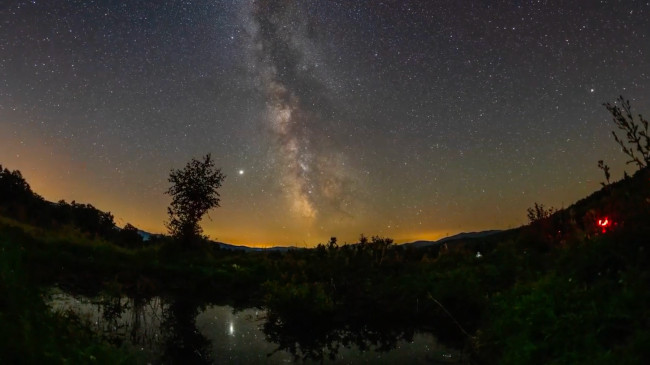
Flowing Night Sky
vidéo
Créé pour l'OAE
Légende : Honourable mention in the 2022 IAU OAE Astrophotography Contest, category Time lapses of celestial patterns.
This time-lapse was shot from Slovakia in August 2020. By fixing the relative movement of the sky to Earth's rotation in some of the frames, we can experience a different perspective as a viewer.
The Milky Way, our home galaxy, is visible throughout the whole video. The bright objects near the Milky Way are Jupiter and Saturn, close together, Jupiter being the brighter one.
This video also shows the interaction of amateur astronomers observing the Perseids meteor shower with their telescopes pointed towards the sky. An unfortunate aspect of the art of astronomical observing, clouds can suddenly cover the whole sky. The fog occurs mostly because of the higher humidity after the rain.
Most of the light trails in the sky are made by satellites, but some of them, appearing just very briefly and not very noticeably, are meteors, as the video was shot around the peak of Perseids meteor shower.
Crédit : Robert Barsa/IAU OAE
Termes du glossaire:
Jupiter , Voie lactée , Saturne , Étoile filante
Catégories :
Voie lactée et milieu interstellaire
, Astronomie à l'œil nu
, Étoiles
Licence : Creative Commons (CC) Attribution 4.0 International (CC BY 4.0) Creative Commons (CC) Attribution 4.0 International (CC BY 4.0) Icônes
Ce fichier est sur Zenodo ( vidéo 254.11 MB)
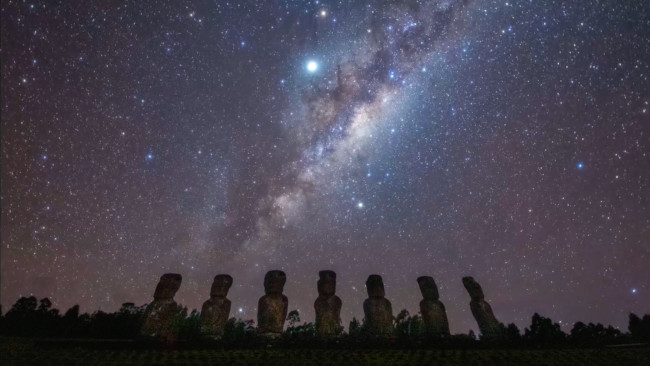
Le ciel de l'hémisphère Sud
vidéo
Créé pour l'OAE
Légende : Première place au concours d'astrophotographie 2022 de l'IAU OAE, catégorie "Time lapses of celestial patterns".
Cette vidéo est une compilation de plusieurs enregistrements pris à diverses occasions en juin 2019, à la fois sur l'île de Pâques et dans le désert d'Atacama au Chili. Elle commence par une ouverture impressionnante composée de nuages semblant émerger derrière les célèbres statues de l'Île de Pâques et se déplaçant directement vers l'avant en direction de l'observateur. Cette ouverture crée l'impression que les divinités puissantes envoient des nuages pour couvrir le ciel nocturne.
Dans les deux scènes suivantes, nous voyons des paysages terrestres avec une magnifique Voie lactée tournant au-dessus de nos têtes, mais cette scène tranquille est continuellement interrompue par des satellites en chute ou - dans l'une des scènes - par les lumières des voitures au sol. Ce film illustre à la fois la majesté du ciel et la perturbation de la nature par l'influence humaine.
Puis il y a une autre scène de nuages qui passent, mais maintenant de gauche à droite. Les nuages terrestres passent sous les nuages d'étoiles qui forment la Voie lactée. La dernière scène montre un motif immobile d'étoiles qui ressemble à un vol au-dessus d'une photographie agrandie, et montre que nous ne sommes pas habitués à faire l'expérience du calme et du silence de la nature.
Crédit : Jianfeng Dai/IAU OAE
Termes du glossaire:
Voie lactée
Catégories :
Voie lactée et milieu interstellaire
, Astronomie à l'œil nu
Licence : Creative Commons (CC) Attribution 4.0 International (CC BY 4.0) Creative Commons (CC) Attribution 4.0 International (CC BY 4.0) Icônes
Ce fichier est sur Zenodo ( vidéo 526.21 MB)
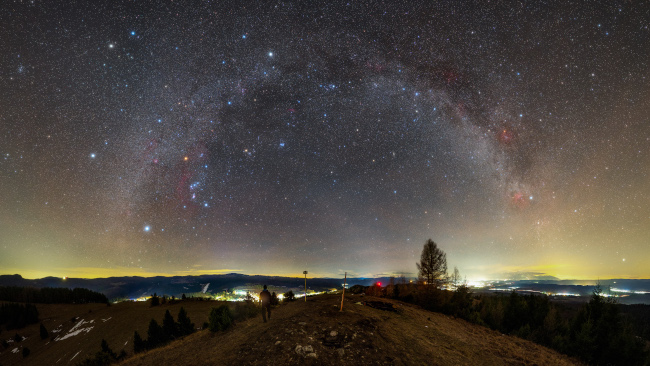
Warm Winter Night Over Spiš Region
image
Créé pour l'OAE
Légende : Winner in the 2022 IAU OAE Astrophotography Contest, category Still images of celestial patterns.
This image, taken in Slovakia in January 2022, shows regions of the Milky Way and a rich variety of constellations. The summer constellations of the northern hemisphere are very low in the sky towards the bottom-right. The bright stars of Cygnus and Lyra shine through the artificial lights at the horizon. The huge array of northern winter and autumn constellations with many bright stars are associated with diverse cultural stories.
For the Lakota people in North America the belt of the Orion constellation represents the spine of a bison (“Tayamnicankh”). Orion, the Hunter of Greek mythology, is sometimes described chasing the Seven Sisters, the Pleiades. The Arabs transformed this view by considering the follower of the Pleiades only one star instead of a constellation. Aldebaran, the star in the right eye of Taurus, the Bull, comes from this interpretation, because the name Aldebaran derives from al-dabaran, The Follower.
At the bottom-right, on the horizon, we can see the milky lightcone of the Zodiacal light stretching from the constellation Pisces through Aries, almost reaching the Pleiades, indicating the path of the planets and the Moon in this area. The Pleiades and the Hyades together form a gate on this path, where the heavenly bodies occasionally pass before entering the Milky Way. The planets were considered sheep in ancient Babylon and the modern constellation Orion was considered the “True Shepherd” of the Sky, with his shepherd’s tool reaching the ecliptic. In Roman tradition, the bright white star above the Pleiades and the Milky Way is called Capella, the Goat, which can be traced back to an Egyptian constellation in this area.
Above the treetop in the middle-right part of the image, we see the autumn square, the Andromeda Galaxy and the W-shaped pattern of Cassiopeia. To the left of this group, in the central part of the visible Milky Way, is the constellation Perseus, with Cepheus in the dark area above Cassiopeia completing the celestial family. The Andromeda saga is a Greek story from the area that is now called Israel, and is rooted in Syrian traditions. The location of Andromeda was considered by the ancient Babylonians as the location of the goddess of sexual love, and by the Syrians as the location of the goddess of fertility. According to the saga, Andromeda was chained to a rock at the coast of Jaffa (Tel Aviv) in order to protect her land from a sea monster. The name of the hero who rescued her is Perseus, probably meaning “from Persia” (today’s Iran).
Noticeable in the valley are the lights from towns. The yellow light above the horizon indicates larger cities there, which are given away by their light pollution.
Crédit : Robert Barsa/IAU OAE
Termes du glossaire:
Constellation , Voie lactée , Poissons , Taureau , Orion , Pléiades
Catégories :
Voie lactée et milieu interstellaire
, Astronomie à l'œil nu
Licence : Creative Commons (CC) Attribution 4.0 International (CC BY 4.0) Creative Commons (CC) Attribution 4.0 International (CC BY 4.0) Icônes
Ce fichier est sur Zenodo ( image 37.27 MB)
Milky Way Arch over La Palma
image
Créé pour l'OAE
Légende : Winner in the 2022 IAU OAE Astrophotography Contest, category Still images of celestial patterns.
This image, which shows the majestic band of the Milky Way and a range of culturally significant patterns, was taken in May 2022 at a very high altitude from the Roque de los Muchachos Observatory in La Palma, from which one can see the clouds below. Some prominent star patterns include Scorpius, Sagittarius, Lyra, Cygnus, Aquila, the Summer Triangle asterism, and the Teapot asterism.
As the Canary Islands used to be a starting point for European sailors to explore the world, we use this place to point to the many indigenous cultures they encountered. Most notably it is the dark patterns within the band of the Milky Way that hold significance for many Indigenous cultures around the world. The dark patterns are in fact dense, cool clouds of gas and dust that block the light from stars. Indigenous people see caves, waterways and various patterns associated with the dark regions of the Milky Way.
The constellations and patterns hold different cultural significance and interpretations for different people. For example, the constellation Scorpius is referred to by Polynesian people as the demigod Maui’s Fishhook. The Yolnu people of Arnhem Land associate Scorpius with a crocodile called Ingalpir. Some Indigenous Australian groups associate stories with individual stars within Scorpius, most notably Antares, the orange-red star in the top right of the image above the band of the Milky Way. Next to the Scorpion and above the bright centre of the Milky Way, there is a prominent dark cloud that is called the Pipe Nebula by modern astrophotographers. The smoke of this pipe goes up to rho Ophiuchi. This and all the other dark clouds in the Milky Way together form the backbone of heaven for some tribes, and an animal with black-and-white skin for South African Zulu people.
The nomenclature of bright stars also has cross-cultural roots. For example, Vega (the bright blue star towards the top of the image) comes from the Arabic waqi, from al-nasr al-waqi, the Eagle who throws himself down (in order to hunt). This contrasts with the Flying Eagle, Altair, also derived from Arabic. Antares is a Greek word meaning “the one similar to Mars”, referring to its colour. The star name Shaula in the stinger of the Scorpion is a modern version of the Babylonian or even Sumerian star name.
Crédit : Amirreza Kamkar/IAU OAE
Termes du glossaire:
Constellation , Poussière , Voie lactée , Scorpius , Astérisme , Nuage de poussière , L'extinction interstellaire , Sagittaire
Catégories :
Voie lactée et milieu interstellaire
, Astronomie à l'œil nu
, Télescopes, instruments et observatoires
Licence : Creative Commons (CC) Attribution 4.0 International (CC BY 4.0) Creative Commons (CC) Attribution 4.0 International (CC BY 4.0) Icônes
Ce fichier est sur Zenodo ( image 3.31 MB)
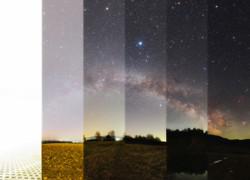
Real Light Pollution Panorama, by Tomáš Slovinský, Slovakia
image
Créé pour l'OAE
Légende : Second place in the 2021 IAU OAE Astrophotography Contest, category Light pollution.
This composite image taken in Slovakia in 2020 illustrates the effect due to artificial illumination of light polluted areas. The higher the level of light pollution, the less we can observe in the sky, notice how the number of stars visible even to a sensitive digital camera decreases from right to left. Light pollution not only affects the visibility of objects in the night sky, but also significantly impacts ecosystems, negatively affecting many animals, such as migratory night birds, which may encounter difficulties to find the direction to where they should migrate to, or the sea turtles, which may be confused by the lights from coastal cities located near the beaches where they are supposed to spawn. Light pollution can also negatively impact some human health. Therefore, it is important to preserve the dark and quiet night sky for the benefit of the entire planet and all the diverse life it supports.
Crédit : Tomáš Slovinský/IAU OAE
Termes du glossaire:
Pollution lumineuse
Catégories :
Astronomie à l'œil nu
Licence : Creative Commons (CC) Attribution 4.0 International (CC BY 4.0) Creative Commons (CC) Attribution 4.0 International (CC BY 4.0) Icônes
Ce fichier est sur Zenodo ( image 7.60 MB)



- Ressources
- Moteur de recherche des ressources pédagogiques
- Parcourir les ressources pédagogiques par Sujet
- Parcourir les images
- AstroEdu - Activités en classe
- Grandes Idées - Littéracie en astronomie
- Glossaire
- Rapports de l'OAE
- L'astronomie pour l'Education à travers le monde
- Sélection de ressources externes