Documents & Ressources - Résultat de la recherche
Résultats de la recherche

Winter Constellations
image
Créé pour l'OAE
Légende : Winner in the 2022 IAU OAE Astrophotography Contest, category Still images of celestial patterns.
Taken from the Kottamia Astronomical Observatory, Cairo, Egypt, in December 2021, this image shows a few prominent winter constellations of the northern sky above the largest telescope in North Africa.
The photograph depicts the constellation of Orion (prominently in the middle of the image) with its belt of stars pointing up to Aldebaran in Taurus and down to Sirius in Canis Major. Aldebaran is a reddish star that we see in front of the open star cluster of the Hyades (at the upper right edge of the image), which is the face of Taurus, the bull. The bright white star is Sirius, the brightest star in the night sky. Its Greek name (Seirios) means “the burner” and can be understood metaphorically as “the brightest”.
This constellation has been represented in a variety of different cultures from all over the world. The ancient Egyptian religion also associates the constellation of Orion with a male figure, namely the god Osiris. It is told that Osiris was murdered by his envious brother Seth, who then dismembered the body and scattered the pieces all over the land. Fortunately, Osiris’s sister-wife Aset (Greek: Isis) is the most powerful sorceress and protective mother goddess. She collected the pieces, put them back together and breathed life back into the god. Aset is seen in the star pattern around the bright star Sirius at the bottom of the photograph. The Egyptian name for Sirius (and adjacent areas) is Sopdet (Greek: Sothis). The heliacal rise of Sirius in summer was a harbinger of the Egyptian new year.
Going north, we can spot a bluish star. This is Alhena, one of the stars in the feet of the zodiacal constellation Gemini, the twins, whose bright head stars would be beyond the upper left edge of the photograph. In the top centre we can see the star Elnath, in the constellation of Auriga, the charioteer. It is associated with Erichthonius, a hero of Greek mythology believed to be the inventor of the four-horse chariot. This same star is also considered the tip of the upper horn of Taurus, the bull. In Greek mythology Taurus is associated with the god Zeus who had sent him to rob a princess. It is commonly known that this Greek story was invented in order to include the Babylonian constellation in Greek mythology. In the Mesopotamian Gilgamesh saga, which is one of the oldest pieces of literature that we know (being traced back to the 3rd millennium), Taurus is the bull of heaven, sent by a jealous goddess and defeated by the king of Uruk to save his people. In the sky it harbours several interesting astronomical objects.
Crédit : Mohamed Aboushelib/IAU OAE
Termes du glossaire:
Couleur , Constellation , Taureau , Orion
Catégories :
Astronomie à l'œil nu
, Étoiles
Licence : Creative Commons (CC) Attribution 4.0 International (CC BY 4.0) Creative Commons (CC) Attribution 4.0 International (CC BY 4.0) Icônes
Ce fichier est sur Zenodo ( image 21.09 MB)

Winter Constellations
vidéo
Créé pour l'OAE
Légende : Second place in the 2022 IAU OAE Astrophotography Contest, category Time lapses of celestial patterns.
Sirius, the brightest star in the night sky, is shown rising, setting and passing by. Sometimes constellations and asterisms are also visible, including Orion, Taurus and the Pleiades. In the first scene, the aforementioned constellations are covered by a semi-transparent golden veil. The next scenes show it rising in a dark blue night sky. In one of the scenes, a planet brightly decorates the faint constellation Pisces.
The videos were taken above various landscapes and places of cultural heritage on Earth. Some of them simply show monuments in the desert, while others show palm trees with waving leaves.
Crédit : Amirreza Kamkar/IAU OAE
Termes du glossaire:
Constellation , Sirius , Taureau , Orion , Pléiades
Licence : Creative Commons (CC) Attribution 4.0 International (CC BY 4.0) Creative Commons (CC) Attribution 4.0 International (CC BY 4.0) Icônes
Ce fichier est sur Zenodo ( vidéo 200.21 MB)
Constellations from the World
vidéo
Créé pour l'OAE
Légende : Third place in the 2022 IAU OAE Astrophotography Contest, category Time lapses of celestial patterns.
This video tries to cover a huge variety of phenomena in the night sky from different locations — Iceland and China — and is designed like a theatre play, starring mother nature herself.
It starts with a blue twilight sky that dims and unveils the starry night sky on the stage with terrestrial clouds on a beautiful landscape. The impressive parts of the southern Milky Way between Scorpius and Crux, with the pointer stars Alpha and Beta Centaurus, are shown passing by majestically. The terrestrial clouds blur the stars and allow us to recognise their colours even more clearly.
The first act presents the starry sky in human culture. One scene shows the Pleiades rising over the top of a hill, while a human moves hastily with a flashlight below. At the very moment that the Pleiades rises behind the hill, the beam of the flashlight hits the camera. There is some humour in this remarkable scene referencing the human relationship to the rise of the Pleiades in cultural history.
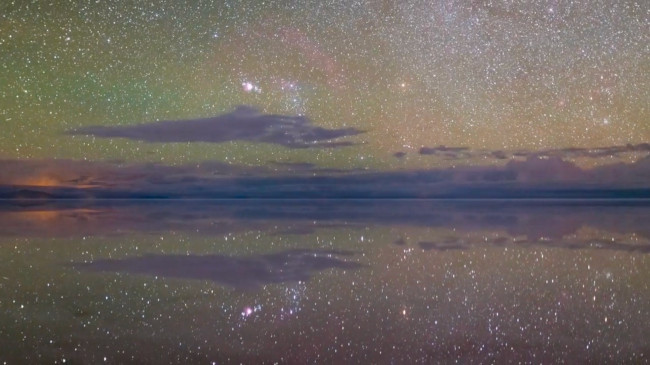
The next scene shows The Big Dipper, Ursa Major, as a typical northern constellation, with an arch of aurora below it. The aurora evolves and moves but does not change much fundamentally. In northern human cultures, aurorae were often interpreted as the ghosts of ancestors, but this play does not spend any time on human beliefs, instead moving the view southwards in the subsequent scenes. First we see some stars rising shortly before sunrise. The lightcone of Zodiacal light appears in Gemini/Taurus and the horizon gets brighter. In the next scene, at about 1 minute and 13 seconds, we see Orion setting over water, so that the water surface mirrors the celestial scene. Some clouds crossing the image prove that the videos were really taken on our beautiful planet, and, since Orion’s shoulder and foot are seen to set almost simultaneously, this sequence must have been captured almost at the equator. In this area, the bright stars of Orion look like a huge butterfly, with Orion’s Belt forming the body, and the quadrilateral of four bright stars interpreted as the wings.
As in a real theatre, we now see a curtain before the next act of the heavenly play, an aurora curtain. The next act presents several bright stars in original scenes: the Chinese asterisms of The Tail (of the Azure Dragon), the Winnowing Basket and the Southern Dipper, which are seen in the modern constellations Scorpius and Sagittarius. The striking shape of Corona Borealis that has been recognised as an asterism in many cultures all over the globe, is also shown, as are some planets, the stars Vega and Deneb with adjacent areas, Altair, the Milky Way, and the characteristic W shape of Cassiopeia that has also been an asterism for many cultures on Earth.
The outro presents two more scenes with a smooth and silent night sky.
Crédit : Stephanie Ye Ziyi/IAU OAE
Termes du glossaire:
Grande Ourse , Constellation , Voie lactée , Orion
Catégories :
Voie lactée et milieu interstellaire
, Astronomie à l'œil nu
Licence : Creative Commons (CC) Attribution 4.0 International (CC BY 4.0) Creative Commons (CC) Attribution 4.0 International (CC BY 4.0) Icônes
Ce fichier est sur Zenodo ( vidéo 46.52 MB)

Le chasseur dans la forêt
image
Créé pour l'OAE
Légende : Mention honorable au Concours d'Astrophotographie 2022 de l'UAI OAE, catégorie Images fixes de motifs célestes.
Prise en décembre 2016, cette image montre un ciel clair et étoilé au-dessus du parc national du volcan Masaya au Nicaragua.
La constellation d'Orion est le motif le plus visible sur cette image. Orion est associé à un grand chasseur selon la culture grecque, et est vu ici en plein milieu de l'image. L'étoile rougeâtre au centre est Bételgeuse, la deuxième étoile plus brillante de cette constellation et l'une des plus brillantes du ciel nocturne. Au-dessus et à droite de Bételgeuse se trouve Bellatrix, une autre étoile brillante, qui forme l'épaule droite du chasseur. En prolongeant une ligne à partir de Bellatrix vers la droite, nous trouvons un groupe d'étoiles faibles formant une courbe, associée à l'arc d'Orion. Nous pouvons également voir facilement un groupe de trois étoiles brillantes alignées formant la ceinture du chasseur, un astérisme reconnu par de nombreuses cultures différentes. Juste en dessous de la ceinture, on peut voir le scintillement argenté qui a été interprété comme le métal de l'épée ou du couteau d'Orion par la tradition gréco-romaine. Certaines cultures australiennes l'ont également interprété comme un poisson rôti sur un feu de camp. En son centre, avec des jumelles, on peut voir la Petite et la Grande Nébuleuse d'Orion, qui forment ensemble un gigantesque nuage de poussière et de gaz où de nouvelles étoiles sont en train de se former. En bas à gauche de l'ensemble argenté de minuscules étoiles et de nébuleuses, se trouve une étoile brillante appelée Saiph, terme arabe signifiant "épée" ou "sabre", car elle était considérée comme la pointe d'un énorme couteau à la partie supérieure recourbée. À sa droite se trouve l'étoile bleuâtre Rigel, un terme arabe qui désigne le pied (ici, celui d'Orion).
La ceinture d'Orion pointe vers Aldébaran au bord de la photo et vers Sirius entre les branches des arbres ; c'est l'étoile la plus brillante du ciel nocturne et elle est située dans la constellation Canis Major. L'atmosphère terrestre fait scintiller Sirius de toutes les couleurs. Vue de l'espace, elle est d'un blanc pur, mais lorsque sa lumière traverse l'air, elle est diffusée et déformée par les molécules. C'est pourquoi l'étoile semble changer de couleur comme un diamant.
Une ligne reliant les deux épaules d'Orion pointe vers une autre étoile brillante dans le coin inférieur gauche de la photo. Il s'agit de Procyon, située dans la constellation Canis Minor. Procyon a été utilisée par les anciens Babyloniens pour indiquer le lever héliaque du Cancer (dont les étoiles sont faibles et invisibles au crépuscule) et pour prédire le lever de Sirius. Ainsi, pendant très longtemps dans l'histoire ancienne, Procyon a été considérée comme un astérisme à une seule étoile. Ce n'est peut-être qu'à l'époque romaine qu'un plus grand nombre d'étoiles ont été utilisées pour créer une constellation dans cette région du ciel, bien que cette constellation n'ait jamais été clairement reconnaissable.
Crédit : René Antonio Urroz Álvarez/IAU OAE
Termes du glossaire:
Constellation , Orion
Catégories :
Astronomie à l'œil nu
, Étoiles
Licence : Creative Commons (CC) Attribution 4.0 International (CC BY 4.0) Creative Commons (CC) Attribution 4.0 International (CC BY 4.0) Icônes
Ce fichier est sur Zenodo ( image 2.04 MB)
Portrait of a Bat
image
Créé pour l'OAE
Légende : Honourable mention in the 2022 IAU OAE Astrophotography Contest, category Still images of celestial patterns.
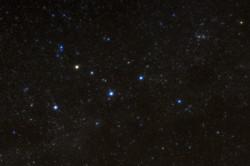
Taken in November 2019 from the Doi Inthanon National Park, Chiang Mai, Thailand, this image captures the notable northern constellation Cassiopeia, in the shape of the letter M. Although the official constellation name is the Latinised version of the name of queen “Kasseipeia” from Greek mythology, these five bright stars were considered a constellation in many cultures around the world and they are associated with diverse stories. In Thailand, for example, the constellation represents a Bat, while in Hawaiian culture it is called 'Iwa Keli'i, the chief frigate bird.
For the Navajo in North America, the bright stars are the central part of the celestial mother (of all stars and humans) revolving around the celestial pole together with her husband, the celestial father (of all stars and humans) seen in the constellation of Ursa Major. For the Maya it was part of the huge constellation of the Hole-Backed Caiman, and for the Inuit a Lamp Stand and a Blubber Container.
In ancient China, the bottom-left star was associated with the mythological general Wangliang who drove four horses, represented by the two bright and two fainter stars of the M’s next stroke (from upper-left to lower-middle). The remaining two bright stars and a couple of the other fainter ones are considered a Flying Corridor, a sort of highway, next to the Emperor’s Forbidden Palace that is located at the northern polar region.
On the island of Tonga in the South Pacific, this asterism is considered the Wing of Tafahi and it is not clear if this refers to the shape of the island of Tafahi, or if it is based on an error and originally referred to a wing of the Polynesian hero Tafaki.
The various colours of the stars indicate their temperatures, with redder stars being relatively cooler on their surface than blue and white stars.
Crédit : Thanakrit Santikunaporn/IAU OAE
Termes du glossaire:
Couleur , Constellation , Astérisme
Catégories :
Astronomie à l'œil nu
Licence : Creative Commons (CC) Attribution 4.0 International (CC BY 4.0) Creative Commons (CC) Attribution 4.0 International (CC BY 4.0) Icônes
Ce fichier est sur Zenodo ( image 9.65 MB)



- Ressources
- Moteur de recherche des ressources pédagogiques
- Parcourir les ressources pédagogiques par Sujet
- Parcourir les images
- AstroEdu - Activités en classe
- Grandes Idées - Littéracie en astronomie
- Glossaire
- Rapports de l'OAE
- L'astronomie pour l'Education à travers le monde
- Sélection de ressources externes