Documents & Ressources - Résultat de la recherche
Résultats de la recherche
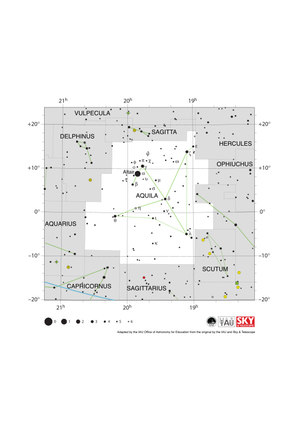
Aquila Constellation Map
image
Légende : The constellation Aquila with its bright stars and surrounding constellations. Aquila is surrounded by (going clockwise from the top): Sagitta, Hercules, Ophiuchus, Serpens Cauda, Scutum, Sagittarius, Capricornus, Aquarius and Delphinus. Aquila is most notable for its brightest star Altair. This forms one vertex of the prominent Summer Triangle asterism that is visible in northern hemisphere summer evenings.
Aquila spans the celestial equator and thus some part of it is visible from all of the Earth at some point in the year. It is most visible in the evenings in the late northern hemisphere summer and late southern hemisphere winter.
The y-axis of this diagram is in degrees of declination with north as up and the x-axis is in hours of right ascension with east to the left. The sizes of the stars marked here relate to the star's apparent magnitude, a measure of its apparent brightness. The larger dots represent brighter stars. The Greek letters mark the brightest stars in the constellation. These are ranked by brightness with the brightest star being labeled alpha, the second brightest beta, etc., although this ordering is not always followed exactly. The dotted boundary lines mark the IAU's boundaries of the constellations and the solid green lines mark one of the common forms used to represent the figures of the constellations. The blue line in the lower right of the diagram is the ecliptic. Neither the constellation boundaries, nor the line marking the ecliptic, nor the lines joining the stars appear on the sky.
Crédit : Adapted by the IAU Office of Astronomy for Education from the original by IAU/Sky & Telescope
Lien du crédit
Termes du glossaire:
Magnitude apparente , Capricorne , Coordonnées célestes , Équateur céleste , Constellation , Déclinaison , Ecliptique , Ascension droite (AD) , Verseau , Astérisme
Catégories :
Astronomie à l'œil nu
Licence : Creative Commons (CC) Attribution 4.0 International (CC BY 4.0) Creative Commons (CC) Attribution 4.0 International (CC BY 4.0) Icônes
Fichier
( image
95.28 kB)
Fichier PDF
(PDF file
175.09 kB)
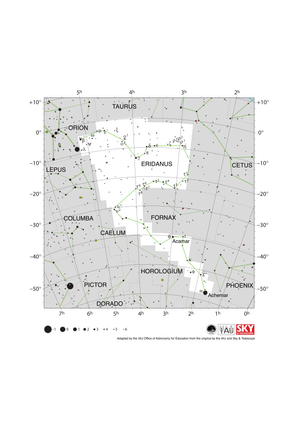
Eridanus Constellation Map
image
Légende : The constellation Eridanus with its bright stars and surrounding constellations. Eridanus is surrounded by (going clockwise from the top): Taurus, Cetus, Fornax, Phoenix, Tucana, Hydrus, Horologium, Caelum, Lepus and Orion.
Eridanus is a large constellation that spans a wide range in declination. A small portion of the constellation is in the northern hemisphere with the southern-most point lying at a declination of almost -60°. As it spans the celestial equator, parts of the constellation are visible to the whole Earth at some point in the year. The whole constellation can be observed from northern and southern equatorial regions, southern temperate regions and most of Antarctica. Eridanus is best viewed in the evening in the northern hemisphere winter and southern hemisphere summer.
The y-axis of this diagram is in degrees of declination with north as up and the x-axis is in hours of right ascension with east to the left. The sizes of the stars marked here relate to the star's apparent magnitude, a measure of its apparent brightness. The larger dots represent brighter stars. The Greek letters mark the brightest stars in the constellation. These are ranked by brightness with the brightest star being labeled alpha, the second brightest beta, etc., although this ordering is not always followed exactly. The dotted boundary lines mark the IAU's boundaries of the constellations and the solid green lines mark one of the common forms used to represent the figures of the constellations. Neither the constellation boundaries, nor the lines joining the stars appear on the sky.
Crédit : Adapted by the IAU Office of Astronomy for Education from the original by the IAU and Sky & Telescope
Lien du crédit
Termes du glossaire:
Magnitude apparente , Coordonnées célestes , Constellation , Déclinaison , Ascension droite (AD) , Taureau , Orion
Catégories :
Astronomie à l'œil nu
Licence : Creative Commons (CC) Attribution 4.0 International (CC BY 4.0) Creative Commons (CC) Attribution 4.0 International (CC BY 4.0) Icônes
Fichier
( image
148.42 kB)
Fichier PDF
(PDF file
243.47 kB)
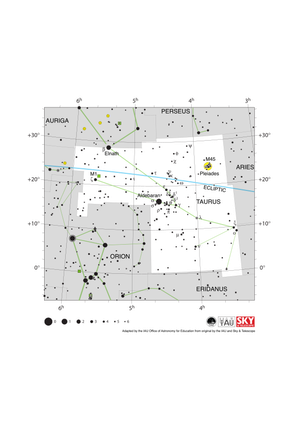
Taurus Constellation Map
image
Légende : The constellation Taurus along with its bright stars and surrounding constellations. Taurus is surrounded by (going clockwise from the top) Perseus, Aries, Cetus, Eridanus, Orion, Gemini and Auriga. Taurus’s brightest star Aldebaran appears in the middle of the constellation. Taurus lies on the ecliptic (shown here as a blue line), this is the path the Sun appears to take across the sky over the course of a year. The Sun is in Taurus from mid May to late June. The other planets of the Solar System can often be found in Taurus.
Taurus lies mostly north of the celestial equator with a small part in the celestial southern hemisphere. The whole constellation is visible at some point in the year to whole planet except for the Antarctic and a small region around the North Pole. Taurus is most visible in the evenings in the northern hemisphere winter and southern hemisphere summer.
In the eastern part of Taurus we can find the supernova remnant M1 (commonly known as the Crab Nebula), marked here with a green square. In Taurus’s north-east find one of the sky’s most famous open stars clusters M45 (the Pleiades), marked here with a yellow circle. Many of the stars near Aldebaran (but not) Aldebaran are members of another star cluster, the Hyades. However this cluster is close to the solar system so is too dispersed on the sky to have a Messier object designation like the Pleiades has.
The y-axis of this diagram is in degrees of declination with north as up and the x-axis is in hours of right ascension with east to the left. The sizes of the stars marked here relate to the star's apparent magnitude, a measure of its apparent brightness. The larger dots represent brighter stars. The Greek letters mark the brightest stars in the constellation. These are ranked by brightness with the brightest star being labeled alpha, the second brightest beta, etc., although this ordering is not always followed exactly. The dotted boundary lines mark the IAU's boundaries of the constellations and the solid green lines mark one of the common forms used to represent the figures of the constellations. Neither the constellation boundaries, nor the line marking the ecliptic, nor the lines joining the stars appear on the sky.
Crédit : Adapted by the IAU Office of Astronomy for Education from the original by IAU/Sky & Telescope
Lien du crédit
Termes du glossaire:
Magnitude apparente , Bélier , Coordonnées célestes , Constellation , Déclinaison , Ecliptique , Gémeaux , Ascension droite (AD) , Taureau , Zodiaque , Amas ouvert , Orion , Pléiades , Rémanent de supernova
Catégories :
Astronomie à l'œil nu
Licence : Creative Commons (CC) Attribution 4.0 International (CC BY 4.0) Creative Commons (CC) Attribution 4.0 International (CC BY 4.0) Icônes
Fichier
( image
110.14 kB)
Fichier PDF
(PDF file
196.52 kB)
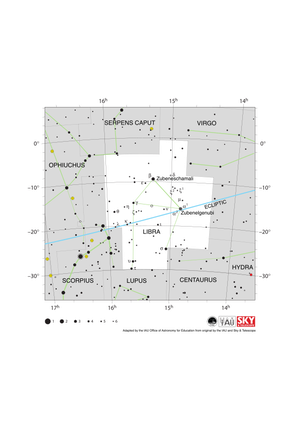
Libra Constellation Map
image
Légende : The constellation Libra along with its bright stars and surrounding constellations. Libra is surrounded by (going clockwise from the top) Serpens Caput, Virgo, Hydra, Centaurus, Lupus, Scorpius and Ophiuchus. Libra lies on the ecliptic (shown here as a blue line), this is the path the Sun appears to take across the sky over the course of a year. The Sun is in Libra from late October to late November. The other planets of the Solar System can often be found in Libra.
Libra lies just south of the celestial equator and is thus visible at some time in all but the most arctic regions. Libra is most visible in the evenings in the northern hemisphere late spring/early summer and southern hemisphere late autumn/early winter.
The y-axis of this diagram is in degrees of declination with north as up and the x-axis is in hours of right ascension with east to the left. The sizes of the stars marked here relate to the star's apparent magnitude, a measure of its apparent brightness. The larger dots represent brighter stars. The Greek letters mark the brightest stars in the constellation. These are ranked by brightness with the brightest star being labeled alpha, the second brightest beta, etc., although this ordering is not always followed exactly. The dotted boundary lines mark the IAU's boundaries of the constellations and the solid green lines mark one of the common forms used to represent the figures of the constellations. Neither the constellation boundaries, nor the line marking the ecliptic, nor the lines joining the stars appear on the sky.
Crédit : Adapted by the IAU Office of Astronomy for Education from the original by IAU/Sky & Telescope
Lien du crédit
Termes du glossaire:
Magnitude apparente , Coordonnées célestes , Constellation , Déclinaison , Ecliptique , La Balance , Ascension droite (AD) , Scorpius , Zodiaque , Vierge
Catégories :
Astronomie à l'œil nu
Licence : Creative Commons (CC) Attribution 4.0 International (CC BY 4.0) Creative Commons (CC) Attribution 4.0 International (CC BY 4.0) Icônes
Fichier
( image
101.25 kB)
Fichier PDF
(PDF file
181.72 kB)
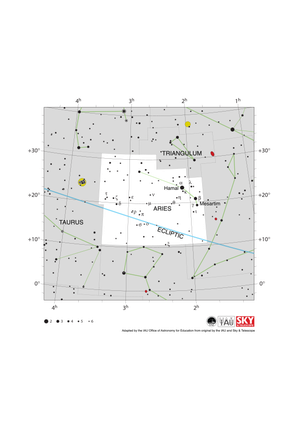
Aries Constellation Map
image
Légende : The constellation Aries along with its bright stars and surrounding constellations. Aries is surrounded by (going clockwise from the top) Triangulum, Pisces, Cetus, Taurus and Perseus. Aries lies on the ecliptic (shown here as a blue line), this is the path the Sun appears to take across the sky over the course of a year. The Sun is in Aries from mid April to mid May. The other planets of the Solar System can often be found in Aries.
Aries lies just north of the celestial equator and is thus visible at some time in the year from all of planet Earth except for the most antarctic regions of the world. Aries is most visible in the evenings in the northern hemisphere winter and southern hemisphere summer.
The y-axis of this diagram is in degrees of declination with north as up and the x-axis is in hours of right ascension with east to the left. The sizes of the stars marked here relate to the star's apparent magnitude, a measure of its apparent brightness. The larger dots represent brighter stars. The Greek letters mark the brightest stars in the constellation. These are ranked by brightness with the brightest star being labeled alpha, the second brightest beta, etc., although this ordering is not always followed exactly. The dotted boundary lines mark the IAU's boundaries of the constellations and the solid green lines mark one of the common forms used to represent the figures of the constellations. Neither the constellation boundaries, nor the line marking the ecliptic, nor the lines joining the stars appear on the sky.
Crédit : Adapted by the IAU Office of Astronomy for Education from the original by IAU/Sky & Telescope
Lien du crédit
Termes du glossaire:
Magnitude apparente , Bélier , Coordonnées célestes , Constellation , Déclinaison , Ecliptique , Poissons , Ascension droite (AD) , Taureau , Zodiaque
Catégories :
Astronomie à l'œil nu
Licence : Creative Commons (CC) Attribution 4.0 International (CC BY 4.0) Creative Commons (CC) Attribution 4.0 International (CC BY 4.0) Icônes
Fichier
( image
96.59 kB)
Fichier PDF
(PDF file
178.36 kB)









- Ressources
- Moteur de recherche des ressources pédagogiques
- Parcourir les ressources pédagogiques par Sujet
- Parcourir les images
- AstroEdu - Activités en classe
- Grandes Idées - Littéracie en astronomie
- Glossaire
- Rapports de l'OAE
- L'astronomie pour l'Education à travers le monde
- Sélection de ressources externes