Documents & Ressources - Résultat de la recherche
Résultats de la recherche
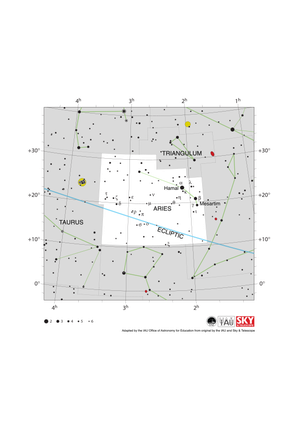
Aries Constellation Map
image
Légende : The constellation Aries along with its bright stars and surrounding constellations. Aries is surrounded by (going clockwise from the top) Triangulum, Pisces, Cetus, Taurus and Perseus. Aries lies on the ecliptic (shown here as a blue line), this is the path the Sun appears to take across the sky over the course of a year. The Sun is in Aries from mid April to mid May. The other planets of the Solar System can often be found in Aries.
Aries lies just north of the celestial equator and is thus visible at some time in the year from all of planet Earth except for the most antarctic regions of the world. Aries is most visible in the evenings in the northern hemisphere winter and southern hemisphere summer.
The y-axis of this diagram is in degrees of declination with north as up and the x-axis is in hours of right ascension with east to the left. The sizes of the stars marked here relate to the star's apparent magnitude, a measure of its apparent brightness. The larger dots represent brighter stars. The Greek letters mark the brightest stars in the constellation. These are ranked by brightness with the brightest star being labeled alpha, the second brightest beta, etc., although this ordering is not always followed exactly. The dotted boundary lines mark the IAU's boundaries of the constellations and the solid green lines mark one of the common forms used to represent the figures of the constellations. Neither the constellation boundaries, nor the line marking the ecliptic, nor the lines joining the stars appear on the sky.
Crédit : Adapted by the IAU Office of Astronomy for Education from the original by IAU/Sky & Telescope
Lien du crédit
Termes du glossaire:
Magnitude apparente , Bélier , Coordonnées célestes , Constellation , Déclinaison , Ecliptique , Poissons , Ascension droite (AD) , Taureau , Zodiaque
Catégories :
Astronomie à l'œil nu
Licence : Creative Commons (CC) Attribution 4.0 International (CC BY 4.0) Creative Commons (CC) Attribution 4.0 International (CC BY 4.0) Icônes
Fichier
( image
96.59 kB)
Fichier PDF
(PDF file
178.36 kB)
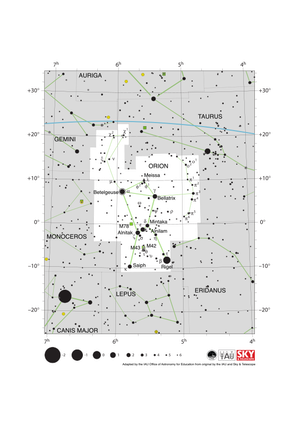
Orion Constellation Map
image
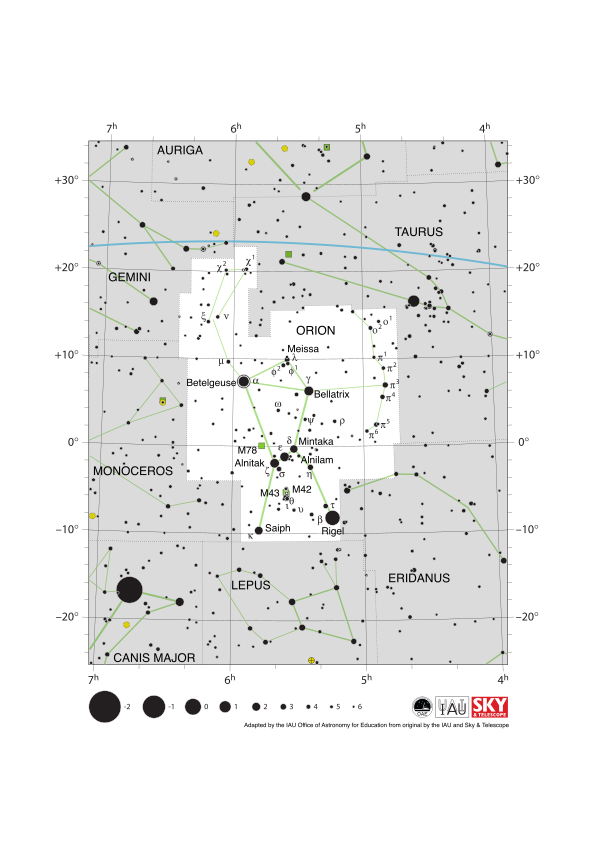
Légende : The constellation Orion along with its bright stars and surrounding constellations. Orion is surrounded by (going clockwise from the top) Taurus, Eridanus, Lepus, Monoceros and Gemini. Orion’s brightest stars Betelgeuse and Rigel appear at the northern (upper on this diagram) and southern (lower) end of the constellation respectively with the famous three star “belt” in the middle.
Orion spans the celestial equator and is thus visible at some time in the year from all of planet Earth. In the most arctic or antarctic regions of the world, some parts of the constellation may not be visible. Orion is most visible in the evenings in the northern hemisphere winter and southern hemisphere summer. The blue line above Orion marks the ecliptic, the path the Sun appears to travel across the sky over the course of a year. The Sun never passes through Orion, but one can occasionally find the other planets of the Solar System and the Moon in Orion.
Just south of Orion’s belt lie two Messier objects M42 (the Orion nebula) and M43, marked by green squares. These nebulae along with M78 (here the green square to the left of the belt) are part of the huge Orion Molecular Cloud Complex. This covers most of the constellation and includes regions where these molecular clouds are collapsing to form young starts.
The y-axis of this diagram is in degrees of declination with north as up and the x-axis is in hours of right ascension with east to the left. The sizes of the stars marked here relate to the star's apparent magnitude, a measure of its apparent brightness. The larger dots represent brighter stars. The Greek letters mark the brightest stars in the constellation. These are ranked by brightness with the brightest star being labeled alpha, the second brightest beta, etc., although this ordering is not always followed exactly. The circle around Betelgeuse indicates that it is a variable star. The dotted boundary lines mark the IAU's boundaries of the constellations and the solid green lines mark one of the common forms used to represent the figures of the constellations. Neither the constellation boundaries, nor the line marking the ecliptic, nor the lines joining the stars appear on the sky.
Crédit : Adapted by the IAU Office of Astronomy for Education from the original by IAU/Sky & Telescope
Lien du crédit
Termes du glossaire:
Magnitude apparente , Coordonnées célestes , Constellation , Déclinaison , Ecliptique , Gémeaux , Ascension droite (AD) , Taureau , Orion , Étoile variable
Catégories :
Astronomie à l'œil nu
Licence : Creative Commons (CC) Attribution 4.0 International (CC BY 4.0) Creative Commons (CC) Attribution 4.0 International (CC BY 4.0) Icônes
Fichier
( image
147.68 kB)
Fichier PDF
(PDF file
220.54 kB)
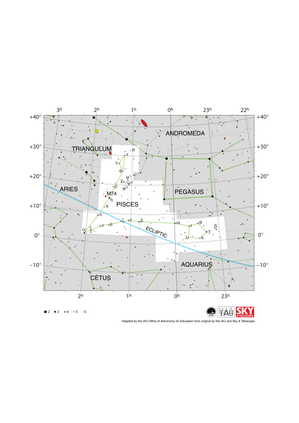
Pisces Constellation Map
image
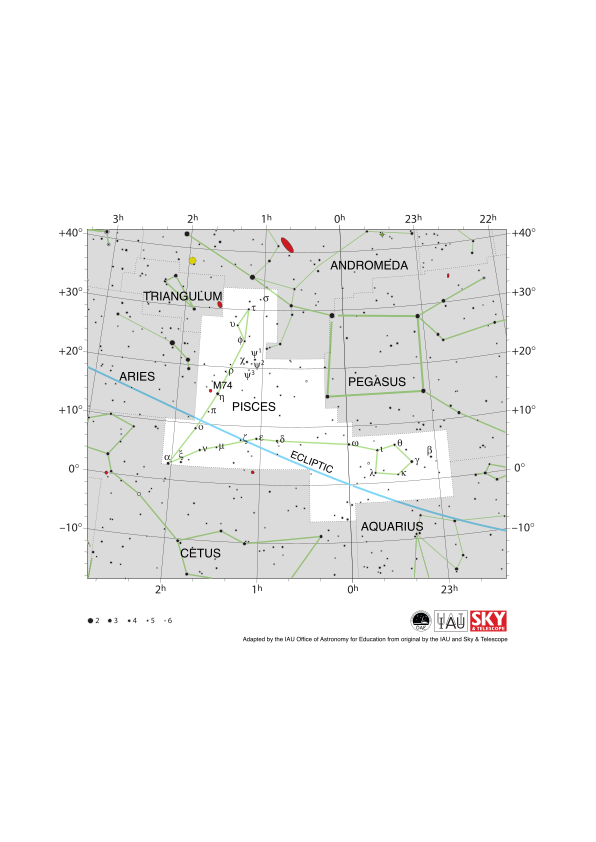
Légende : The constellation Pisces along with its bright stars and surrounding constellations. Pisces is surrounded by (going clockwise from the top) Andromeda, Pegasus, Aquarius, Cetus, Aries and Triangulum. Pisces lies on the ecliptic (shown here as a blue line), this is the path the Sun appears to take across the sky over the course of a year. The Sun is in Pisces from mid March to mid April. Thus the Sun is in Pisces at the March equinox. At this point the ecliptic crosses the celestial equator. The Sun’s location at the spring equinox is used to set the zero point of the Right Ascension positional coordinate. The other planets of the Solar System can often be found in Pisces.
Pisces spans the celestial equator and is thus visible at some time in the year from all of planet Earth. In the most arctic or antarctic regions of the world, some parts of the constellation may not be visible. Pisces is most visible in the evenings in the northern hemisphere autumn and southern hemisphere spring
The grand design spiral galaxy M74 is marked on this diagram with a small red circle.
The y-axis of this diagram is in degrees of declination with north as up and the x-axis is in hours of right ascension with east to the left. The sizes of the stars marked here relate to the star's apparent magnitude, a measure of its apparent brightness. The larger dots represent brighter stars. The Greek letters mark the brightest stars in the constellation. These are ranked by brightness with the brightest star being labeled alpha, the second brightest beta, etc., although this ordering is not always followed exactly. The dotted boundary lines mark the IAU's boundaries of the constellations and the solid green lines mark one of the common forms used to represent the figures of the constellations. Neither the constellation boundaries, nor the line marking the ecliptic, nor the lines joining the stars appear on the sky.
Crédit : Adapted by the IAU Office of Astronomy for Education from the original by IAU/Sky & Telescope
Lien du crédit
Termes du glossaire:
Andromède , Magnitude apparente , Bélier , Equinoxe , Coordonnées célestes , Constellation , Déclinaison , Ecliptique , Poissons , Ascension droite (AD) , Zodiaque , Verseau
Catégories :
Astronomie à l'œil nu
Licence : Creative Commons (CC) Attribution 4.0 International (CC BY 4.0) Creative Commons (CC) Attribution 4.0 International (CC BY 4.0) Icônes
Fichier
( image
116.67 kB)
Fichier PDF
(PDF file
209.48 kB)
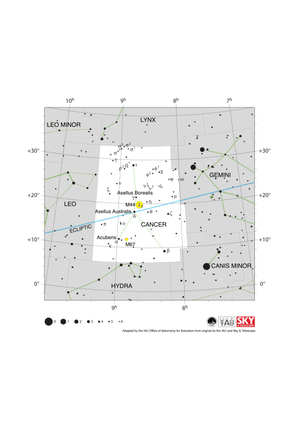
Cancer Constellation Map
image
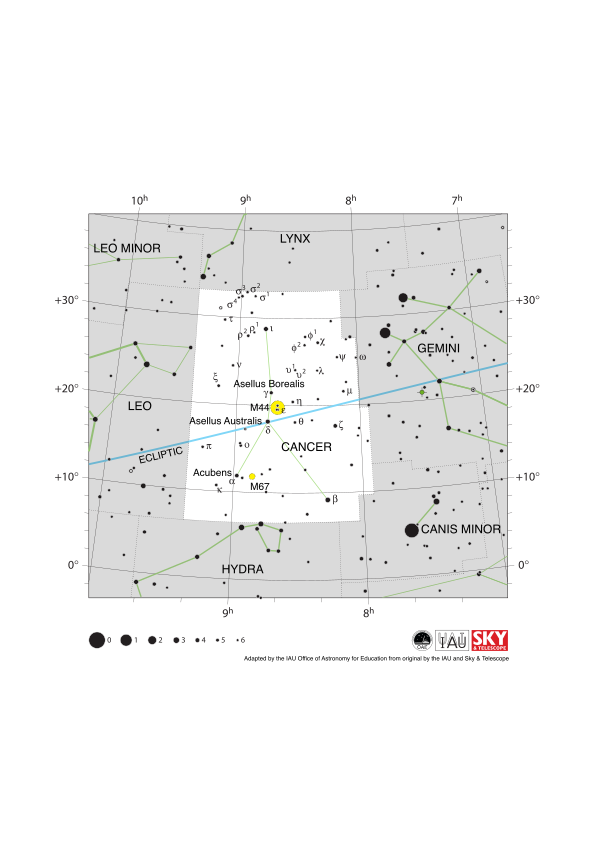
Légende : The zodiac constellation Cancer and its surrounding constellations. Starting from the top of the diagram and going clockwise, these are Lynx, Gemini, Canis Minor, Hydra, Leo and Leo Minor. The ecliptic (shown here as a blue line) passes almost exactly through the middle of the constellation, this is the path the Sun appears to take across the sky over the course of a year. The Sun is in Cancer from late July to mid August. The other planets of the Solar System can often be found in Cancer.
Cancer lies just north of the celestial equator and is thus visible at some time in the year from all of planet Earth except for the most antarctic regions of the world. Cancer is most visible in the evenings in the northern hemisphere spring and southern hemisphere autumn.
Two star clusters are visible in Cancer: M44, an open cluster often called the Beehive Cluster, and M67, a denser open cluster with about four times more stars than M44. These clusters are indicated by yellow circles with a dotted border on the map.
The y-axis of this diagram is in degrees of declination with north as up and the x-axis is in hours of right ascension with east to the left. The sizes of the stars marked here relate to the star's apparent magnitude, a measure of its apparent brightness. The larger dots represent brighter stars. The Greek letters mark the brightest stars in the constellation. These are ranked by brightness with the brightest star being labelled alpha, the second brightest beta, etc., although this ordering is not always followed exactly. The dotted boundary lines mark the IAU's boundaries of the constellations and the solid green lines mark one of the common forms used to represent the figures of the constellations. Neither the constellation boundaries, nor the line marking the ecliptic, nor the lines joining the stars appear on the sky.
Crédit : Adapted by the IAU Office of Astronomy for Education from the original by IAU/Sky & Telescope
Lien du crédit
Termes du glossaire:
Magnitude apparente , Coordonnées célestes , Constellation , Déclinaison , Ecliptique , Gémeaux , Leo , Ascension droite (AD) , Zodiaque , Cancer , Amas ouvert
Catégories :
Astronomie à l'œil nu
Licence : Creative Commons (CC) Attribution 4.0 International (CC BY 4.0) Creative Commons (CC) Attribution 4.0 International (CC BY 4.0) Icônes
Fichier
( image
103.00 kB)
Fichier PDF
(PDF file
182.01 kB)
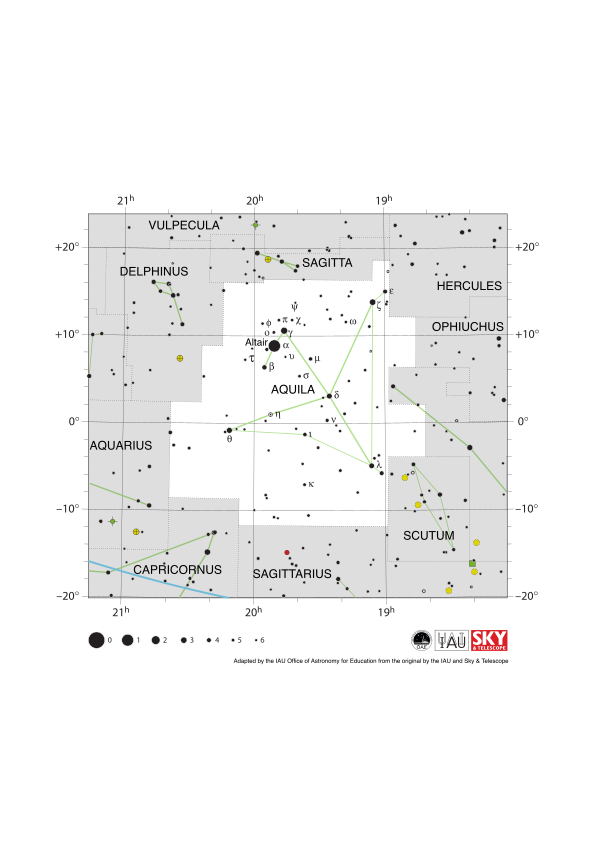
Aquila Constellation Map
image
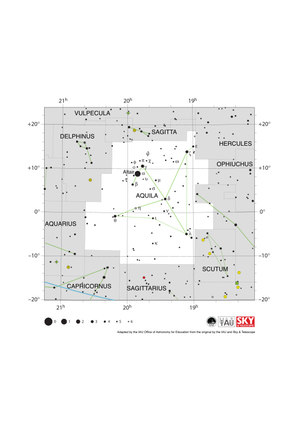
Légende : The constellation Aquila with its bright stars and surrounding constellations. Aquila is surrounded by (going clockwise from the top): Sagitta, Hercules, Ophiuchus, Serpens Cauda, Scutum, Sagittarius, Capricornus, Aquarius and Delphinus. Aquila is most notable for its brightest star Altair. This forms one vertex of the prominent Summer Triangle asterism that is visible in northern hemisphere summer evenings.
Aquila spans the celestial equator and thus some part of it is visible from all of the Earth at some point in the year. It is most visible in the evenings in the late northern hemisphere summer and late southern hemisphere winter.
The y-axis of this diagram is in degrees of declination with north as up and the x-axis is in hours of right ascension with east to the left. The sizes of the stars marked here relate to the star's apparent magnitude, a measure of its apparent brightness. The larger dots represent brighter stars. The Greek letters mark the brightest stars in the constellation. These are ranked by brightness with the brightest star being labeled alpha, the second brightest beta, etc., although this ordering is not always followed exactly. The dotted boundary lines mark the IAU's boundaries of the constellations and the solid green lines mark one of the common forms used to represent the figures of the constellations. The blue line in the lower right of the diagram is the ecliptic. Neither the constellation boundaries, nor the line marking the ecliptic, nor the lines joining the stars appear on the sky.
Crédit : Adapted by the IAU Office of Astronomy for Education from the original by IAU/Sky & Telescope
Lien du crédit
Termes du glossaire:
Magnitude apparente , Capricorne , Coordonnées célestes , Équateur céleste , Constellation , Déclinaison , Ecliptique , Ascension droite (AD) , Verseau , Astérisme
Catégories :
Astronomie à l'œil nu
Licence : Creative Commons (CC) Attribution 4.0 International (CC BY 4.0) Creative Commons (CC) Attribution 4.0 International (CC BY 4.0) Icônes
Fichier
( image
95.28 kB)
Fichier PDF
(PDF file
175.09 kB)



- Ressources
- Moteur de recherche des ressources pédagogiques
- Parcourir les ressources pédagogiques par Sujet
- Parcourir les images
- AstroEdu - Activités en classe
- Grandes Idées - Littéracie en astronomie
- Glossaire
- Rapports de l'OAE
- L'astronomie pour l'Education à travers le monde
- Sélection de ressources externes