Documents & Ressources - Résultat de la recherche
Résultats de la recherche
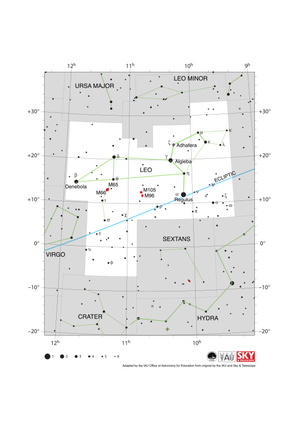
Leo Constellation Map
image
Légende : The zodiac constellation Leo and its surrounding constellations. Starting from the top of the diagram and going clockwise, these are Leo Minor, Cancer, Sextans, Hydra, Crater, Virgo and Ursa Major. The brightest star in Leo, Regulus, lies almost exactly on the ecliptic (shown here as a blue line): the path the Sun appears to take across the sky over the course of a year. The Sun spends the period from mid August to mid September in Leo. The other planets in the Solar System can often be found in Leo.
Leo spans the celestial equator and is thus part of it is visible at some time in the year from all of planet Earth with some of the constellation obscured for the most arctic and antarctic regions of the world. Leo is most visible in the evenings in the northern hemisphere spring and southern hemisphere autumn.
Several objects can be seen in Leo, including M65 and M66 – two galaxies in the Leo Triplet, a trio of galaxies including NGC 3628, not listed here. In addition, M96, a spiral galaxy, can be seen as a fuzzy object using a small telescope, and Messier 105, an elliptical galaxy. Each of these objects are labelled on the map as red ellipses.
The y-axis of this diagram is in degrees of declination with north as up and the x-axis is in hours of right ascension with east to the left. The sizes of the stars marked here relate to the star's apparent magnitude, a measure of its apparent brightness. The larger dots represent brighter stars. The Greek letters mark the brightest stars in the constellation. These are ranked by brightness with the brightest star being labelled alpha, the second brightest beta, etc., although this ordering is not always followed exactly. The dotted boundary lines mark the IAU's boundaries of the constellations and the solid green lines mark one of the common forms used to represent the figures of the constellations. Neither the constellation boundaries, nor the line marking the ecliptic, nor the lines joining the stars appear on the sky.
Crédit : Adapted by the IAU Office of Astronomy for Education from the original by IAU/Sky & Telescope
Lien du crédit
Termes du glossaire:
Magnitude apparente , Coordonnées célestes , Constellation , Déclinaison , Ecliptique , Galaxie elliptique , Galaxie , Leo , Ascension droite (AD) , Galaxie spirale , Zodiaque , Cancer , Vierge
Catégories :
Astronomie à l'œil nu
Licence : Creative Commons (CC) Attribution 4.0 International (CC BY 4.0) Creative Commons (CC) Attribution 4.0 International (CC BY 4.0) Icônes
Fichier
( image
114.25 kB)
Fichier PDF
(PDF file
186.50 kB)
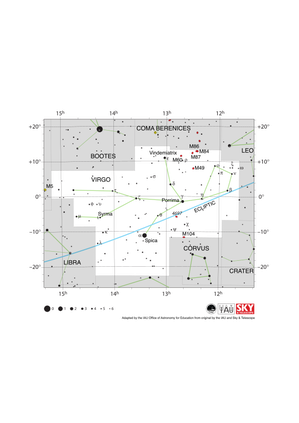
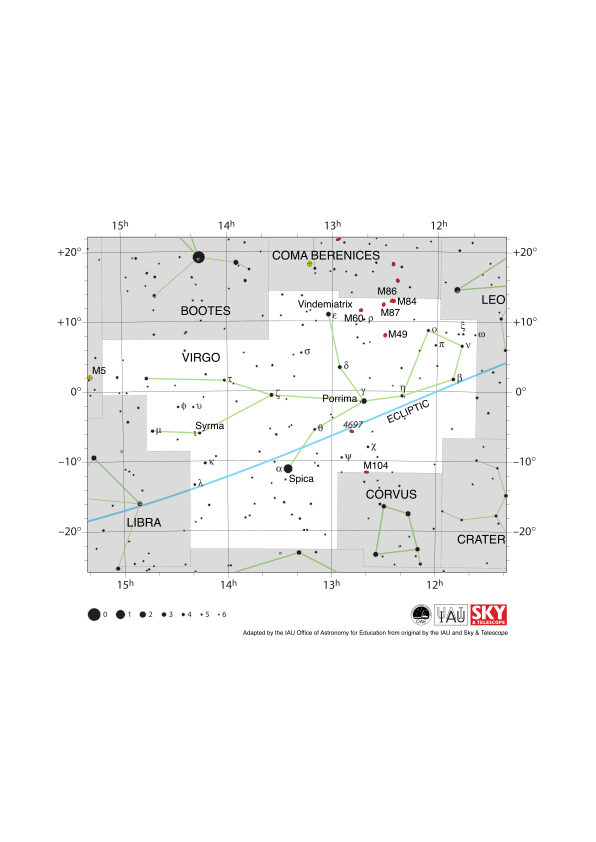
Virgo Constellation Map
image
Légende : The zodiac constellation Virgo and its surrounding constellations. Starting from the top of the diagram and going clockwise, these are Coma Berenices, Leo, Crater, Corvus, Libra, and Bootes. The brightest star in Virgo, Spica, lies just below the ecliptic (shown here as a blue line) in the middle of the map. One way of locating this star in the night sky is to follow the handle of the Big Dipper to the star Arcturus in Bootes and go along a line straight down to Spica (“arc to Arcturus and spike to Spica”). This star lies just below the ecliptic. The ecliptic is the path the Sun appears to take across the sky over the course of a year. The Sun is in Virgo from mid September to late October. The other planets of the Solar System can often be found in Virgo.
Virgo spans the celestial equator and is thus part of it is visible at some time in the year from all of planet Earth with some of the constellation obscured for the most arctic and antarctic regions of the world. Virgo is most visible in the evenings in the northern hemisphere spring and southern hemisphere autumn.
The constellation Virgo appears as a person lying with their back roughly against the ecliptic, arms outstretched, and feet pointed east. Several deep-sky objects are visible in Virgo, including NGC4697, M49, M87, M86, M84, and M60, all of which are labelled as red ellipses on the map. These are all spiral and elliptical galaxies located several millions of lightyears from Earth. Most notably, M87 is host to the supermassive black hole (Pōwehi) that was imaged by the Event Horizon Telescope in 2019. All of these galaxies are members of the Virgo Cluster, the nearest cluster of galaxies to the Milky Way.
The y-axis of this diagram is in degrees of declination with north as up and the x-axis is in hours of right ascension with east to the left. The sizes of the stars marked here relate to the star's apparent magnitude, a measure of its apparent brightness. The larger dots represent brighter stars. The Greek letters mark the brightest stars in the constellation. These are ranked by brightness with the brightest star being labelled alpha, the second brightest beta, etc., although this ordering is not always followed exactly. The dotted boundary lines mark the IAU's boundaries of the constellations and the solid green lines mark one of the common forms used to represent the figures of the constellations. Neither the constellation boundaries, nor the line marking the ecliptic, nor the lines joining the stars appear on the sky.
Crédit : Adapted by the IAU Office of Astronomy for Education from the original by IAU/Sky & Telescope
Lien du crédit
Termes du glossaire:
Magnitude apparente , Grande Ourse , Coordonnées célestes , Amas de galaxies , Constellation , Déclinaison , Ecliptique , Galaxie elliptique , Leo , La Balance , Ascension droite (AD) , Galaxie spirale , Trou noir supermassif , Zodiaque , Vierge
Catégories :
Astronomie à l'œil nu
Licence : Creative Commons (CC) Attribution 4.0 International (CC BY 4.0) Creative Commons (CC) Attribution 4.0 International (CC BY 4.0) Icônes
Fichier
( image
94.70 kB)
Fichier PDF
(PDF file
188.33 kB)

Lunar Phase Equator
image
Créé pour l'OAE
Légende : The phases of the Moon when viewed from the Equator. Here west is up, north is left and east is down. The Moon orbits the Earth every 29.5 days. It is tidally locked to the Earth meaning its rotation period is the same as its orbital period and the same side of the Moon always faces the Earth. At any particular time, half of the Moon is illuminated by the Sun and half is in shadow. Over the course of the Moon’s orbit around the Earth every part of the Moon is illuminated for half of the orbit and is in shadow for the other half of the orbit.
When the Moon sits between the Earth and the Sun its illuminated half faces away from the Earth and we only see the half that is in shadow. This phase of the Moon is known as new moon. As the Moon moves in its orbit, a small but growing sliver of the illuminated half of the Moon begins to be seen from the Earth. This illuminated sliver appears on the western side of the Moon’s face when viewed from Earth. This phase is known as waxing crescent moon. By a quarter of the way through the Moon’s orbit around the Earth the Moon appears 90° away from the Sun and half of the Moon’s illuminated half points toward the Earth. This phase is known as first quarter moon. As the orbit continues more than half of the Moon seen from Earth is now illuminated with a dark crescent. This phase is known as waxing gibbous moon. Once we reach the halfway point in the Moon’s orbit round the Earth the Moon is now on the opposite side of the Earth from the Sun and we see all of the Moon’s illuminated half. As the whole of the side of the Moon that faces the Earth is now illuminated this is referred to as full moon.
For the remaining half of the Moon’s orbit the half of the moon that faces the Earth begins to move into shadow. Hence the illuminated portion of the Moon that we see from Earth begins to shrink or wane. The western edge of the face of the Moon when viewed from Earth begins to appear dark and this grows through subsequent phases. The phases are repeated in reverse order: waning gibbous, third quarter, waning crescent and finally back to new moon.
The perspective for this diagram is with west up, north left and east down. When the moon is viewed looking west, for example viewing the waxing crescent just after sunset, the view of the Moon would be rotated by 180°.
Note the surface features of the Moon are illustrative and do not accurately represent the Moon’s true surface.
Crédit : Aneta Margraf/IAU OAE
Termes du glossaire:
Pleine lune , Phase lunaire , Nouvelle lune , Quartier de lune , Dernier croissant , Gibbeuse décroissante , Le premier croissant , Lune gibbeuse , Croissant de lune , Lune gibbeuse
Catégories :
Astronomie à l'œil nu
Licence : Creative Commons (CC) Attribution 4.0 International (CC BY 4.0) Creative Commons (CC) Attribution 4.0 International (CC BY 4.0) Icônes
Fichier
( image
1.27 MB)
Fichier PDF
(PDF file
451.94 kB)
Also available in black and white
Fichier
( image
168.11 kB)
Fichier PDF
(
414.51 kB)








- Ressources
- Moteur de recherche des ressources pédagogiques
- Parcourir les ressources pédagogiques par Sujet
- Parcourir les images
- AstroEdu - Activités en classe
- Grandes Idées - Littéracie en astronomie
- Glossaire
- Rapports de l'OAE
- L'astronomie pour l'Education à travers le monde
- Sélection de ressources externes