Documents & Ressources - Résultat de la recherche
Résultats de la recherche

Sextans Constellation Map
image
Légende : The constellation Sextans with its brighter stars and surrounding constellations. Sextans is surrounded by (going clockwise from the top): Leo, Hydra and Crater. Sextans is a small constellation with relatively few bright stars.
Sextans spans the celestial equator and thus parts of the constellation are visible at some point in the year across the Earth. The whole constellation is visible in all but the most arctic and most antarctic regions. Sextans is best viewed in the evening in the northern hemisphere spring and southern hemisphere autumn.
The lenticular galaxy NGC 3115 lies in Sextans. It is marked here with a red ellipse.
The y-axis of this diagram is in degrees of declination with north as up and the x-axis is in hours of right ascension with east to the left. The sizes of the stars marked here relate to the star's apparent magnitude, a measure of its apparent brightness. The larger dots represent brighter stars. The Greek letters mark the brightest stars in the constellation. These are ranked by brightness with the brightest star being labeled alpha, the second brightest beta, etc., although this ordering is not always followed exactly. The dotted boundary lines mark the IAU's boundaries of the constellations and the solid green lines mark one of the common forms used to represent the figures of the constellations. The blue line at the top of the diagram marks the ecliptic. Neither the constellation boundaries, nor the lines joining the stars, nor the ecliptic, appear on the sky.
Crédit : Adapted by the IAU Office of Astronomy for Education from the original by the IAU and Sky & Telescope
Lien du crédit
Termes du glossaire:
Magnitude apparente , Coordonnées célestes , Équateur céleste , Constellation , Déclinaison , Ecliptique , Leo , Ascension droite (AD) , Galaxie lenticulaire
Catégories :
Astronomie à l'œil nu
Licence : Creative Commons (CC) Attribution 4.0 International (CC BY 4.0) Creative Commons (CC) Attribution 4.0 International (CC BY 4.0) Icônes
Fichier
( image
73.40 kB)
Fichier PDF
(PDF file
153.02 kB)
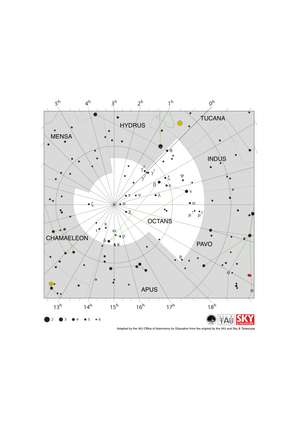
Octans Constellation Map
image
Légende : The constellation Octans along with its bright stars and its surrounding constellations. Octans is surrounded by (going clockwise from the top): Hydrus, Indus, Pavo, Apus, Chameleon and Mensa. Octans is a relatively faint constellation that is notable as it lies at the south celestial pole. While the northern pole star is the relatively bright Polaris, sigma Octans, the southern pole star, is barely visible with the naked eye.
Octans lies at the south celestial pole and is thus visible from the whole southern hemisphere with some of the constellation visible from equatorial regions of the northern hemisphere. The constellation is circumpolar for most of the southern hemisphere. It is best viewed in the evening in the northern hemisphere autumn and southern hemisphere spring.
This diagram maps an area around the south celestial pole. Here lines of constant right ascension converge. The right ascension values of these lines (in hours) are marked on the x-axis above and below the diagram. The solid circle around the pole marks a line of -80° declination with the larger, incomplete circle to the right marking -70° declination. The sizes of the stars marked here relate to the star's apparent magnitude, a measure of its apparent brightness. The larger dots represent brighter stars. The Greek letters mark the brightest stars in the constellation. These are ranked by brightness with the brightest star being labeled alpha, the second brightest beta, etc., although this ordering is not always followed exactly. The dotted boundary lines mark the IAU's boundaries of the constellations and the solid green lines mark one of the common forms used to represent the figures of the constellations. Neither the constellation boundaries, nor the lines joining the stars appear on the sky.
Crédit : Adapted by the IAU Office of Astronomy for Education from the original by IAU/Sky & Telescope
Lien du crédit
Termes du glossaire:
Magnitude apparente , Coordonnées célestes , Constellation , Déclinaison , Polaris , Ascension droite (AD) , Pôle céleste sud (PCS)
Catégories :
Astronomie à l'œil nu
Licence : Creative Commons (CC) Attribution 4.0 International (CC BY 4.0) Creative Commons (CC) Attribution 4.0 International (CC BY 4.0) Icônes
Fichier
( image
109.17 kB)
Fichier PDF
(PDF file
161.98 kB)

Serpens Caput Constellation Map
image
Légende : A map of part of the constellation Serpens. Serpens is unique amongst IAU constellations in that it is divided into two non-contiguous parts. The part of Serpens shown here is known as Serpens Caput, representing the head of the serpent. This part of Serpens is surrounded by (going clockwise from the top): Corona Borealis, Boötes, Virgo, Libra, Ophiuchus and Hercules.
Serpens Caput spans the celestial equator thus parts of the constellation are visible at some point in the year across the Earth. The whole constellation is visible to temperate and equatorial regions of the southern hemisphere and all of the northern hemisphere except a small region around the north pole. Serpens Caput is best viewed in the evening in the northern hemisphere summer and southern hemisphere winter.
The globular cluster M5 lies in Serpens Caput. It is marked here with a yellow circle with a plus sign superimposed on it.
The y-axis of this diagram is in degrees of declination with north as up and the x-axis is in hours of right ascension with east to the left. The sizes of the stars marked here relate to the star's apparent magnitude, a measure of its apparent brightness. The larger dots represent brighter stars. The Greek letters mark the brightest stars in the constellation. These are ranked by brightness with the brightest star being labeled alpha, the second brightest beta, etc., although this ordering is not always followed exactly. The dotted boundary lines mark the IAU's boundaries of the constellations and the solid green lines mark one of the common forms used to represent the figures of the constellations. Neither the constellation boundaries, nor the lines joining the stars appear on the sky.
Crédit : Adapted by the IAU Office of Astronomy for Education from the original by the IAU and Sky & Telescope
Lien du crédit
Termes du glossaire:
Magnitude apparente , Coordonnées célestes , Équateur céleste , Constellation , Déclinaison , Amas globulaire , La Balance , Ascension droite (AD) , Vierge
Catégories :
Astronomie à l'œil nu
Licence : Creative Commons (CC) Attribution 4.0 International (CC BY 4.0) Creative Commons (CC) Attribution 4.0 International (CC BY 4.0) Icônes
Fichier
( image
97.60 kB)
Fichier PDF
(PDF file
161.10 kB)

Serpens Cauda Constellation Map
image
Légende : A map of part of the constellation Serpens. Serpens is unique amongst IAU constellations in that it is divided into two non-contiguous parts. The part of Serpens shown here is known as Serpens Cauda, representing the tail of the serpent. This part of Serpens is surrounded by (going clockwise from the top): Ophiuchus, Sagittarius, Scutum and Aquila.
Serpens Cauda spans the celestial equator thus parts of the constellation are visible at some point in the year across the Earth. The whole constellation is visible to all but the most arctic and antarctic regions. Serpens Cauda is best viewed in the evening in the northern hemisphere summer and southern hemisphere winter.
The Eagle Nebula and its associated star cluster are marked here as M16 with a yellow circle. This region was the location of the famous “pillars of creation” image taken by the Hubble Space Telescope.
The y-axis of this diagram is in degrees of declination with north as up and the x-axis is in hours of right ascension with east to the left. The sizes of the stars marked here relate to the star's apparent magnitude, a measure of its apparent brightness. The larger dots represent brighter stars. The Greek letters mark the brightest stars in the constellation. These are ranked by brightness with the brightest star being labeled alpha, the second brightest beta, etc., although this ordering is not always followed exactly. The dotted boundary lines mark the IAU's boundaries of the constellations and the solid green lines mark one of the common forms used to represent the figures of the constellations. The blue line at the bottom of the diagram marks the ecliptic. Neither the constellation boundaries, nor the lines joining the stars, nor the ecliptic, appear on the sky.
Crédit : Adapted by the IAU Office of Astronomy for Education from the original by the IAU and Sky & Telescope
Lien du crédit
Termes du glossaire:
Magnitude apparente , Coordonnées célestes , Équateur céleste , Constellation , Déclinaison , Nébuleuse , Ascension droite (AD) , Amas ouvert , Sagittaire
Catégories :
Astronomie à l'œil nu
Licence : Creative Commons (CC) Attribution 4.0 International (CC BY 4.0) Creative Commons (CC) Attribution 4.0 International (CC BY 4.0) Icônes
Fichier
( image
103.44 kB)
Fichier PDF
(PDF file
218.49 kB)
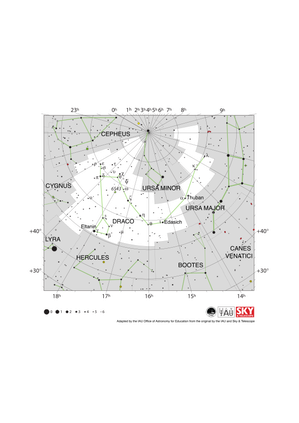
Draco Constellation Map
image
Légende : The constellation Draco with its bright stars and surrounding constellations. Draco is surrounded by (going clockwise from the top): Cepheus, Ursa Minor, Boötes, Hercules, Lyra and Cygnus.
Draco is a sprawling northern constellation, parts of which lie close to the celestial north pole. As such the whole constellation is visible at some point in the year from the whole northern hemisphere and a thin sliver of the southern hemisphere near the equator. Parts of the constellation are visible from all other southern equatorial and some southern temperate regions. Draco is best viewed in the evenings in the northern hemisphere summer and southern hemisphere winter.
The planetary nebula NGC 6543 (also known as the Cat’s Eye Nebula) lies in Draco. It is marked here with a green circle superimposed on a plus sign.
This diagram maps an area around the north celestial pole. Here lines of constant right ascension converge. The right ascension values of these lines are marked on the x-axis above and below the diagram. Some of the lines of constant declination are marked on the y-axis. The sizes of the stars marked here relate to the star's apparent magnitude, a measure of its apparent brightness. The larger dots represent brighter stars. The Greek letters mark the brightest stars in the constellation. These are ranked by brightness with the brightest star being labeled alpha, the second brightest beta, etc., although this ordering is not always followed exactly. The dotted boundary lines mark the IAU's boundaries of the constellations and the solid green lines mark one of the common forms used to represent the figures of the constellations. Neither the constellation boundaries, nor the lines joining the stars appear on the sky.
Crédit : Adapted by the IAU Office of Astronomy for Education from the original by the IAU and Sky & Telescope
Lien du crédit
Termes du glossaire:
Magnitude apparente , Coordonnées célestes , Étoiles circumpolaires , Constellation , Déclinaison , Pôle céleste nord (PCN) , Nébuleuse planétaire , Ascension droite (AD)
Catégories :
Astronomie à l'œil nu
Licence : Creative Commons (CC) Attribution 4.0 International (CC BY 4.0) Creative Commons (CC) Attribution 4.0 International (CC BY 4.0) Icônes
Fichier
( image
138.13 kB)
Fichier PDF
(PDF file
223.43 kB)






- Ressources
- Moteur de recherche des ressources pédagogiques
- Parcourir les ressources pédagogiques par Sujet
- Parcourir les images
- AstroEdu - Activités en classe
- Grandes Idées - Littéracie en astronomie
- Glossaire
- Rapports de l'OAE
- L'astronomie pour l'Education à travers le monde
- Sélection de ressources externes