Documents & Ressources - Résultat de la recherche
Résultats de la recherche
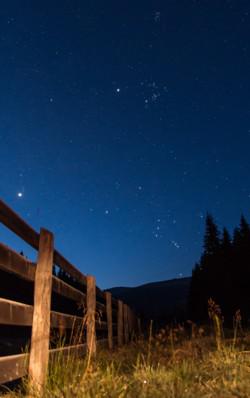
Romanian Orion
image
Créé pour l'OAE
Légende : Winner in the 2022 IAU OAE Astrophotography Contest, category Still images of celestial patterns.
Taken in Romania in August 2012, this image shows two of the most recognisable constellations in the sky, Orion and Taurus.
Orion, the Hunter, is found near the horizon. The most prominent star visible in this image is Betelgeuse, while the asterism of Orion’s belt is formed by three aligned bright stars. Just above Orion we can find Taurus, one of the constellations of the Zodiac. As the Zodiac is inherited from Babylon, The Bull of Heaven represents a mighty but dangerous creature that was defeated by King Gilgamesh and his friend Enkidu. They cut the Bull in half and sacrificed the animal to the gods in order to protect their people. Taurus is also home to the star cluster Pleiades, also known as the Seven Sisters. Two planets are visible: Venus, the bright spot near the fence, and Jupiter, the bright spot at the top, next to the Bull’s face.
Different cultures have included the stars of these constellations in their own mythology. The Romanians, for instance, after Christianisation identified four other constellations using some of the stars of Orion and others surrounding it. One such constellation is called Trisfetitele (the Three Saints), which is associated with the three stars comprising Orion's Belt, representing the Three Hierarchs Basil, Gregory and John. This same asterism is also called Three Wise Men, Kings from the East or just Three Kings — all of these names being rooted in the Christian religion.
The agricultural calendar, in contrast, led farmers to define two other constellations, the Little Plough and the Sickle. Both are seen in the southern half of the Orion rectangle; the Little Plough is drawn by connecting the southern quadrilateral with Orion’s left shoulder, and the Sickle is formed by connecting Orion’s left foot (Rigel) with the belt stars, forming an arch and completing the form of a hoe. In the cultural calendar, these constellations were used to announce the harvest of wheat/grain. Finally, the fourth Romanian constellation is the Great Auger, where Orion’s belt represents the handle of the auger, and Betelgeuse is the tip, facing towards Pollux in Gemini. This constellation is associated with treasure, as Romanian peasants believe that the Auger points to the treasure when they approach the end of the world.
Most of the official star names in Orion are Arabic; Mintaka (meaning “belt”) is at the waist; Alnitak (meaning “girdle”) and Alnilam (meaning “string”) are at the belt; and Rigel (meaning foot) is at the left foot. The star on the left shoulder is named Bellatrix, the Latin term for a female warrior. The star at the right leg is called Saiph, for the sword or sabre of the Arabic Orion.
Crédit : Alex Conu/IAU OAE
Termes du glossaire:
Constellation , Gémeaux , Jupiter , Taureau , Vénus , Astérisme , Orion , Pléiades
Catégories :
Astronomie à l'œil nu
Licence : Creative Commons (CC) Attribution 4.0 International (CC BY 4.0) Creative Commons (CC) Attribution 4.0 International (CC BY 4.0) Icônes
Ce fichier est sur Zenodo ( image 6.37 MB)

Le royaume d'Orion
image
Créé pour l'OAE
Légende : Gagnant du concours d'astrophotographie 2022 de l'AIU OAE, catégorie Images fixes de motifs célestes.
Cette image, prise en janvier 2022, montre un paysage de Navarre, une province du nord de l'Espagne, avec des ruines d'anciennes civilisations au premier plan. Au-dessus, nous voyons un ciel partiellement nuageux et étoilé avec les étoiles les plus importantes appartenant à la constellation d'Orion. Composée de nombreuses étoiles brillantes et de plusieurs objets intéressants du ciel profond, Orion est l'une des 88 constellations officiellement reconnues par l'UAI. Elle trouve son origine dans la mythologie grecque, où le héros Orion est le fils du dieu de la mer Poséidon. Orion est caractérisé comme un chasseur géant guettant juste avant d'attaquer un animal (on ne sait pas exactement quel animal il attaque, mais dans la version babylonienne originale de la saga de Gilgamesh, il s'agit du taureau du ciel, représenté par la constellation du Taureau). L'interprétation moderne du planétarium le représente comme un guerrier romain levant son bouclier, mais les deux chiens qui l'accompagnent, représentés par les constellations Canis Major et Canis Minor, rappellent le chasseur grec.
Situé à l'équateur céleste, le motif stellaire est visible dans le monde entier et est interprété différemment selon les mythologies, par exemple comme trois pêcheurs autour d'un feu de camp dans certaines régions d'Australie, comme un papillon dans certaines régions d'Afrique et comme un escalier pour les âmes des ancêtres dans certaines régions d'Amérique du Sud. L'Espagne ayant appartenu à l'empire romain, on ne connaît pas les constellations d'origine. Certaines peintures rupestres de la péninsule ibérique pourraient contenir des références astronomiques. Toutefois, il n'est pas certain que ces figures peintes sur des rochers représentent des motifs d'étoiles.
Orion est visible de novembre à janvier. Sa caractéristique la plus reconnaissable est la "ceinture", un astérisme composé de trois étoiles brillantes et alignées (Alnitak, Alnilam et Mintaka), également reconnues par différentes cultures. Juste en dessous de cette ceinture se trouve la nébuleuse d'Orion, une région de formation d'étoiles célèbre et largement étudiée, située à environ 1 500 années-lumière de la Terre. Les étoiles les plus brillantes de la constellation sont Rigel, une supergéante bleue qui est l'une des étoiles les plus brillantes du ciel, et Bételgeuse, une supergéante rouge massive. La première sert de pied gauche et la seconde d'épaule droite au chasseur. Alors que Rigel est au milieu de sa vie, Bételgeuse devrait exploser dans les prochaines dizaines de milliers d'années. Les Orionides, une pluie de météores avec des taux typiques de dizaines de météores par heure, dont le corps parent est la comète de Halley, peuvent être observées chaque année dans la région d'Orion, près de la frontière avec la constellation des Gémeaux au cours du mois d'octobre.
Crédit : Carlos Zudaire/IAU OAE
Termes du glossaire:
Constellation , Supergéante rouge , Orion
Catégories :
Astronomie à l'œil nu
, Étoiles
Licence : Creative Commons (CC) Attribution 4.0 International (CC BY 4.0) Creative Commons (CC) Attribution 4.0 International (CC BY 4.0) Icônes
Ce fichier est sur Zenodo ( image 2.07 MB)
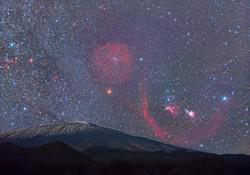
Orion Rises Over Mount Etna
image
Créé pour l'OAE
Légende : Honourable mention in the 2022 IAU OAE Astrophotography Contest, category Still images of celestial patterns.
Taken in February 2021, this image is a composite of an astronomy picture in the background and Mount Etna, the famous volcano in Sicily, Italy, in the foreground. Prominently, we see the red hydrogen clouds in space in the area of Orion. Barnard’s Loop is the gigantic bow with the Great Orion Nebula and the Horsehead Nebula in its centre. The deeper-coloured Horse Head is below the southernmost stars in Orion’s Belt, which is the line of white stars above the red nebula. Clearly visible is also the division between the Small and the Great Orion Nebula, the circular and the trapezium-shaped structure in light pink within which one of the nearest star-forming regions is located. The nebula is only a bit more than a thousand light-years away.
In the middle-left, close to the edge of the image, the small red structure is the Monkey Head Nebula still in the constellation Orion. It hosts a young star cluster and the deep red colour of this hydrogen cloud indicates its potential to build new stars in the future if the material is compressed again. All these reddish objects are strongly processed in this image, as they are not visible to the unaided eye.
Still, this image provides an interesting feature; the red supergiant star Betelgeuse lies in the middle of the image and it seems to be directly above the active volcano Mount Etna. At the foot of this volcano is an ancient settlement, the city of Catania. We consider both Betelgeuse and Mount Etna somehow dangerous — but which of them will erupt first?
Ok, we know that Etna occasionally erupts. Normally it exhibits only small eruptions, but the bigger ones happen every few centuries. We also know that Betelgeuse as a giant star will become a supernova in the future. Astronomers call the timescale for the potential supernova short, implying that it will be only 10 000 or maybe 100 000 years until this star explodes. This is “soon” for astronomers, meaning that on Earth, two to four precession cycles will pass by (with the consequence that the Sahara will turn green and dry again two to four times), continental drift will take Africa further north and cause the Alps to grow in height, the Niagara falls in America will wash the rock completely away and only after all this (and much more) happening on Earth will Betelgeuse explode as a supernova. Mount Etna is much more dangerous for the people in Sicily, and Catania in particular, because it will erupt sooner.
Crédit : Dario Giannobile/IAU OAE
Termes du glossaire:
Constellation , Milieu interstellaire , Orion
Catégories :
Astronomie à l'œil nu
, Étoiles
Licence : Creative Commons (CC) Attribution 4.0 International (CC BY 4.0) Creative Commons (CC) Attribution 4.0 International (CC BY 4.0) Icônes
Ce fichier est sur Zenodo ( image 15.44 MB)

Le chasseur dans la forêt
image
Créé pour l'OAE
Légende : Mention honorable au Concours d'Astrophotographie 2022 de l'UAI OAE, catégorie Images fixes de motifs célestes.
Prise en décembre 2016, cette image montre un ciel clair et étoilé au-dessus du parc national du volcan Masaya au Nicaragua.
La constellation d'Orion est le motif le plus visible sur cette image. Orion est associé à un grand chasseur selon la culture grecque, et est vu ici en plein milieu de l'image. L'étoile rougeâtre au centre est Bételgeuse, la deuxième étoile plus brillante de cette constellation et l'une des plus brillantes du ciel nocturne. Au-dessus et à droite de Bételgeuse se trouve Bellatrix, une autre étoile brillante, qui forme l'épaule droite du chasseur. En prolongeant une ligne à partir de Bellatrix vers la droite, nous trouvons un groupe d'étoiles faibles formant une courbe, associée à l'arc d'Orion. Nous pouvons également voir facilement un groupe de trois étoiles brillantes alignées formant la ceinture du chasseur, un astérisme reconnu par de nombreuses cultures différentes. Juste en dessous de la ceinture, on peut voir le scintillement argenté qui a été interprété comme le métal de l'épée ou du couteau d'Orion par la tradition gréco-romaine. Certaines cultures australiennes l'ont également interprété comme un poisson rôti sur un feu de camp. En son centre, avec des jumelles, on peut voir la Petite et la Grande Nébuleuse d'Orion, qui forment ensemble un gigantesque nuage de poussière et de gaz où de nouvelles étoiles sont en train de se former. En bas à gauche de l'ensemble argenté de minuscules étoiles et de nébuleuses, se trouve une étoile brillante appelée Saiph, terme arabe signifiant "épée" ou "sabre", car elle était considérée comme la pointe d'un énorme couteau à la partie supérieure recourbée. À sa droite se trouve l'étoile bleuâtre Rigel, un terme arabe qui désigne le pied (ici, celui d'Orion).
La ceinture d'Orion pointe vers Aldébaran au bord de la photo et vers Sirius entre les branches des arbres ; c'est l'étoile la plus brillante du ciel nocturne et elle est située dans la constellation Canis Major. L'atmosphère terrestre fait scintiller Sirius de toutes les couleurs. Vue de l'espace, elle est d'un blanc pur, mais lorsque sa lumière traverse l'air, elle est diffusée et déformée par les molécules. C'est pourquoi l'étoile semble changer de couleur comme un diamant.
Une ligne reliant les deux épaules d'Orion pointe vers une autre étoile brillante dans le coin inférieur gauche de la photo. Il s'agit de Procyon, située dans la constellation Canis Minor. Procyon a été utilisée par les anciens Babyloniens pour indiquer le lever héliaque du Cancer (dont les étoiles sont faibles et invisibles au crépuscule) et pour prédire le lever de Sirius. Ainsi, pendant très longtemps dans l'histoire ancienne, Procyon a été considérée comme un astérisme à une seule étoile. Ce n'est peut-être qu'à l'époque romaine qu'un plus grand nombre d'étoiles ont été utilisées pour créer une constellation dans cette région du ciel, bien que cette constellation n'ait jamais été clairement reconnaissable.
Crédit : René Antonio Urroz Álvarez/IAU OAE
Termes du glossaire:
Constellation , Orion
Catégories :
Astronomie à l'œil nu
, Étoiles
Licence : Creative Commons (CC) Attribution 4.0 International (CC BY 4.0) Creative Commons (CC) Attribution 4.0 International (CC BY 4.0) Icônes
Ce fichier est sur Zenodo ( image 2.04 MB)

Luminous Salar de Uyuni
image
Créé pour l'OAE
Légende : Winner in the 2022 IAU OAE Astrophotography Contest, category Still images of celestial patterns.
This black and white image taken in February 2017 in Uyuni Salt Flat of southwest Bolivia, the biggest salt flat in the world, shows one of the most recognisable constellations, Orion the hunter, and the open star cluster of the Hyades directly above the clouds at the horizon. Various cultures have different stories associated with Orion. The Aymara in this area of the world (Bolivia and Northern Chile) consider Orion’s Belt to be a Sky Bridge (chacka cilitu) or a Stairway made out of dough. This stairway is rather obvious in this picture. It appears as if the stars in the sky are scattered like grains of salt on the ground — an amazing composition.
For the Aymara, who were Christianised by the Spanish conquistadores, Orion and the Stairway are connected to the November festivals of the dead ancestors and the souls. In contrast to the original Christian culture, for these people in the southern hemisphere these festivals mark the beginning of summer, not the beginning of winter. While in the north, the “ghosts” of the ancestors are represented by the foggy weather in November, the Aymara greet the ancestors with flowers. This photograph in the dry salt flat, in contrast, seems to show the unlivable loneliness where the photographer meets the souls of the deceased.
The Yolnu people of Arnhem Land in Australia’s Northern Territory have a rich culturally significant story associated with Orion that carries a lesson. It tells of the three brothers of the Kingfish clan and their canoe Djulpan. Owing to their lack of patience, the brothers ate the sacred Kingfish, angering the Sun woman Walu who created a waterspout that sent them into the sky. Looking at the constellation Orion, the three stars in Orion’s belt represent the three brothers, Orion’s sword is the fishing line, and the two dimmer stars Bellatrix and Saiph form the two ends of the canoe Djulpan.
Crédit : Stephanie Ye Ziyi/IAU OAE
Termes du glossaire:
Constellation , Orion
Catégories :
Astronomie à l'œil nu
, Étoiles
Licence : Creative Commons (CC) Attribution 4.0 International (CC BY 4.0) Creative Commons (CC) Attribution 4.0 International (CC BY 4.0) Icônes
Ce fichier est sur Zenodo ( image 4.81 MB)



- Ressources
- Moteur de recherche des ressources pédagogiques
- Parcourir les ressources pédagogiques par Sujet
- Parcourir les images
- AstroEdu - Activités en classe
- Grandes Idées - Littéracie en astronomie
- Glossaire
- Rapports de l'OAE
- L'astronomie pour l'Education à travers le monde
- Sélection de ressources externes