Documents & Ressources - Résultat de la recherche
Résultats de la recherche

Winter Constellations
image
Créé pour l'OAE
Légende : Winner in the 2022 IAU OAE Astrophotography Contest, category Still images of celestial patterns.
Taken from the Kottamia Astronomical Observatory, Cairo, Egypt, in December 2021, this image shows a few prominent winter constellations of the northern sky above the largest telescope in North Africa.
The photograph depicts the constellation of Orion (prominently in the middle of the image) with its belt of stars pointing up to Aldebaran in Taurus and down to Sirius in Canis Major. Aldebaran is a reddish star that we see in front of the open star cluster of the Hyades (at the upper right edge of the image), which is the face of Taurus, the bull. The bright white star is Sirius, the brightest star in the night sky. Its Greek name (Seirios) means “the burner” and can be understood metaphorically as “the brightest”.
This constellation has been represented in a variety of different cultures from all over the world. The ancient Egyptian religion also associates the constellation of Orion with a male figure, namely the god Osiris. It is told that Osiris was murdered by his envious brother Seth, who then dismembered the body and scattered the pieces all over the land. Fortunately, Osiris’s sister-wife Aset (Greek: Isis) is the most powerful sorceress and protective mother goddess. She collected the pieces, put them back together and breathed life back into the god. Aset is seen in the star pattern around the bright star Sirius at the bottom of the photograph. The Egyptian name for Sirius (and adjacent areas) is Sopdet (Greek: Sothis). The heliacal rise of Sirius in summer was a harbinger of the Egyptian new year.
Going north, we can spot a bluish star. This is Alhena, one of the stars in the feet of the zodiacal constellation Gemini, the twins, whose bright head stars would be beyond the upper left edge of the photograph. In the top centre we can see the star Elnath, in the constellation of Auriga, the charioteer. It is associated with Erichthonius, a hero of Greek mythology believed to be the inventor of the four-horse chariot. This same star is also considered the tip of the upper horn of Taurus, the bull. In Greek mythology Taurus is associated with the god Zeus who had sent him to rob a princess. It is commonly known that this Greek story was invented in order to include the Babylonian constellation in Greek mythology. In the Mesopotamian Gilgamesh saga, which is one of the oldest pieces of literature that we know (being traced back to the 3rd millennium), Taurus is the bull of heaven, sent by a jealous goddess and defeated by the king of Uruk to save his people. In the sky it harbours several interesting astronomical objects.
Crédit : Mohamed Aboushelib/IAU OAE
Termes du glossaire:
Couleur , Constellation , Taureau , Orion
Catégories :
Astronomie à l'œil nu
, Étoiles
Licence : Creative Commons (CC) Attribution 4.0 International (CC BY 4.0) Creative Commons (CC) Attribution 4.0 International (CC BY 4.0) Icônes
Ce fichier est sur Zenodo ( image 21.09 MB)
Chilean Nights
vidéo
Créé pour l'OAE
Légende : Honourable mention in the 2022 IAU OAE Astrophotography Contest, category Time lapses of celestial patterns.
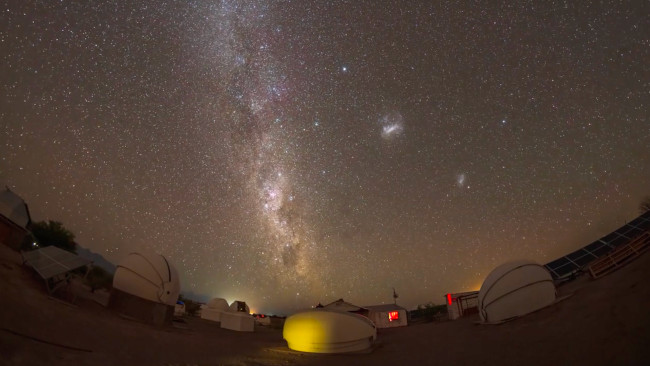
Shot in December 2020, this time-lapse shows the sky from San Pedro de Atacama, Chile, in the southern hemisphere.
Right in the first frame we can see our home galaxy, the Milky Way, as well as both the Large and Small Magellanic clouds, two satellite galaxies orbiting the Milky Way. In the bottom of the image the bright stars Rigil Kentaurus and Hadar (also known as Alpha and Beta Centauri) are visible, both in the constellation Centaurus. Just above, we can also see the small constellation Crux, visible from the northern tropical circles southwards. It is important for navigation purposes because its longer axis indicates the direction of the celestial south pole. The bright whitish star in the top of the image and to the right of the Galaxy is Canopus, one of the brightest stars in the night sky, located in the constellation Carina. Canopus is the second brightest star in the sky, while Rigil Kentaurus is the third brightest.
In some of the next frames, Orion, the great hunter, appears clearly with its bright stars and its characteristic asterism, the belt, composed of three aligned bright stars. Since this video was taken from the southern hemisphere, the Greek hero from the northern hemisphere seems to be performing a headstand.
We can also see the planets Jupiter and Saturn in a close conjunction, even finding themselves in the significant beam of Zodiacal light setting down below the horizon. There are also a few meteors blinking in some of the frames, one of them with a long-lasting and developing trail. The very bright object rising from behind the volcanoes of the Andes, creating spectacular shadows and crepuscular rays, is the Moon. In the last frame we see the Moon next to Saturn and Jupiter.
Crédit : Robert Barsa/IAU OAE
Termes du glossaire:
Observatoire astronomique , Constellation , Voie lactée , Orion , Grand nuage de Magellan (LMC) , Petit Nuage de Magellan (SMC) , Alpha du Centaure
Catégories :
Galaxies
, Voie lactée et milieu interstellaire
, Étoiles
, Télescopes, instruments et observatoires
Licence : Creative Commons (CC) Attribution 4.0 International (CC BY 4.0) Creative Commons (CC) Attribution 4.0 International (CC BY 4.0) Icônes
Ce fichier est sur Zenodo ( vidéo 114.03 MB)
Chilean observatories at home office, by Robert Barsa, Slovakia
image
Créé pour l'OAE
Légende : Third place in the 2021 IAU OAE Astrophotography Contest, category Wide star fields.
This rich panoramic image shows a range of constellations, deep sky objects and planets. The brightest point of light with a pale reddish hue (left of center) is the planet Mars. In the bottom far left of the image, located just above the sloped roof of the building are two points of light appearing very close to each other, these are the planets Jupiter (brighter) and Saturn. To the far right of the image the two fuzzy cloud-like objects are the Large and Small Magellanic Clouds. These are satellite dwarf galaxies of the Milky Way located at a distance of approximately 160,000 and 200,000 light years, respectively. The Andromeda Galaxy, which is located at an approximate distance of 2.5 million light years, appears in this image as a small, angled smudge between Mars and the brightest glow on the horizon (closer to the horizon). The bright glow is not from the Sun or the Moon, but the city lights of San Pedro de Atacama.
Prominent constellations include: Orion – identified by the three stars forming Orion’s Belt; Taurus – a small triangle shaped collection of stars to the left of Orion and identified by the pale orange star (Aldebaran) at the vertex of the triangle; Canis Major – to the bottom right of Orion, identified by the bright star Sirius (the brightest star in the night sky) and three stars in the shape of a triangle just above the observatory dome in the foreground; Pegasus – identified by the trapezium shape diagonally below Mars. Other constellations include Andromeda, Perseus and Aries. Diverse cultures around the world have their own names and rich stories associated with these constellations and many others.
To the top right of Orion’s Belt is an angled line of stars (Orion’s Sword) within which is a pinkish smudge (looks like a fuzzy star when observed with the unaided eye) that is the Orion Nebula – a stellar nursery located 1500 light years from Earth – where stars are formed. To the left of Taurus is a compact fuzzy smudge, and that is the Pleiades star cluster. The variation in the colour of stars is the result of temperature of the stars, for example, the red orange star to the bottom left of Orion’s Belt is the red giant star Betelgeuse. Cooler stars appear redder, compared to the higher temperature white and bluish stars. The colours in the image are enhanced because of the higher sensitivity of the digital camera compared to the human eye.
Crédit : Robert Barsa/IAU OAE
Termes du glossaire:
Bélier , Astronomie , Observatoire
Catégories :
Astronomie à l'œil nu
, Télescopes, instruments et observatoires
Licence : Creative Commons (CC) Attribution 4.0 International (CC BY 4.0) Creative Commons (CC) Attribution 4.0 International (CC BY 4.0) Icônes
Ce fichier est sur Zenodo ( image 77.18 MB)
Stellar birth environment
image
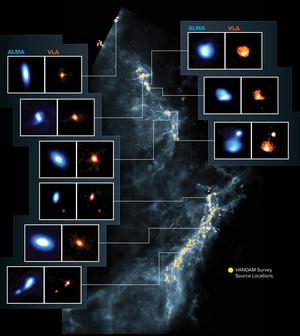
Légende : Snapshot of the formation of multiple protostars in the Orion Molecular Clouds with a closer look at each of them with the Atacama Large Millimeter/submillimeter Array and Very Large Array. Such an image provides unique insights of the process and early stages of star formation as well as the influence of the parent cloud in which they form.
Crédit : ALMA (ESO/NAOJ/NRAO), J. Tobin; NRAO/AUI/NSF, S. Dagnello; Herschel/ESA
Lien du crédit
Termes du glossaire:
Protoétoile , Formation des étoiles
Catégories :
Voie lactée et milieu interstellaire
, Étoiles
Licence : Creative Commons (CC) Attribution 3.0 non transposé Creative Commons (CC) Attribution 3.0 non transposé Icônes
Fichier
( image
426.34 kB)
Pluie de météores Gemini, par Hao Yin, Chine
image
Créé pour l'OAE
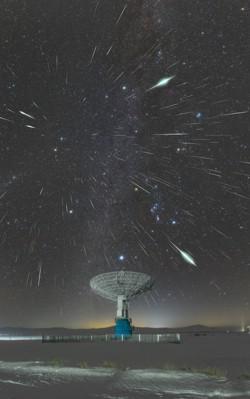
Légende : Troisième place au concours d'astrophotographie 2021 de l'UAI OAE, catégorie pluies de météores.
Lorsque la Terre voyage autour du Soleil, elle peut croiser la trajectoire de débris laissés par une comète ou, plus rarement, par un astéroïde. Ces débris pénètrent dans l'atmosphère à grande vitesse, produisant de magnifiques traces lorsqu'ils brûlent dans le ciel en raison de la friction avec l'atmosphère. L'image capture la pluie de météores des Géminides, ainsi nommée parce que le point radiant est situé dans la constellation des Gémeaux. Les particules qui composent la pluie de météores se déplacent à la même vitesse et selon des trajectoires parallèles, ce qui produit un effet de perspective comme si la pluie rayonnait à partir d'un seul point dans le ciel, connu sous le nom de point radiant. Cette image, prise en décembre 2020 en Chine, montre clairement cette perspective. Il s'agit d'une pluie très prolifique, de telle sorte que plus d'une centaine de météorites ont pu être observées par heure lors d'apparitions récentes. Cette pluie de météores est l'une des rares à être associée non pas à une comète, mais à un astéroïde - 3200 Phaeton, qui pourrait être une comète ayant perdu toute sa matière volatile. Cette image montre le grand nombre de météores qui peuvent être observés lors de cette pluie, qui a lieu chaque année en décembre. L'image montre également l'une des constellations les plus importantes du ciel nocturne, Orion, facilement visible grâce aux trois étoiles en diagonale qui forment la ceinture d'Orion, et à l'étoile rouge-orange Bételgeuse. Juste au-dessus du réflecteur paraboliquela se trouve un point lumineux : il s'agit de Sirius, l'étoile la plus brillante du ciel nocturne, qui fait partie de la constellation Canis Major. La tache bleuâtre floue à environ 2 heures est l'amas d'étoiles des Pléiades.
Crédit : Hao Yin/IAU OAE
Termes du glossaire:
Étoile filante
Catégories :
Astronomie à l'œil nu
Licence : Creative Commons (CC) Attribution 4.0 International (CC BY 4.0) Creative Commons (CC) Attribution 4.0 International (CC BY 4.0) Icônes
Ce fichier est sur Zenodo ( image 9.78 MB)



- Ressources
- Moteur de recherche des ressources pédagogiques
- Parcourir les ressources pédagogiques par Sujet
- Parcourir les images
- AstroEdu - Activités en classe
- Grandes Idées - Littéracie en astronomie
- Glossaire
- Rapports de l'OAE
- L'astronomie pour l'Education à travers le monde
- Sélection de ressources externes