Documents & Ressources - Résultat de la recherche
Résultats de la recherche
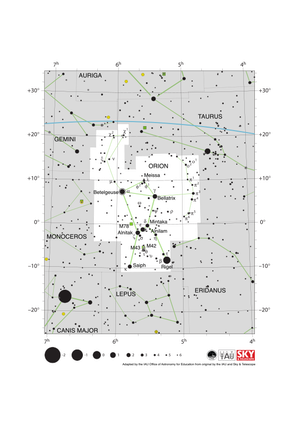
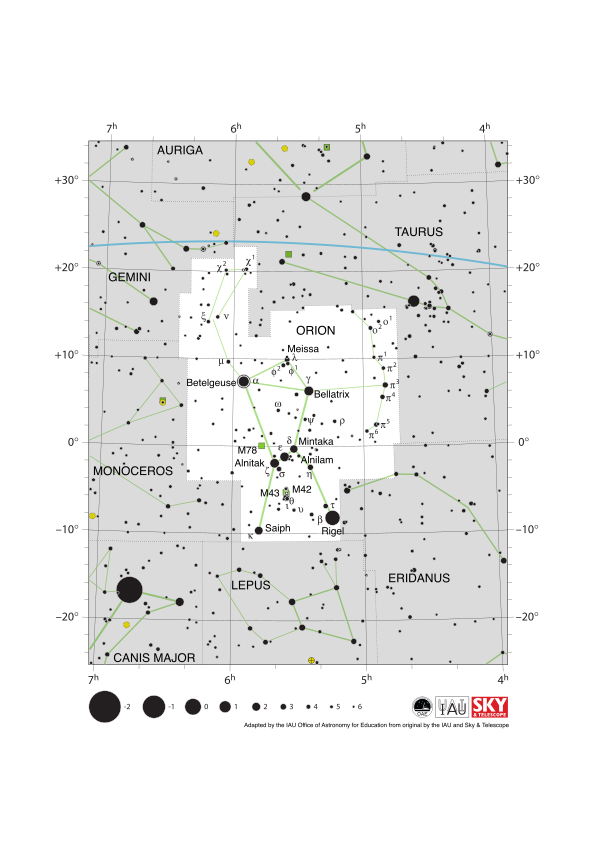
Orion Constellation Map
image
Légende : The constellation Orion along with its bright stars and surrounding constellations. Orion is surrounded by (going clockwise from the top) Taurus, Eridanus, Lepus, Monoceros and Gemini. Orion’s brightest stars Betelgeuse and Rigel appear at the northern (upper on this diagram) and southern (lower) end of the constellation respectively with the famous three star “belt” in the middle.
Orion spans the celestial equator and is thus visible at some time in the year from all of planet Earth. In the most arctic or antarctic regions of the world, some parts of the constellation may not be visible. Orion is most visible in the evenings in the northern hemisphere winter and southern hemisphere summer. The blue line above Orion marks the ecliptic, the path the Sun appears to travel across the sky over the course of a year. The Sun never passes through Orion, but one can occasionally find the other planets of the Solar System and the Moon in Orion.
Just south of Orion’s belt lie two Messier objects M42 (the Orion nebula) and M43, marked by green squares. These nebulae along with M78 (here the green square to the left of the belt) are part of the huge Orion Molecular Cloud Complex. This covers most of the constellation and includes regions where these molecular clouds are collapsing to form young starts.
The y-axis of this diagram is in degrees of declination with north as up and the x-axis is in hours of right ascension with east to the left. The sizes of the stars marked here relate to the star's apparent magnitude, a measure of its apparent brightness. The larger dots represent brighter stars. The Greek letters mark the brightest stars in the constellation. These are ranked by brightness with the brightest star being labeled alpha, the second brightest beta, etc., although this ordering is not always followed exactly. The circle around Betelgeuse indicates that it is a variable star. The dotted boundary lines mark the IAU's boundaries of the constellations and the solid green lines mark one of the common forms used to represent the figures of the constellations. Neither the constellation boundaries, nor the line marking the ecliptic, nor the lines joining the stars appear on the sky.
Crédit : Adapted by the IAU Office of Astronomy for Education from the original by IAU/Sky & Telescope
Lien du crédit
Termes du glossaire:
Magnitude apparente , Coordonnées célestes , Constellation , Déclinaison , Ecliptique , Gémeaux , Ascension droite (AD) , Taureau , Orion , Étoile variable
Catégories :
Astronomie à l'œil nu
Licence : Creative Commons (CC) Attribution 4.0 International (CC BY 4.0) Creative Commons (CC) Attribution 4.0 International (CC BY 4.0) Icônes
Fichier
( image
147.68 kB)
Fichier PDF
(PDF file
220.54 kB)
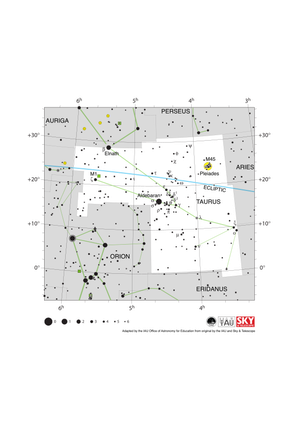
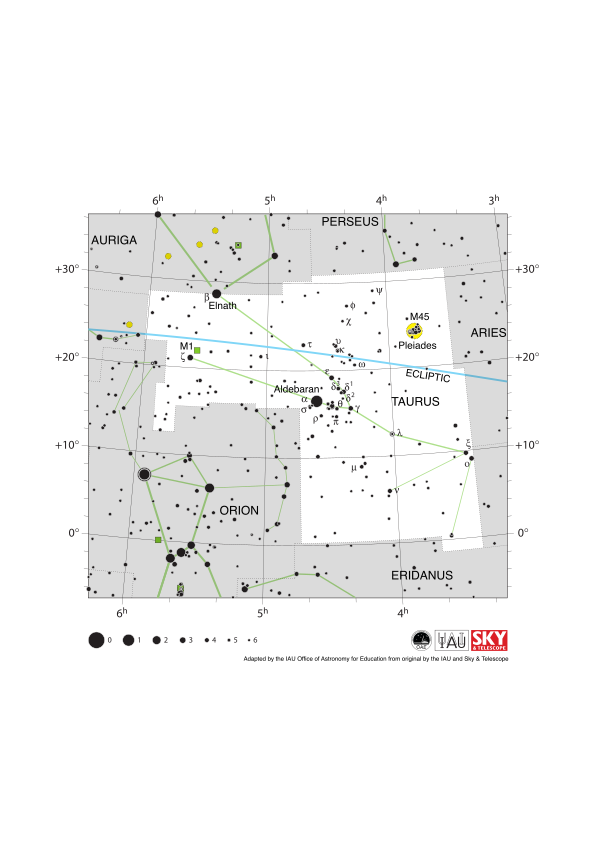
Taurus Constellation Map
image
Légende : The constellation Taurus along with its bright stars and surrounding constellations. Taurus is surrounded by (going clockwise from the top) Perseus, Aries, Cetus, Eridanus, Orion, Gemini and Auriga. Taurus’s brightest star Aldebaran appears in the middle of the constellation. Taurus lies on the ecliptic (shown here as a blue line), this is the path the Sun appears to take across the sky over the course of a year. The Sun is in Taurus from mid May to late June. The other planets of the Solar System can often be found in Taurus.
Taurus lies mostly north of the celestial equator with a small part in the celestial southern hemisphere. The whole constellation is visible at some point in the year to whole planet except for the Antarctic and a small region around the North Pole. Taurus is most visible in the evenings in the northern hemisphere winter and southern hemisphere summer.
In the eastern part of Taurus we can find the supernova remnant M1 (commonly known as the Crab Nebula), marked here with a green square. In Taurus’s north-east find one of the sky’s most famous open stars clusters M45 (the Pleiades), marked here with a yellow circle. Many of the stars near Aldebaran (but not) Aldebaran are members of another star cluster, the Hyades. However this cluster is close to the solar system so is too dispersed on the sky to have a Messier object designation like the Pleiades has.
The y-axis of this diagram is in degrees of declination with north as up and the x-axis is in hours of right ascension with east to the left. The sizes of the stars marked here relate to the star's apparent magnitude, a measure of its apparent brightness. The larger dots represent brighter stars. The Greek letters mark the brightest stars in the constellation. These are ranked by brightness with the brightest star being labeled alpha, the second brightest beta, etc., although this ordering is not always followed exactly. The dotted boundary lines mark the IAU's boundaries of the constellations and the solid green lines mark one of the common forms used to represent the figures of the constellations. Neither the constellation boundaries, nor the line marking the ecliptic, nor the lines joining the stars appear on the sky.
Crédit : Adapted by the IAU Office of Astronomy for Education from the original by IAU/Sky & Telescope
Lien du crédit
Termes du glossaire:
Magnitude apparente , Bélier , Coordonnées célestes , Constellation , Déclinaison , Ecliptique , Gémeaux , Ascension droite (AD) , Taureau , Zodiaque , Amas ouvert , Orion , Pléiades , Rémanent de supernova
Catégories :
Astronomie à l'œil nu
Licence : Creative Commons (CC) Attribution 4.0 International (CC BY 4.0) Creative Commons (CC) Attribution 4.0 International (CC BY 4.0) Icônes
Fichier
( image
110.14 kB)
Fichier PDF
(PDF file
196.52 kB)

Diagramme de Hertzsprung-Russell
image
Créé pour l'OAE
Légende : Ce diagramme montre la température et la luminosité de différentes étoiles. La taille de chaque point représente le rayon de l'étoile et sa couleur est celle que l'œil humain verrait. La couleur des étoiles varie d'un bleu pâle à un orange rougeâtre. Aucune étoile n'a une couleur pure comme le rouge, le vert ou le bleu, car les spectres des étoiles contiennent de la lumière de nombreuses couleurs différentes. Toutefois, les étoiles les plus rouges sont communément appelées "rouges" et les étoiles les plus bleues "bleues". L'échantillon d'étoiles utilisé pour réaliser ce diagramme a été choisi pour présenter un large éventail d'étoiles de différents types. Le nombre relatif de chaque type d'étoile n'est donc pas représentatif de la fréquence de chaque type.
Du haut à gauche au bas à droite, on observe une longue ligne d'étoiles brûlant de l'hydrogène dans leur cœur. C'est ce qu'on appelle la séquence principale. Sur cette ligne, on trouve les étoiles Mintaka, Achernar, Sirius A, le Soleil et Proxima du Centaure. En bas à droite de cette ligne se trouvent Teide 1 et Kelu-1 A. Ces deux objets sont des naines brunes, des objets de masse trop faible pour avoir des noyaux suffisamment chauds pour fusionner l'hydrogène pendant une période de temps prolongée. Le nom de naine brune n'est pas lié à leur couleur.
Au-dessus de la séquence principale, on trouve les sous-géantes, les géantes et les supergéantes. Il s'agit d'étoiles qui ont fini de brûler de l'hydrogène dans leur cœur et qui ont évolué pour devenir des objets plus gros. La luminosité d'une étoile dépend de sa température et de sa taille. Ainsi, les étoiles géantes sont plus lumineuses que les étoiles ayant un rayon plus petit mais ont la même température. Avec le temps, ces objets atteindront la fin de leur vie et passeront par une phase de nébuleuse planétaire ou deviendront des supernovae. Les étoiles qui terminent leur vie par une phase de nébuleuse planétaire deviennent un type de vestige stellaire appelé naine blanche. Ces objets sont beaucoup plus petits que les étoiles de même température et sont donc moins lumineux ; on les trouve bien en dessous de la séquence principale. Les étoiles qui terminent leur vie en supernovae deviennent soit des trous noirs, soit des étoiles à neutrons. Elles ne sont pas représentées sur ce graphique.
Crédit : AIU OAE/Niall Deacon
Termes du glossaire:
Naine brune , Couleur , Étoile géante , Diagramme Hertzsprung-Russell (HR) , Luminosité , Séquence principale , Evolution stellaire , Étoile supergéante , Naine blanche , Température effective , Étoile sous-géante , Classe de luminosité
Catégories :
Étoiles
Licence : Creative Commons (CC) Attribution 4.0 International (CC BY 4.0) Creative Commons (CC) Attribution 4.0 International (CC BY 4.0) Icônes
Fichier
( image
73.59 kB)
Fichier PDF
(PDF file
65.64 kB)







- Ressources
- Moteur de recherche des ressources pédagogiques
- Parcourir les ressources pédagogiques par Sujet
- Parcourir les images
- AstroEdu - Activités en classe
- Grandes Idées - Littéracie en astronomie
- Glossaire
- Rapports de l'OAE
- L'astronomie pour l'Education à travers le monde
- Sélection de ressources externes