Documents & Ressources - Résultat de la recherche
Résultats de la recherche
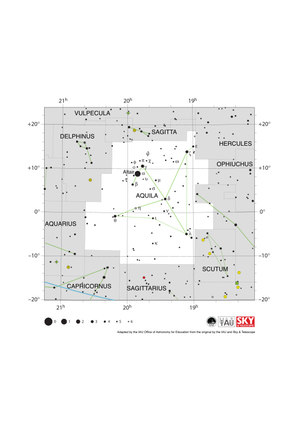
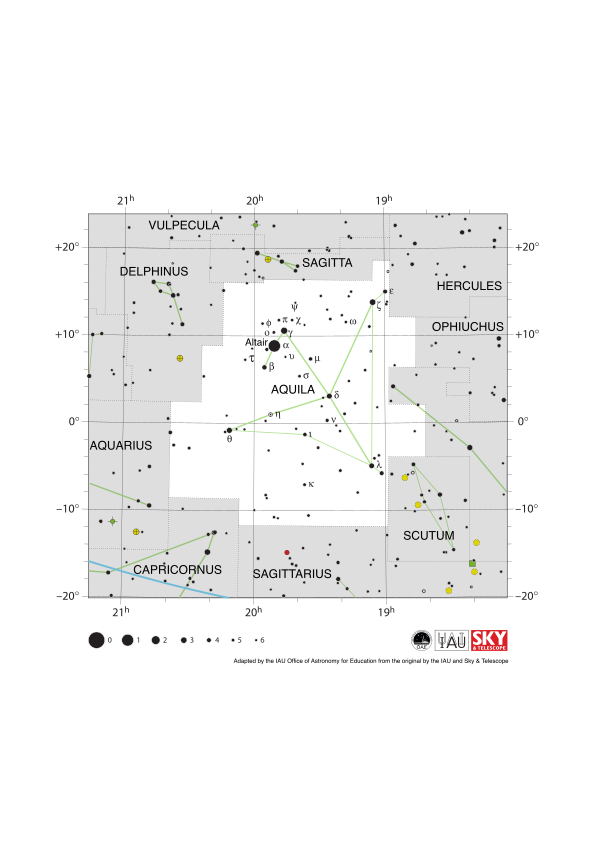
Aquila Constellation Map
image
Légende : The constellation Aquila with its bright stars and surrounding constellations. Aquila is surrounded by (going clockwise from the top): Sagitta, Hercules, Ophiuchus, Serpens Cauda, Scutum, Sagittarius, Capricornus, Aquarius and Delphinus. Aquila is most notable for its brightest star Altair. This forms one vertex of the prominent Summer Triangle asterism that is visible in northern hemisphere summer evenings.
Aquila spans the celestial equator and thus some part of it is visible from all of the Earth at some point in the year. It is most visible in the evenings in the late northern hemisphere summer and late southern hemisphere winter.
The y-axis of this diagram is in degrees of declination with north as up and the x-axis is in hours of right ascension with east to the left. The sizes of the stars marked here relate to the star's apparent magnitude, a measure of its apparent brightness. The larger dots represent brighter stars. The Greek letters mark the brightest stars in the constellation. These are ranked by brightness with the brightest star being labeled alpha, the second brightest beta, etc., although this ordering is not always followed exactly. The dotted boundary lines mark the IAU's boundaries of the constellations and the solid green lines mark one of the common forms used to represent the figures of the constellations. The blue line in the lower right of the diagram is the ecliptic. Neither the constellation boundaries, nor the line marking the ecliptic, nor the lines joining the stars appear on the sky.
Crédit : Adapted by the IAU Office of Astronomy for Education from the original by IAU/Sky & Telescope
Lien du crédit
Termes du glossaire:
Magnitude apparente , Capricorne , Coordonnées célestes , Équateur céleste , Constellation , Déclinaison , Ecliptique , Ascension droite (AD) , Verseau , Astérisme
Catégories :
Astronomie à l'œil nu
Licence : Creative Commons (CC) Attribution 4.0 International (CC BY 4.0) Creative Commons (CC) Attribution 4.0 International (CC BY 4.0) Icônes
Fichier
( image
95.28 kB)
Fichier PDF
(PDF file
175.09 kB)
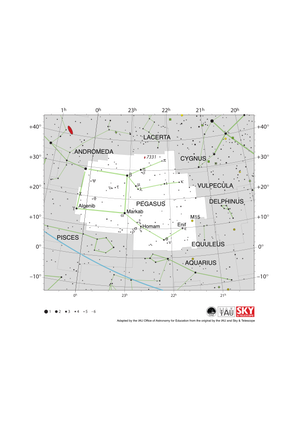
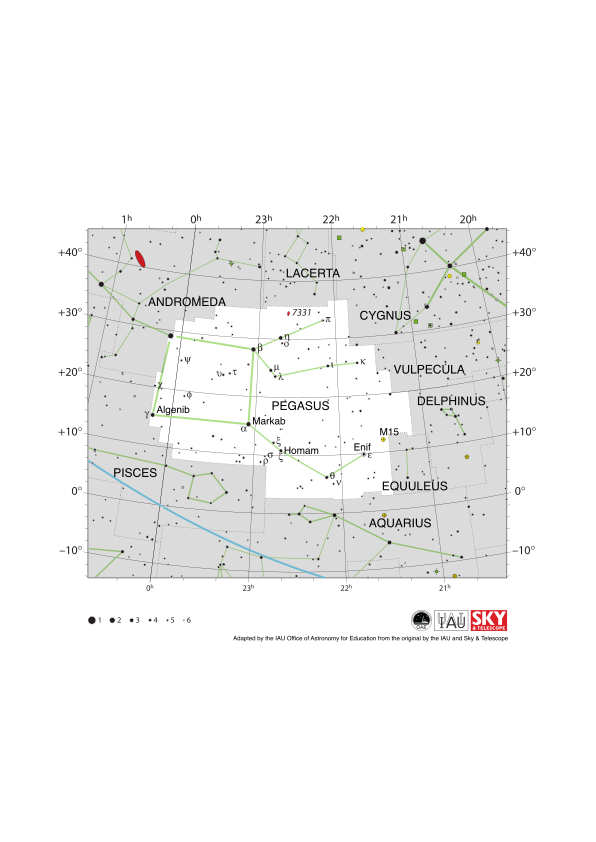
Pegasus Constellation Map
image
Légende : The constellation Pegasus with its bright stars and surrounding constellations. Pegasus is surrounded by (going clockwise from the top): Lacerta, Cygnus, Vulpecula, Delphinus, Equuleus, Aquarius, Pisces and Andromeda. Pegasus is known for the prominent asterism the “Square of Pegasus” which consists of its three brightest stars plus the brightest star in Andromeda.
Pegasus is a northern constellation and thus the whole constellation is visible at some point in the year throughout the northern hemisphere. The whole constellation is also visible to southern hemisphere equatorial and temperate zones with parts of the constellation visible from all but the most antarctic regions. Pegasus is best viewed in the evening in the northern hemisphere autumn and southern hemisphere spring.
The globular cluster M15 lies in Pegasus and is marked here with a yellow circle with a plus sign superimposed on it. The spiral galaxy NGC 7331 also lies in Pegasus and is marked here with a red ellipse.
The y-axis of this diagram is in degrees of declination with north as up and the x-axis is in hours of right ascension with east to the left. The sizes of the stars marked here relate to the star's apparent magnitude, a measure of its apparent brightness. The larger dots represent brighter stars. The Greek letters mark the brightest stars in the constellation. These are ranked by brightness with the brightest star being labeled alpha, the second brightest beta, etc., although this ordering is not always followed exactly. The dotted boundary lines mark the IAU's boundaries of the constellations and the solid green lines mark one of the common forms used to represent the figures of the constellations. The blue line at the bottom of the diagram marks the ecliptic. Neither the constellation boundaries, nor the lines joining the stars, nor the ecliptic, appear on the sky.
Crédit : Adapted by the IAU Office of Astronomy for Education from the original by the IAU and Sky & Telescope
Lien du crédit
Termes du glossaire:
Andromède , Magnitude apparente , Coordonnées célestes , Constellation , Déclinaison , Ecliptique , Amas globulaire , Poissons , Ascension droite (AD) , Galaxie spirale , Verseau , Astérisme
Catégories :
Astronomie à l'œil nu
Licence : Creative Commons (CC) Attribution 4.0 International (CC BY 4.0) Creative Commons (CC) Attribution 4.0 International (CC BY 4.0) Icônes
Fichier
( image
122.04 kB)
Fichier PDF
(PDF file
213.33 kB)
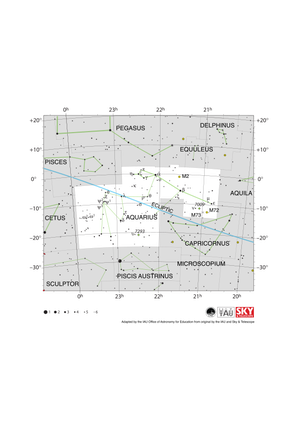
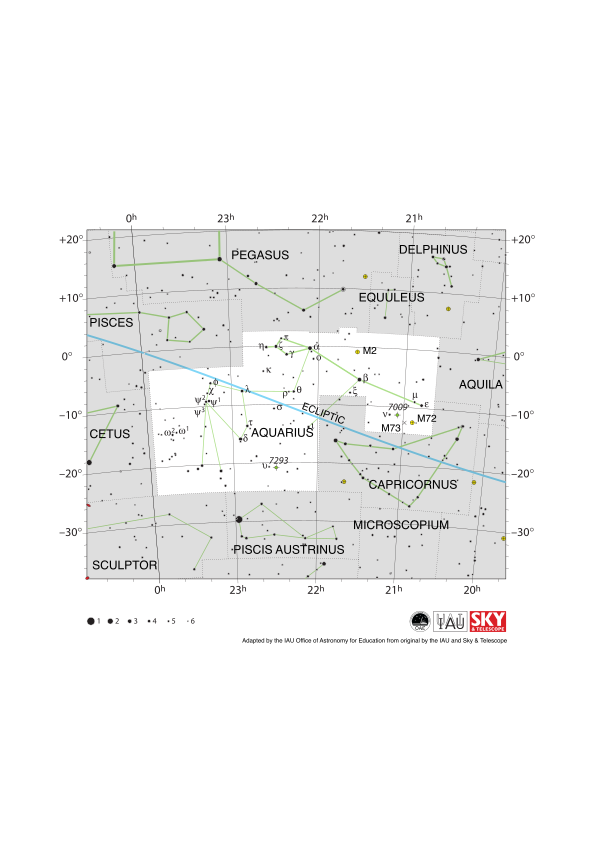
Aquarius Constellation Map
image
Légende : The constellation Aquarius along with its bright stars and surrounding constellations. Aquarius is surrounded by (going clockwise from the top) Pegasus, Equuleus, Aquila, Capricornus, Piscis Austrinus, Sculptor, Cetus and Pisces. Aquarius lies on the ecliptic (shown here as a blue line), this is the path the Sun appears to take across the sky over the course of a year. The Sun is in Aquarius from mid February to mid March. The other planets of the Solar System can often be found in Aquarius.
Aquarius spans the celestial equator and is thus visible at some time in the year from all of planet Earth. In the most arctic or antarctic regions of the world, some parts of the constellation may not be visible. Aquarius is most visible in the evenings in the northern hemisphere autumn and southern hemisphere spring.
The yellow circles with plus symbols superimposed on them mark the globular clusters M2 and M72. The green circles superimposed on plus symbols mark the planetary nebulae NGC 7293 (the Helix Nebula) and NGC 7002 (the Saturn Nebula). M73 (marked with an x symbol) is a coincident grouping of stars previously erroneously classified as an open cluster.
The y-axis of this diagram is in degrees of declination with north as up and the x-axis is in hours of right ascension with east to the left. The sizes of the stars marked here relate to the star's apparent magnitude, a measure of its apparent brightness. The larger dots represent brighter stars. The Greek letters mark the brightest stars in the constellation. These are ranked by brightness with the brightest star being labeled alpha, the second brightest beta, etc., although this ordering is not always followed exactly. The dotted boundary lines mark the IAU's boundaries of the constellations and the solid green lines mark one of the common forms used to represent the figures of the constellations. Neither the constellation boundaries, nor the line marking the ecliptic, nor the lines joining the stars appear on the sky.
Crédit : Adapted by the IAU Office of Astronomy for Education from the original by IAU/Sky & Telescope
Lien du crédit
Termes du glossaire:
Magnitude apparente , Capricorne , Coordonnées célestes , Constellation , Déclinaison , Ecliptique , Amas globulaire , Poissons , Nébuleuse planétaire , Ascension droite (AD) , Zodiaque , Verseau , Amas ouvert
Catégories :
Astronomie à l'œil nu
Licence : Creative Commons (CC) Attribution 4.0 International (CC BY 4.0) Creative Commons (CC) Attribution 4.0 International (CC BY 4.0) Icônes
Fichier
( image
119.18 kB)
Fichier PDF
(PDF file
215.13 kB)
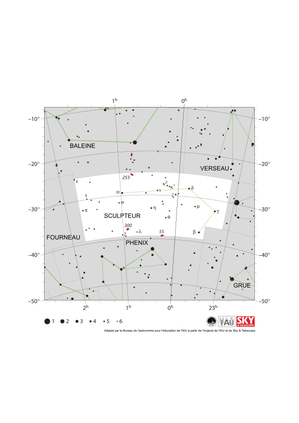
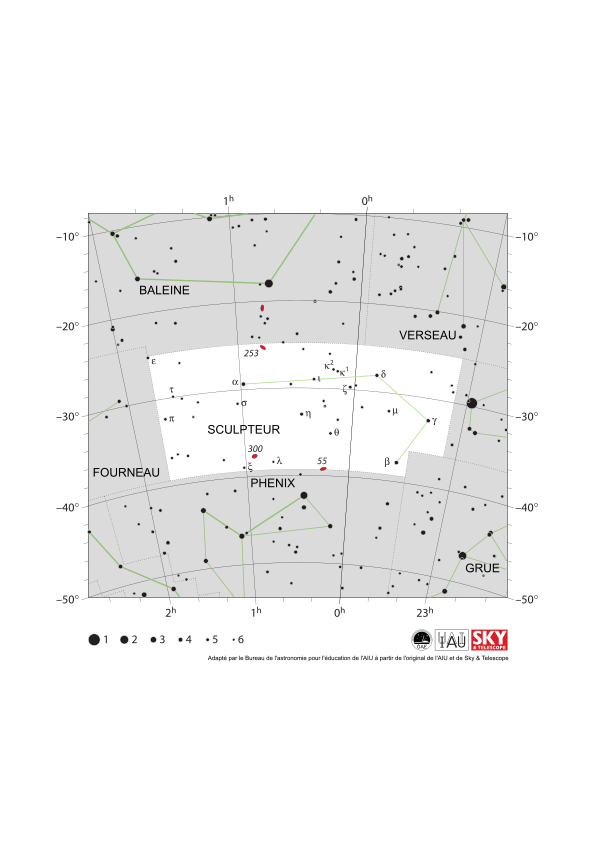
Carte de la constellation du Sculpteur
image
Légende : La constellation du Sculpteur avec ses étoiles les plus brillantes et les constellations environnantes. Sculptor est entourée de (dans le sens des aiguilles d'une montre à partir du haut) : Baleine, Verseau, Poisson Austral, Grue, Phoenix et Fornax.
Le Sculpteur est une constellation méridionale et, par conséquent, l'ensemble de la constellation est visible à un moment donné de l'année dans tout l'hémisphère sud. Elle est également visible dans les régions équatoriales et la plupart des régions tempérées de l'hémisphère nord. Certaines parties de la constellation sont également visibles dans les autres régions tempérées du nord. Le Sculpteur est plus facile à observer le soir, à la fin de l'automne de l'hémisphère nord et à la fin du printemps de l'hémisphère sud.
La galaxie irrégulière NGC 55 et les galaxies spirales NGC 253 et NGC 300 se trouvent toutes dans le Sculpteur. Elles sont marquées ici par des ellipses rouges.
L'axe des y de ce diagramme est en degrés de déclinaison avec le nord en haut et l'axe des x est en heures d'ascension droite avec l'est à gauche. La taille des étoiles marquées ici correspond à la magnitude apparente de l'étoile, une mesure de sa luminosité apparente. Les points les plus gros représentent les étoiles les plus brillantes. Les lettres grecques indiquent les étoiles les plus brillantes de la constellation. Elles sont classées par ordre de luminosité, l'étoile la plus brillante étant étiquetée alpha, la deuxième plus brillante bêta, etc., bien que cet ordre ne soit pas toujours respecté à la lettre. Les lignes pointillées marquent les limites des constellations selon l'UAI et les lignes vertes pleines marquent l'une des formes couramment utilisées pour représenter les figures des constellations. Ni les limites des constellations, ni les lignes reliant les étoiles n'apparaissent sur le ciel.
Crédit : Adapté par le Bureau de l'astronomie pour l'éducation de l'AIU à partir de l'original de l'AIU et de Sky & Telescope.
Lien du crédit
Termes du glossaire:
Magnitude apparente , Coordonnées célestes , Constellation , Déclinaison , Galaxie irrégulière , Ascension droite (AD) , Galaxie spirale
Catégories :
Astronomie à l'œil nu
Licence : Creative Commons (CC) Attribution 4.0 International (CC BY 4.0) Creative Commons (CC) Attribution 4.0 International (CC BY 4.0) Icônes
Fichier
( image
89.99 kB)
Fichier PDF
(PDF file
175.37 kB)






- Ressources
- Moteur de recherche des ressources pédagogiques
- Parcourir les ressources pédagogiques par Sujet
- Parcourir les images
- AstroEdu - Activités en classe
- Grandes Idées - Littéracie en astronomie
- Glossaire
- Rapports de l'OAE
- L'astronomie pour l'Education à travers le monde
- Sélection de ressources externes