Documenti e Risorse - Risultati della Ricerca
risultati della ricerca
Stellar Structure
immagine
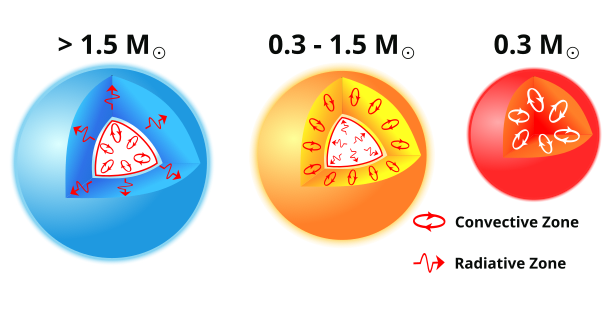
Didascalia: Stars are balls of plasma. For most of a star’s life it burns hydrogen into helium in its core. This phase of a star’s life is known as the main sequence. Burning hydrogen into helium produces heat, that heat travels out of the star’s core eventually reaching the star’s photosphere (often referred to as the “surface” of the star). From here the heat can radiate into space as various forms of electromagnetic radiation. However, how heat travels from the core to the photosphere depends on the star’s mass.
Imagine a parcel of gas rising inside a star. As it rises, it moves into an area of lower pressure, so it cools down and expands. If the parcel is still hotter, and therefore less dense than its surroundings, it keeps moving upward due to buoyancy. Eventually, it will rise far enough to cool and sink back down. This rising and sinking cycle is called convection. Whether convection occurs depends on how quickly temperature changes as you move away from the star’s core. If the temperature in a star drops rapidly, rising parcels of gas are more likely to stay hotter than their surroundings, so convection dominates as the mode of energy transfer in this part of the star. Conversely if the temperature drops more slowly (i.e. if the temperature gradient is small) then heat will mostly be transferred by radiation (photons).
In the most massive main sequence stars (more massive than about 1.5 times the mass of the Sun, seen here on the left), hydrogen is burned into helium using the CNO cycle. This is highly temperature dependent and thus energy production is concentrated near the center of the star. This leads to a larger temperature gradient and thus a convective core. Further out the temperature gradient becomes smaller and heat transport is dominated by radiation. This is called the radiative zone.
For lower mass stars like the Sun (between 0.3 and 1.5 solar masses, seen here in the middle) hydrogen is burned to helium using a different process (the pp chain). This depends less on the internal temperature than the CNO cycle and so energy production is more distributed in the star’s core. This leads to a smaller temperature gradient and thus a radiative core where convection occurs surrounded by a radiative zone. Going further out the gas becomes cool enough for some elements to hang to on some of their electrons, i.e. not being completely ionised. This partially ionised gas is more opaque to photons, trapping heat. This leads to a large temperature gradient and thus convection.
The lowest mass stars (below 0.3 solar masses, seen here on the right) have no radiative zone and are fully convective.
The arrows in the radiative zone are shown as wavy lines heading out of the star. However, a photon’s journey out of a star is much more complex with each individual photon travelling only a short distance before being deflected by some of the charged particles that make up the plasma of the star’s interior. This leads to a long and winding road that takes millennia instead of the few seconds it would take if the photon did not interact with particles in the plasma.
Crediti: Based on a vector diagram by Wikimedia user Д.Ильин which itself is based on a diagram from sun.org
Link per i Crediti
Termini del Glossario:
Radiazione elettromagnetica , Fusione di idrogeno , Fotosfera , Zona radiativa , Struttura stellare , zona convettiva , nucleo stellare
Categorie:
Stelle
Licenza: Creative Commons Attribuzione 4.0 Internazionale (CC BY 4.0) Creative Commons Attribuzione 4.0 Internazionale (CC BY 4.0) icone
File
( immagine
102.93 kB)
File PDF
(PDF file
26.25 kB)
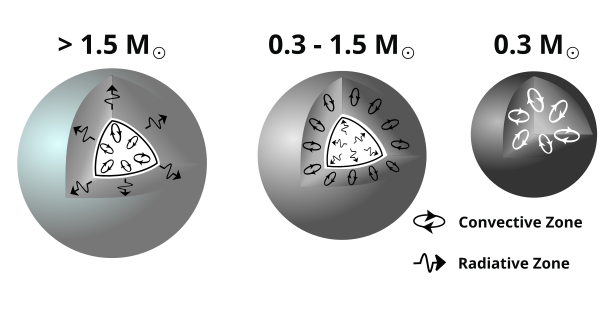
Also available in black and white
File
( immagine
74.95 kB)
File PDF
(
18.56 kB)

Vista ravvicinata di una macchia solare
immagine
Didascalia: Questa immagine di una macchia solare è stata scattata dal Daniel K Inouye Solar Telescope (DKIST), gestito dalla National Science Foundation degli Stati Uniti. È stata scattata solo con una luce di lunghezza d'onda pari a 530 nanometri, nella parte giallo-verde dello spettro visibile.
L'immagine rivela i dettagli della struttura della macchia e della fotosfera del Sole. La regione centrale scura, nota come umbra, è circondata da un'area più chiara, chiamata penombra, con caratteristiche radiali allungate che si estendono verso l'umbra. Si noti che l'ombra e la penombra qui riportate non corrispondono all'umbra e alla penumbra che si verificano durante un'eclissi.
La macchia solare ha un diametro di circa 5.000 chilometri, equivalente all'incirca alla distanza est-ovest della Cina. L'umbra sembra nera, ma in realtà è calda e luminosa. Appare scura solo perché è più fredda di qualche migliaio di Kelvin rispetto alla fotosfera solare circostante. Intorno alla macchia solare, sulla superficie fotosferica del Sole, sono visibili disegni di granulazione del plasma.
Crediti: NSO/NSF/AURA
Link per i Crediti
Termini del Glossario:
Fotosfera , Sole , Macchia solare , Granulazione
Licenza: Creative Commons Attribuzione 4.0 Internazionale (CC BY 4.0) Creative Commons Attribuzione 4.0 Internazionale (CC BY 4.0) icone
File
( immagine
5.23 MB)

Immagine H-alfa della cromosfera del Sole
immagine
Didascalia: Questa immagine in falsi colori è stata acquisita con un telescopio da 10 cm presso il Big Bear Solar Observatory (BBSO) negli Stati Uniti nel luglio 2002. Raffigura l'intero disco del Sole utilizzando la linea di emissione H-alfa dell'idrogeno. Quando viene osservata in questa linea spettrale, la cromosfera del Sole appare particolarmente evidente a causa degli atomi di idrogeno che emettono luce a quella specifica lunghezza d'onda. Questa emissione produce un caratteristico colore rosso, rendendo altamente visibili caratteristiche come le spicole (getti di plasma che sembrano capelli) e le facule (macchie luminose nella cromosfera). È possibile osservare diverse piccole protuberanze solari che sporgono dal bordo del disco solare. Quando le protuberanze (note anche come filamenti) attraversano la faccia del disco, appaiono come fili scuri causati dal materiale più freddo della protuberanza che assorbe la luce. La cromosfera è visibile anche nella parte violetta dello spettro solare a causa del calcio ionizzato che mostra emissioni in queste lunghezze d'onda.
Crediti: Osservatorio solare di Big Bear (BBSO)/Istituto di Tecnologia del New Jersey (NJIT)
Link per i Crediti
Termini del Glossario:
Cromosfera , Protuberanza solare , Sole , Linea spettrale
Categorie:
Il Sole
Licenza: Dominio Pubblico Dominio Pubblico icone
File
( immagine
2.82 MB)

Immagine ad alta risoluzione della superficie del Sole
immagine
Didascalia: Questa immagine ad alta risoluzione di una piccola porzione della "superficie" visibile più esterna del Sole (la fotosfera) copre un'area di 36.500 per 36.500 km. È una delle prime immagini scattate dal Daniel K. Inouye Solar Telescope, nell'ambito della fase di verifica scientifica del telescopio. Ciascuna delle celle visibili ha le dimensioni dello Stato americano del Texas, della Francia, dell'Afghanistan o della Somalia. Nei centri più luminosi di queste celle, il plasma proveniente dalle regioni sottostanti sale in superficie, si raffredda e poi si abbassa di nuovo in corrispondenza delle tracce più scure che delimitano le celle. In queste tracce scure possiamo anche vedere i piccoli indicatori luminosi dei campi magnetici.
Crediti: NSO/NSF/AURA
Link per i Crediti
Termini del Glossario:
Fotosfera , Granulazione
Categorie:
Il Sole
Licenza: Creative Commons Attribuzione 4.0 Internazionale (CC BY 4.0) Creative Commons Attribuzione 4.0 Internazionale (CC BY 4.0) icone
File
( immagine
17.04 MB)
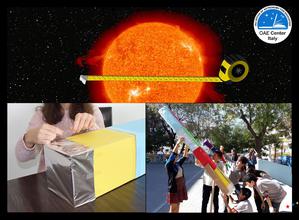
The Sun in our box Attività didattica astroEDU (link al sito web di astroEDU) Origin: astroEDU Descrizione Comparing the size of the Sun and the Earth building and using a pinhole camera.
Termini del Glossario:
Sole
Categorie:
Matematica
, Fisica
, Il Sole
Fasce d'età
10-12
, 12-14
Livello di istruzione
Middle School
Aree di apprendimento
Discussion Groups
, Observation based
, Project-based learning
, Structured-inquiry learning
Costi:
Low Cost
Durata:
3 hours
Dimensione del Gruppo:
Group
Abilità:
Developing and using models
, Engaging in argument from evidence
, Using mathematics and computational thinking
Autori: Aysegul Yelkenci, Korhan Yelkenci, Mert Koçer
Licenza: Creative Commons Attribuzione 4.0 Internazionale (CC BY 4.0) Creative Commons Attribuzione 4.0 Internazionale (CC BY 4.0) icone