Documentos e recursos — Resultados da busca
Resultados da busca
Spectrum of an M-type star
imagem
Criado para o OAE
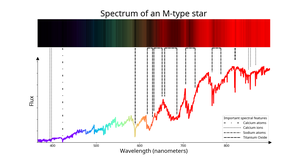
Legenda: The spectrum of the M-type star 2MASS J15581272+8457104. The colour of the line between 400 nm and 700 nm roughly corresponds to the colour the human eye would see light of that wavelength. Below 400 nm and above 700 nm, where the human eye can see little to no light, the lines are coloured blue and red respectively.
The black lines show spectral absorption lines caused by atoms, ions and molecules of different elements in the star’s atmosphere. These atoms, ions and molecules absorb at specific wavelengths, causing sharp, dark lines in the spectra. How strong these lines are depends on the temperature of the star’s atmosphere. Two stars made from the same mix of elements could have spectra with vastly different sets of lines in their spectra if they have different temperatures in their atmospheres. The atmospheres of M-type stars are cool enough for some chemical compounds to form. These are often referred to as molecules in astronomy, even if they are not strictly molecules in chemistry. These molecules produce so many lines in an M-type star’s spectrum that the lines appear to merge together in huge bands that remove large chunks from the spectrum. In M-type stars, titanium oxide has a large number of these bands in visible light, dominating huge regions of the spectrum.
Crédito: IAU OAE/SDSS/Niall Deacon
Termos do Glossário:
Espectro , Comprimento de onda , Estrela tipo M
Categorias
Estrelas
Licença: Creative Commons Attribution 4.0 International (CC BY 4.0) Creative Commons Attribution 4.0 International (CC BY 4.0) ícones
Arquivo
( imagem
100.86 kB)
Arquivo PDF
(PDF file
74.55 kB)
Spectrum of a K-type star
imagem
Criado para o OAE
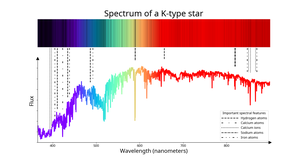
Legenda: The spectrum of the K-type star 2MASS J19554455+4754531. The colour of the line between 400 nm and 700 nm roughly corresponds to the colour the human eye would see light of that wavelength. Below 400 nm and above 700 nm, where the human eye can see little to no light, the lines are coloured blue and red respectively.
The black lines show spectral absorption lines caused by atoms and ions of different elements in the star’s atmosphere. These atoms and ions absorb at specific wavelengths, causing sharp, dark lines in the spectra. How strong these lines are depends on the temperature of the star’s atmosphere. Two stars made from the same mix of elements could have spectra with vastly different sets of lines in their spectra if they have different temperatures in their atmospheres. The spectra of K-type stars are dominated by metal atoms such as iron, sodium and calcium atoms. There are so many lines from metal atoms, far too many to mark individually, that the spectrum has a choppy, ragged appearance. The lines of hydrogen atoms and calcium ions are much weaker than in the hotter G-type stars.
Crédito: IAU OAE/SDSS/Niall Deacon
Termos do Glossário:
Estrela tipo K , Espectro , Comprimento de onda
Categorias
Estrelas
Licença: Creative Commons Attribution 4.0 International (CC BY 4.0) Creative Commons Attribution 4.0 International (CC BY 4.0) ícones
Arquivo
( imagem
111.47 kB)
Arquivo PDF
(PDF file
75.79 kB)
Spectrum of a G-type star
imagem
Criado para o OAE
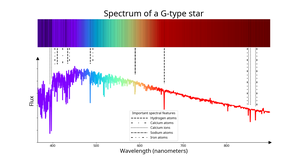
Legenda: The spectrum of the G-type star UCAC4 700-069569. The colour of the line between 400 nm and 700 nm roughly corresponds to the colour the human eye would see light of that wavelength. Below 400 nm and above 700 nm, where the human eye can see little to no light, the lines are coloured blue and red respectively.
The black lines show spectral absorption lines caused by atoms and ions of different elements in the star’s atmosphere. These atoms and ions absorb at specific wavelengths, causing sharp, dark lines in the spectra. How strong these lines are depends on the temperature of the star’s atmosphere. Two stars made from the same mix of elements could have spectra with vastly different sets of lines in their spectra if they have different temperatures in their atmospheres. In G-type stars lines from hydrogen atoms are weaker than in F-type stars and lines from ionised calcium stronger. Lines from metal atoms such as atoms of iron, sodium and calcium also begin to become prominent.
Crédito: IAU OAE/SDSS/Niall Deacon
Termos do Glossário:
Espectro , Comprimento de onda , Estrela do tipo G
Categorias
Estrelas
Licença: Creative Commons Attribution 4.0 International (CC BY 4.0) Creative Commons Attribution 4.0 International (CC BY 4.0) ícones
Arquivo
( imagem
98.84 kB)
Arquivo PDF
(PDF file
75.42 kB)
Spectrum of an F-type star
imagem
Criado para o OAE
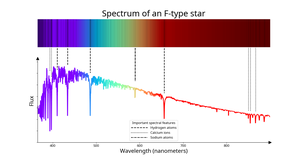
Legenda: The spectrum of the F-type star 2MASS J22243289+4937443. The colour of the line between 400 nm and 700 nm roughly corresponds to the colour the human eye would see light of that wavelength. Below 400 nm and above 700 nm, where the human eye can see little to no light, the lines are coloured blue and red respectively.
The black lines show spectral absorption lines caused by atoms and ions of different elements in the star’s atmosphere. These atoms and ions absorb at specific wavelengths, causing sharp, dark lines in the spectra. How strong these lines are depends on the temperature of the star’s atmosphere. Two stars made from the same mix of elements could have spectra with vastly different sets of lines in their spectra if they have different temperatures in their atmospheres. The lines from hydrogen atoms that are strongest in A-type stars are still relatively strong in F-type stars but lines from metals, particularly ionised calcium begin to become strong at this spectral type.
Crédito: IAU OAE/SDSS/Niall Deacon
Termos do Glossário:
Estrela tipo F , Espectro , Comprimento de onda
Categorias
Estrelas
Licença: Creative Commons Attribution 4.0 International (CC BY 4.0) Creative Commons Attribution 4.0 International (CC BY 4.0) ícones
Arquivo
( imagem
96.47 kB)
Arquivo PDF
(PDF file
74.72 kB)
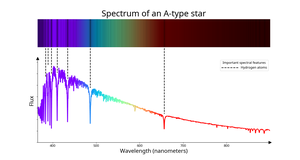
Spectrum of an A-type star
imagem
Criado para o OAE
Legenda: The spectrum of the A-type star BD-11 1212. The colour of the line between 400 nm and 700 nm roughly corresponds to the colour the human eye would see light of that wavelength. Below 400 nm and above 700 nm, where the human eye can see little to no light, the lines are coloured blue and red respectively.
The black lines show spectral absorption lines caused by atoms and ions of different elements in the star’s atmosphere. These atoms and ions absorb at specific wavelengths, causing sharp, dark lines in the spectra. How strong these lines are depends on the temperature of the star’s atmosphere. Two stars made from the same mix of elements could have spectra with vastly different sets of lines in their spectra if they have different temperatures in their atmospheres. Lines from hydrogen atoms dominate the spectra of A-type stars and are strongest at this spectral type.
Crédito: IAU OAE/SDSS/Niall Deacon
Termos do Glossário:
Estrela de tipo A , Espectro , Comprimento de onda
Categorias
Estrelas
Licença: Creative Commons Attribution 4.0 International (CC BY 4.0) Creative Commons Attribution 4.0 International (CC BY 4.0) ícones
Arquivo
( imagem
84.67 kB)
Arquivo PDF
(PDF file
74.28 kB)





