Documentos e recursos — Resultados da busca
Resultados da busca
When the Sun Bounces
imagem
Criado para o OAE
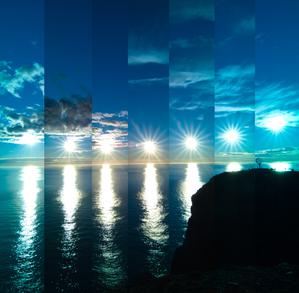
Legenda: First place winner in the 2023 IAU OAE Astrophotography Contest, category of Still images of sunrise and sunset location over the year.
This image was taken at Norway's North Cape. Owing to the latitude of this location, the Sun never truly sets during the summer months, from around April to August. This results in the unique spectacle of continuous daylight, known as a polar day. This captivating series of images, taken in 2022, showcases the Sun's relentless journey across the horizon every 30 minutes. At its lowest point in the sky, the Sun does not set, but appears to bounce off the horizon. The globe on the far right in the photo stands as a sentinel, marking the northernmost point of the European continental mainland.
Crédito: Milos Obert/IAU OAE (CC BY 4.0)
Termos do Glossário:
Trajetória do Sol (Arco Diurno) , Círculo Polar , Círculo Polar Ártico , Dia Polar
Categorias
Astronomia a Olho Nu
Tags:
astrophotography
Licença: Creative Commons Attribution 4.0 International (CC BY 4.0) Creative Commons Attribution 4.0 International (CC BY 4.0) ícones
Este arquivo no Zenodo ( imagem 3.54 MB)
The Path of the Sun
imagem
Criado para o OAE
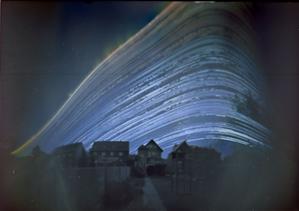
Legenda: Second place winner in the 2023 IAU OAE Astrophotography Contest, category of Still images of day arcs of the Sun and Solargraphs.
This enchanting image, captured in Germany between 21 June 2018 and 21 December 2018, is a poetic blend of art and science, showcasing nature's rhythm and the passage of time. It combines images taken at different times of day over the course of six months. Each curve tracks the Sun’s path (or arc) across the sky on a particular day. The sweeping arc of the Sun is distorted here by the projection, making it appear like a curve. The position of the daily arc across the sky changes with the Sun’s seasonal movement in the sky. Captured using a simple pinhole camera fashioned from a coffee can, it shows the Sun's journey over the course of six months, and the gradual shift of the daily arc from the summer, when it is higher in the sky, to its lowest arc at the winter solstice. Gaps in the Sun’s path represent days or times of day when the Sun was obscured by clouds. This image is a vivid testament to the changing seasons, revealing the Sun's dance in the sky as days grow shorter or longer.
Crédito: Frank Niessen/IAU OAE (CC BY 4.0)
Termos do Glossário:
Equinócio , Solstício , Solstício de verão , Trajetória do Sol (Arco Diurno) , Solstício de Inverno
Categorias
Astronomia a Olho Nu
Tags:
astrophotography
Licença: Creative Commons Attribution 4.0 International (CC BY 4.0) Creative Commons Attribution 4.0 International (CC BY 4.0) ícones
Este arquivo no Zenodo ( imagem 465.46 kB)
Solstices and Equinox
imagem
Criado para o OAE
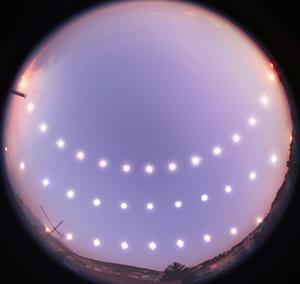
Legenda: Honorable mention in the 2023 IAU OAE Astrophotography Contest, category of Still images of day arcs of the Sun and Solargraphs.
This captivating image showcases the journey of the Sun through the sky during the winter solstice (bottom), equinox (middle), and summer solstice (top) in Bursa, Turkey, between 21 December 2007 and 20 June 2008. Using a fisheye lens, the photographer captured the Sun's positions at regular intervals from sunrise to sunset on the three different days, illustrating the changing lengths of day and night throughout the year. The variations in the Sun’s daily path across the sky, its height at midday, and the positions of sunrise and sunset, as well as the length of a day, depend on Earth’s axial tilt relative to its orbit around the Sun. The series was taken from a rooftop in Bursa, where the local terrain adds its own unique touch by occasionally obstructing the horizon. Oriented with north at the top and south at the bottom, this visual diary serves as a stunning representation of the Sun’s path for those residing in mid-northern latitudes.
Crédito: Tunç Tezel/IAU OAE (CC BY 4.0)
Termos do Glossário:
Equinócio , Solstício , Solstício de verão , Trajetória do Sol (Arco Diurno) , Solstício de Inverno
Categorias
Astronomia a Olho Nu
Tags:
astrophotography
Licença: Creative Commons Attribution 4.0 International (CC BY 4.0) Creative Commons Attribution 4.0 International (CC BY 4.0) ícones
Este arquivo no Zenodo ( imagem 1.71 MB)
Southern Sky Over La Silla
vídeo
Criado para o OAE
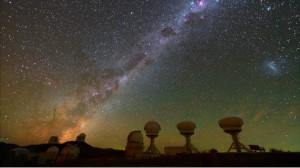
Legenda: First place winner in the 2023 IAU OAE Astrophotography Contest, category of Time-lapses of rotation of Big Dipper or Southern Cross.
This video shows the Milky Way’s sprawling brilliance across the celestial expanse. Among the stars’ grand theatre, the Southern Cross constellation claims its place in the scene, distinguished by its distinctive cross shape as seen in the top of this video and slightly to the right just over the Milky Way, slowly disappearing as the video progresses. This celestial marker, a prominent feature in the southern hemisphere, holds cultural and navigational significance, having served as a navigational guidepost for centuries. Accompanying the Milky Way’s grandeur are the two Magellanic clouds, celestial companions seen dancing in the distant sky. The Carina Nebula adds its ethereal glow to the cosmic panorama, painting a radiant hue against the darkness. In the midst of this celestial ballet, a gentle green hue envelops the atmosphere, a phenomenon known as airglow, adding a touch of subtle luminescence to the night sky. The terrestrial also makes an appearance, with planes flying overhead and vehicles driving between observatory buildings. This time-lapse, taken from the La Silla Observatory in Chile, is a window to the captivating dance of stars, offering a glimpse into the awe-inspiring beauty of our galaxy and the celestial landmarks that grace the southern sky.
Crédito: José Rodrigues/IAU OAE (CC BY 4.0)
Termos do Glossário:
Polo Celeste , Esfera Celeste , Rotação da Terra , Observação , Céu , Cruzeiro do Sul
Categorias
Astronomia a Olho Nu
Tags:
astrophotography
Licença: Creative Commons Attribution 4.0 International (CC BY 4.0) Creative Commons Attribution 4.0 International (CC BY 4.0) ícones
Este arquivo no Zenodo ( vídeo 1.07 GB)

Star Trails
imagem
Criado para o OAE
Legenda: Honorable mention in the 2023 IAU OAE Astrophotography Contest, category of Still images taken exclusively with smartphones/mobile devices.
Taken in the darkness of Panotiya, Amartiya village, India, this image from October 2022 showcases beautiful star trails painting the night sky. With only a smartphone and a tripod, the photographer captured these trails — visual evidence of our planet's rotation, as each streak represents the apparent movement of the stars as the Earth spins, creating a captivating cosmic choreography of light. The distinct colours of the stars — some gleaming blue, others whitish — hint at their varying temperatures and compositions. Additionally, a subtle streak of an aeroplane momentarily intersects the timeless dance of the stars, juxtaposing the serene heavens with the bustling activity of life below.
Crédito: Govind Gurjar/IAU OAE (CC BY 4.0)
Termos do Glossário:
Esfera Celeste , Rotação da Terra
Categorias
Astronomia a Olho Nu
Tags:
astrophotography
Licença: Creative Commons Attribution 4.0 International (CC BY 4.0) Creative Commons Attribution 4.0 International (CC BY 4.0) ícones
Este arquivo no Zenodo ( imagem 1.98 MB)





