Documentos e recursos — Resultados da busca
Resultados da busca
The Big Dipper with the Sardinia Radio Telescope SRT
vídeo
Criado para o OAE
Legenda: Honorable mention in the 2023 IAU OAE Astrophotography Contest, category of Time-lapses of rotation of Big Dipper or Southern Cross.
This time-lapse captures the movement of the stars alongside the majestic 64-metre Sardinia Radio Telescope (SRT) from the National Institute of Astrophysics (INAF), with special attention to the renowned Big Dipper against the backdrop of the celestial sphere. The camera pans as the famous asterism sinks in the sky while planes fly past and the radio telescope rotates. The harmonious interplay between the stellar pathways and the colossal dish of the radio telescope creates a mesmerising visual ode to the cosmic ballet taken in September 2019.
Crédito: Antonio Finazzi/IAU OAE (CC BY 4.0)
Termos do Glossário:
Astronomia , A Grande Concha (Big Dipper, em inglês) , Polo Celeste , Esfera Celeste , Rotação da Terra , Observação , Polaris
Categorias
Astronomia a Olho Nu
Tags:
astrophotography
Licença: Creative Commons Attribution 4.0 International (CC BY 4.0) Creative Commons Attribution 4.0 International (CC BY 4.0) ícones
Este arquivo no Zenodo ( vídeo 441.31 MB)
The Hale Telescope
imagem
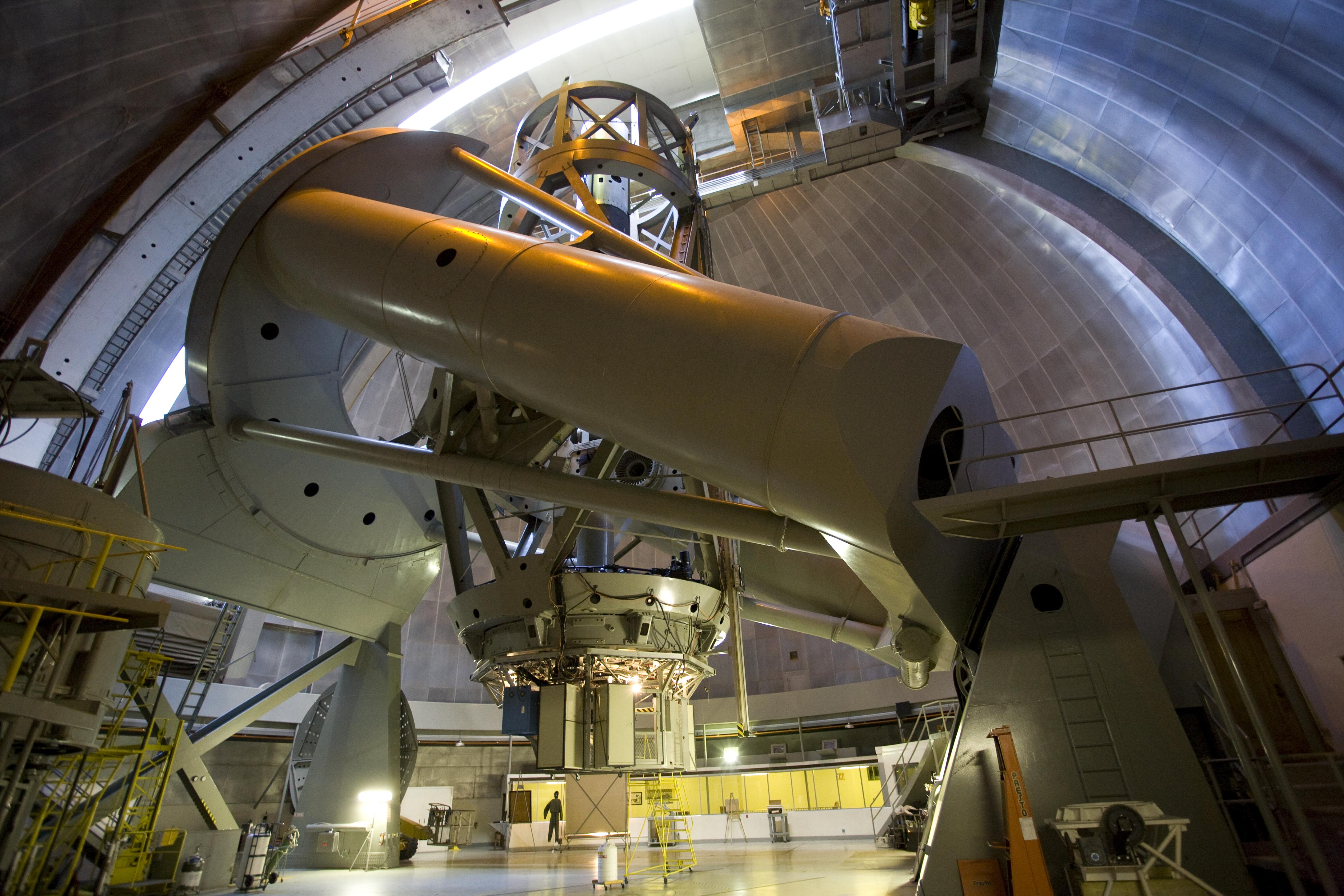
Legenda: This image shows the Hale Telescope at the Palomar Observatory in northern San Diego County, California, USA and operated by the California Institute of Technology (Caltech). With its 5.1 m primary mirror, the Hale Telescope was the largest effective optical telescope in the world from its first light in 1949 until 1993.
Here we see the Hale Telescope when not in operation. The telescope itself is the large, vertical, approximately cylindrical object in the centre of the image. Telescopes like this use mirrors to gather faint light and form clear images of distant targets, enabling scientists to study everything from nearby stars and planets to remote galaxies. The primary mirror, seen here at the bottom of the telescope, focusses light from the sky to the prime focus at the top of the telescope. Instruments such as cameras and spectrographs can be placed at this prime focus or alternatively a secondary mirror can reflect light back down the telescope and through a hole in the primary mirror to instruments.
The telescope is supported by a large mount, seen here at an angle to the telescope. This particular mount is a type of equatorial mount. This means that one of the rotation axes of the mount points to the celestial poles. When a star or galaxy moves across the sky due to the Earth's rotation, the telescope only has rotate on this axis to keep pointing at that star or galaxy. Most modern large telescopes use a different kind of mount and rely on computer calculations to accurately track an object across the sky.
The Hale Telescope is housed under a large rotating dome that opens at night so the telescope can track objects across the sky.
Crédito: JPL/Caltech/Palomar Observatory
Link do crédito
Termos do Glossário:
Telescópio Refletor , Telescópio
Categorias
Astronomia Observacional
, Telescópios, Instrumentos e Observatórios
Licença: Domínio Público Domínio Público ícones
Arquivo
( imagem
12.65 MB)
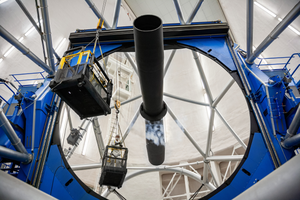
Gemini South's primary mirror and telescope structure
imagem
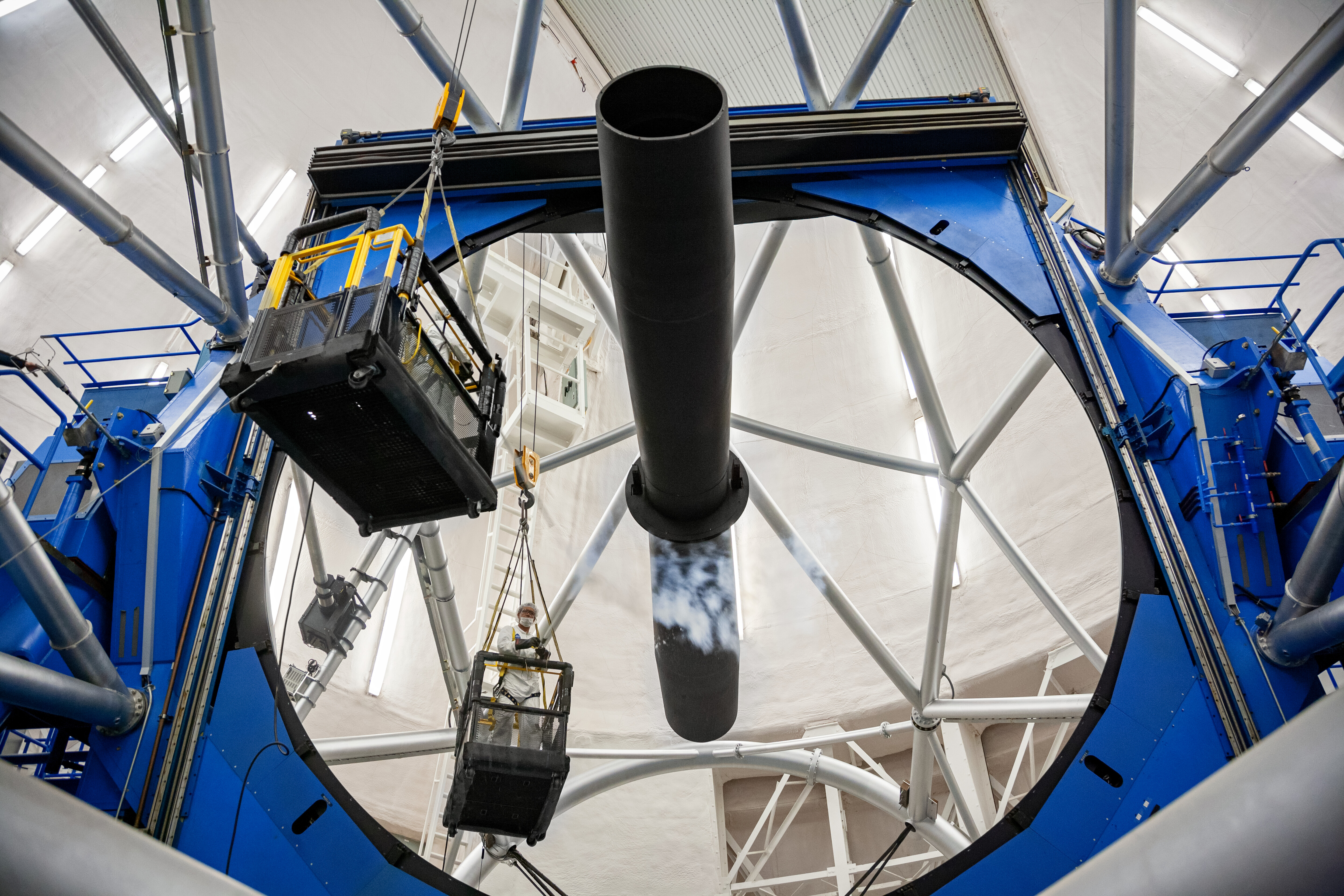
Legenda: This is the primary mirror and supporting structure of a large optical telescope at the Gemini South Observatory in Chile. The primary mirror is the largest and most important mirror in a reflecting telescope: its gently curved surface gathers light from faint stars, galaxies, and nebulae and reflects that light to a focal point. At this focal point light is either fed directly in to an instrument to record spectra and images or redirected to such an instrument by a series of further mirrors. The sturdy metal framework around the primary mirros keeps the mirror precisely aligned and protected while the telescope moves to track objects across the sky.
In telescopes that use mirrors instead of lenses, such as this one, the mirror is what collects and focuses the light from distant celestial objects. Larger mirrors can capture more light, allowing astronomers to see fainter and more distant objects. A larger primary mirror can also take sharper images of the sky, but this is often negated by the blurring effect of the Earth's atmopshere. A primary mirror must be perfectly smooth to tolerances of fractions of a wavelength of light so that it produces sharp, clear images. We can think of the primary mirror as the “eye” of the telescope that looks out into space, with its shape and support enabling powerful astronomical observations.
Crédito: International Gemini Observatory/NOIRLab/NSF/AURA/M. Paredes
Link do crédito
Termos do Glossário:
Telescópio Refletor , Espelho
Categorias
Astronomia Observacional
, Telescópios, Instrumentos e Observatórios
Licença: Creative Commons Attribution 4.0 International (CC BY 4.0) Creative Commons Attribution 4.0 International (CC BY 4.0) ícones
Arquivo
( imagem
23.24 MB)
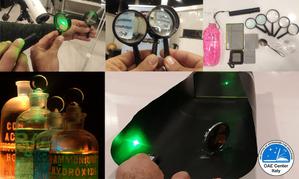
How do telescopes work? atividade educacional astroEDU (link para o site do astroEDU) Origem: astroEDU Descrição: Let's discover telescopes and experiment simple optics
Termos do Glossário:
Óptica , Telescópio
Categorias
Física
, Telescópios, Instrumentos e Observatórios
Faixas etárias:
10-12
Nível de ensino:
Básico
Áreas de aprendizagem:
Aprendizagem por descoberta guiada
, Atividade com foco histórico
, Baseado em observação
Custos:
Custo médio
Duração:
1 hour
Tamanho do grupo:
Grupo
Habilidades:
Fazer perguntas
Autores Alassiry Muhammed, Turkieh Jbour, Tareq Alkhateb
Licença: Creative Commons Attribution 4.0 International (CC BY 4.0) Creative Commons Attribution 4.0 International (CC BY 4.0) ícones

The Fibre Optic Cable Class atividade educacional astroEDU (link para o site do astroEDU) Origem: astroEDU Descrição: Learn about the amazing technology of fibre optics that has done so much for technology here on Earth and in observing space.
Termos do Glossário:
Espectroscopia
Categorias
Telescópios, Instrumentos e Observatórios
Tags:
Hands-on
, Model
, Sloan Digital Sky Survey
, Software
, fibre optics
Faixas etárias:
10-12
, 12-14
Nível de ensino:
Ensino fundamental
Áreas de aprendizagem:
Modelagem
, Aprendizagem baseada em projetos
, Com foco em simulação
, Aprendizagem por investigação estruturada
Custos:
Custo médio
Duração:
1 hour
Tamanho do grupo:
Grupo
Habilidades:
Fazer perguntas
, Planejar e realizar pesquisas
Autores Amee Hennig
Licença: Creative Commons Attribution 4.0 International (CC BY 4.0) Creative Commons Attribution 4.0 International (CC BY 4.0) ícones