Documentos e recursos — Resultados da busca
Resultados da busca
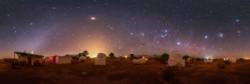
Chilean observatories at home office, by Robert Barsa, Slovakia
imagem
Criado para o OAE
Legenda: Third place in the 2021 IAU OAE Astrophotography Contest, category Wide star fields.
This rich panoramic image shows a range of constellations, deep sky objects and planets. The brightest point of light with a pale reddish hue (left of center) is the planet Mars. In the bottom far left of the image, located just above the sloped roof of the building are two points of light appearing very close to each other, these are the planets Jupiter (brighter) and Saturn. To the far right of the image the two fuzzy cloud-like objects are the Large and Small Magellanic Clouds. These are satellite dwarf galaxies of the Milky Way located at a distance of approximately 160,000 and 200,000 light years, respectively. The Andromeda Galaxy, which is located at an approximate distance of 2.5 million light years, appears in this image as a small, angled smudge between Mars and the brightest glow on the horizon (closer to the horizon). The bright glow is not from the Sun or the Moon, but the city lights of San Pedro de Atacama.
Prominent constellations include: Orion – identified by the three stars forming Orion’s Belt; Taurus – a small triangle shaped collection of stars to the left of Orion and identified by the pale orange star (Aldebaran) at the vertex of the triangle; Canis Major – to the bottom right of Orion, identified by the bright star Sirius (the brightest star in the night sky) and three stars in the shape of a triangle just above the observatory dome in the foreground; Pegasus – identified by the trapezium shape diagonally below Mars. Other constellations include Andromeda, Perseus and Aries. Diverse cultures around the world have their own names and rich stories associated with these constellations and many others.
To the top right of Orion’s Belt is an angled line of stars (Orion’s Sword) within which is a pinkish smudge (looks like a fuzzy star when observed with the unaided eye) that is the Orion Nebula – a stellar nursery located 1500 light years from Earth – where stars are formed. To the left of Taurus is a compact fuzzy smudge, and that is the Pleiades star cluster. The variation in the colour of stars is the result of temperature of the stars, for example, the red orange star to the bottom left of Orion’s Belt is the red giant star Betelgeuse. Cooler stars appear redder, compared to the higher temperature white and bluish stars. The colours in the image are enhanced because of the higher sensitivity of the digital camera compared to the human eye.
Crédito: Robert Barsa/IAU OAE
Termos do Glossário:
Áries , Astronomia , Observatório
Categorias
Astronomia a Olho Nu
, Telescópios, Instrumentos e Observatórios
Licença: Creative Commons Attribution 4.0 International (CC BY 4.0) Creative Commons Attribution 4.0 International (CC BY 4.0) ícones
Este arquivo no Zenodo ( imagem 77.18 MB)
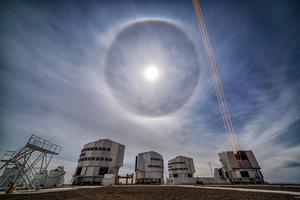
O Very Large Telescope (VLT) da ESO no Observatório Paranal com um halo lunar
imagem
Legenda: O Very Large Telescope, localizado no Cerro Paranal, no Chile, possui quatro telescópios refletores, cada um com um espelho primário de 8,2 m de diâmetro. Nesta imagem, uma das cúpulas está aberta e disparando feixes de laser para o céu. Esses lasers criam estrelas artificiais no céu que podem ser usadas para ajustar a óptica do telescópio e remover o efeito de borramento causado pela atmosfera terrestre. Esse processo é conhecido como óptica adaptativa.
No céu, a Lua está rodeada por um halo brilhante. Isso é causado pela luz da Lua refletindo dentro de cristais de gelo na atmosfera terrestre.
Crédito: Juan Carlos Muñoz-Mateos/ESO
Link do crédito
Termos do Glossário:
Observatório , Ótica Adaptativa , Halo
Categorias
Telescópios, Instrumentos e Observatórios
Licença: Creative Commons Attribution 4.0 International (CC BY 4.0) Creative Commons Attribution 4.0 International (CC BY 4.0) ícones
Arquivo
( imagem
4.27 MB)
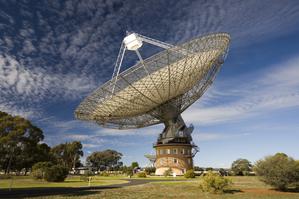
Radiotelescópio Parkes
imagem
Legenda: O radiotelescópio de 64 metros do Observatório Parkes (Nova Gales do Sul, Austrália) está em pleno funcionamento desde 1963 e vem sendo continuamente atualizado desde então. Também chamado de “The Dish” (A Antena), é operado pela Commonwealth Scientific and Industrial Research Organisation (CSIRO). O telescópio pode ser apontado para uma parte do céu. As ondas de rádio dessa parte do céu são então refletidas e focadas pela antena gigante em um receptor no ponto focal. Os dados desse receptor podem então ser analisados pelos astrônomos.
Crédito: David McClenaghan/CSIRO
Link do crédito
Termos do Glossário:
Observatório , Radioastronomia , Radiotelescópio
Categorias
Telescópios, Instrumentos e Observatórios
Licença: Creative Commons Attribution 3.0 Unported Creative Commons Attribution 3.0 Unported ícones
Arquivo
( imagem
3.44 MB)





