Documentos e recursos — Resultados da busca
Resultados da busca
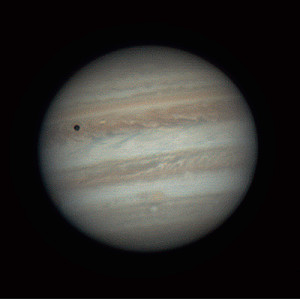
Jupiter, Io and its shadow, by Ralf Burkart, Germany
vídeo
Criado para o OAE
Legenda: First place in the 2021 IAU OAE Astrophotography Contest, category Galilean moons.
This time-lapse of Jupiter taken in 2017 from Germany beautifully illustrates the transit of one of the Galilean moons, Io, in front of Jupiter. As this is simply a moon casting a shadow on a planet it is equivalent to a lunar eclipse on Earth observed from further away. While the shadow of the moon is clearly visible from the beginning, it might be difficult to spot the moon itself against the background of the beautiful atmospheric bands of Jupiter the first time the video is seen. Watching it repeatedly allows appreciating the rapid motion and rotation in this fantastic observation.
Crédito: Ralf Burkart/IAU OAE
Termos do Glossário:
Satélites Galileanos , Gigante gasoso , Io , Júpiter , Luas , Órbita , Planetas Externos , Planeta , Trânsito
Categorias
Sistema Solar
Licença: Creative Commons Attribution 4.0 International (CC BY 4.0) Creative Commons Attribution 4.0 International (CC BY 4.0) ícones
Este arquivo no Zenodo ( vídeo 12.64 MB)
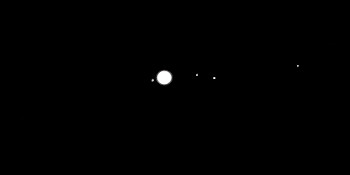
Jupiter Moons Movie2, by Nicolas Hurez, Paul-Antoine Matrangolo, and Carl Pennypacker, United States of America
vídeo
Criado para o OAE
Legenda: Second place in the 2021 IAU OAE Astrophotography Contest, category Galilean moons.
This sequence shows the orbit of the four Galilean moons around the planet Jupiter. Almost two entire orbits of the innermost moon, Io, can be seen, with the other moons (Europa and Ganymede, but in particular Callisto) being further away, orbiting noticeably slower. The images were obtained in 2018 with the Las Cumbres Global Observatory at different locations on Earth, allowing a continuous sequence of images over approximately half a week without gaps during the day. With clear skies and over the course of several nights, the motion of the Galilean moons can also be observed with binoculars (ideally steady your elbows on a surface).
Crédito: Nicolas Hurez, Paul-Antoine Matrangolo and Carl Pennypacker/IAU OAE
Termos do Glossário:
Satélites Galileanos , Gigante gasoso , Io , Júpiter , Luas , Órbita , Planetas Externos , Planeta
Categorias
Sistema Solar
Licença: Creative Commons Attribution 4.0 International (CC BY 4.0) Creative Commons Attribution 4.0 International (CC BY 4.0) ícones
Este arquivo no Zenodo ( vídeo 890.47 kB)

Halley's Comet
imagem
Legenda: Halley’s Comet, is a well-known periodic comet, named after the English astronomer Edmond Halley. It has an orbital period of approximately 75 years and is visible from Earth with the naked eye when it passes through the inner solar system.
The image shows Halley’s Comet, officially designated 1P/Halley, with a tail of gas and dust streaming away from the Sun. It was taken from the La-Silla-Observatory in Chile in 1986 during Halley's Comet's last visit to the inner solar system. The stars in this image appear elongated or as lines of three different colored dots as image was created from three separate observations in different colors of light and the telescope was tracking the comet, which was moving very slightly compared to the background stars. Note that the comets tail does not point in exactly the same direction as the elongation of the stars. This shows us that the comet tail is not always behind the comet, but instead pointing away from the Sun.
The comet passes its perihelion (closest distance to the Sun) at a distance of around 0.59 astronomical units, right between the orbits of Mercury and Venus. Beyond Neptune, it reaches its aphelion (furthest distance from the Sun) at a distance of approximately 35 astronomical units. Halley's Comet reached aphelion in December 2023 and is now moving inwards again. It is expected to be seen with the naked eye from Earth again in mid-2061.
Crédito: ESO
Link do crédito
Termos do Glossário:
Afélio , Cometa , Cauda de cometa , Cometa Halley , Periélio
Licença: Creative Commons Attribution 4.0 International (CC BY 4.0) Creative Commons Attribution 4.0 International (CC BY 4.0) ícones
Arquivo
( imagem
5.23 MB)

Imagem H-alfa da cromosfera do Sol
imagem
Legenda: Esta imagem em cor falsa foi capturada com um telescópio de 10 cm no Big Bear Solar Observatory (BBSO), nos Estados Unidos, em julho de 2002. Ela mostra o disco solar completo utilizando a linha de emissão H-alfa do hidrogênio. Quando observada nessa linha espectral, a cromosfera do Sol aparece particularmente proeminente devido aos átomos de hidrogênio que emitem luz nesse comprimento de onda específico. Essa emissão produz uma coloração vermelha característica, tornando bem visíveis características como as espículas (jatos de plasma que parecem fios de cabelo) e as placas (regiões brilhantes na cromosfera). Várias proeminências solares pequenas podem ser vistas projetando-se da borda do disco solar. Quando as proeminências (também conhecidas como filamentos) cruzam o disco do Sol, aparecem como fios escuros causados pelo material mais frio na proeminência que absorve a luz. A cromosfera também pode ser observada na região violeta do espectro solar devido ao cálcio ionizado, devido às emissões nesses comprimentos de onda.
Crédito: Observatório Solar de Big Bear (BBSO)/Instituto de Tecnologia de Nova Jersey (NJIT)
Link do crédito
Termos do Glossário:
Cromosfera , Proeminência solar , Sol , Linha espectral
Categorias
O Sol
Licença: Domínio Público Domínio Público ícones
Arquivo
( imagem
2.82 MB)
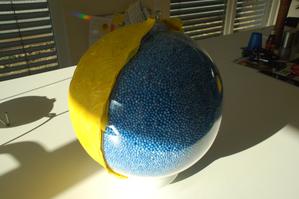
One Million Earths inside our Sun atividade educacional astroEDU (link para o site do astroEDU) Descrição: Learn how to build a model of the Sun...which can fit nearly 1 million little Earth balls!
Termos do Glossário:
Terra , Sol
Categorias
Matemática
, Sistema Solar
, O Sol
Tags:
Dimension
, Distances
, Hands-on
, Model
, Relative sizes
, Scales
Faixas etárias:
4-6
, 6-8
, 8-10
, 10-12
, 12-14
, 14-16
, 16-19
, 19+
Nível de ensino:
Informal
, Ensino fundamental
, Outro
, Pré-escola
, Básico
, Médio
, Universidade
Áreas de aprendizagem:
Aprendizagem por descoberta guiada
, Modelagem
, Resolução de problemas
Custos:
Custo médio
Duração:
30 mins
Tamanho do grupo:
Grupo
Habilidades:
Analisar e interpretar dados
, Fazer perguntas
, Comunicar informações
, Desenvolver e usar modelos
, Usar matemática e pensamento computacional
Autores Natalie Fischer
Licença: Creative Commons Attribution 4.0 International (CC BY 4.0) Creative Commons Attribution 4.0 International (CC BY 4.0) ícones