Documentos e recursos — Resultados da busca
Resultados da busca
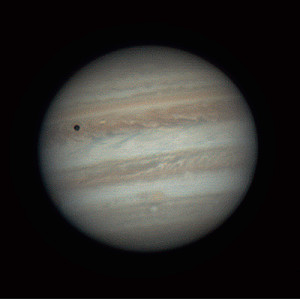
Jupiter, Io and its shadow, by Ralf Burkart, Germany
vídeo
Criado para o OAE
Legenda: First place in the 2021 IAU OAE Astrophotography Contest, category Galilean moons.
This time-lapse of Jupiter taken in 2017 from Germany beautifully illustrates the transit of one of the Galilean moons, Io, in front of Jupiter. As this is simply a moon casting a shadow on a planet it is equivalent to a lunar eclipse on Earth observed from further away. While the shadow of the moon is clearly visible from the beginning, it might be difficult to spot the moon itself against the background of the beautiful atmospheric bands of Jupiter the first time the video is seen. Watching it repeatedly allows appreciating the rapid motion and rotation in this fantastic observation.
Crédito: Ralf Burkart/IAU OAE
Termos do Glossário:
Satélites Galileanos , Gigante gasoso , Io , Júpiter , Luas , Órbita , Planetas Externos , Planeta , Trânsito
Categorias
Sistema Solar
Licença: Creative Commons Attribution 4.0 International (CC BY 4.0) Creative Commons Attribution 4.0 International (CC BY 4.0) ícones
Este arquivo no Zenodo ( vídeo 12.64 MB)
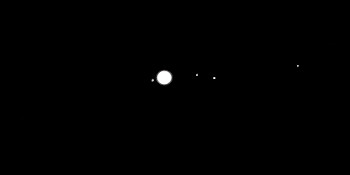
Jupiter Moons Movie2, by Nicolas Hurez, Paul-Antoine Matrangolo, and Carl Pennypacker, United States of America
vídeo
Criado para o OAE
Legenda: Second place in the 2021 IAU OAE Astrophotography Contest, category Galilean moons.
This sequence shows the orbit of the four Galilean moons around the planet Jupiter. Almost two entire orbits of the innermost moon, Io, can be seen, with the other moons (Europa and Ganymede, but in particular Callisto) being further away, orbiting noticeably slower. The images were obtained in 2018 with the Las Cumbres Global Observatory at different locations on Earth, allowing a continuous sequence of images over approximately half a week without gaps during the day. With clear skies and over the course of several nights, the motion of the Galilean moons can also be observed with binoculars (ideally steady your elbows on a surface).
Crédito: Nicolas Hurez, Paul-Antoine Matrangolo and Carl Pennypacker/IAU OAE
Termos do Glossário:
Satélites Galileanos , Gigante gasoso , Io , Júpiter , Luas , Órbita , Planetas Externos , Planeta
Categorias
Sistema Solar
Licença: Creative Commons Attribution 4.0 International (CC BY 4.0) Creative Commons Attribution 4.0 International (CC BY 4.0) ícones
Este arquivo no Zenodo ( vídeo 890.47 kB)
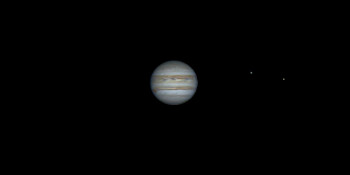
Jupiter's Rotation, by Vishal Sharma, India
vídeo
Criado para o OAE
Legenda: Third place in the 2021 IAU OAE Astrophotography Contest, category Galilean moons: Jupiter’s Rotation, by Vishal Sharma, India.
This time-lapse beautifully shows the rotation of Jupiter and the passage of two Galilean moons on the right side of the frame. Jupiter completes one rotation in just under 10 hours and we see as the Great Red Spot makes its way from left to right. The two moons travel a noticeable fraction of their orbit in this short time. This image was taken in 2020 in the North of India.
Crédito: Vishal Sharma/IAU OAE
Termos do Glossário:
Satélites Galileanos , Gigante gasoso , Júpiter , Luas , Órbita , Planetas Externos , Planeta
Categorias
Sistema Solar
Licença: Creative Commons Attribution 4.0 International (CC BY 4.0) Creative Commons Attribution 4.0 International (CC BY 4.0) ícones
Este arquivo no Zenodo ( vídeo 1.54 MB)

Vista detalhada de Caronte, lua de Plutão
imagem
Legenda: Caronte é a maior lua natural do planeta anão Plutão. Esta imagem detalhada foi obtida pela sonda New Horizons da NASA em 2015, durante sua histórica missão pelo Sistema Solar exterior. A superfície de Caronte apresenta uma mistura fascinante de regiões claras e escuras, incluindo vastos cânions, amplas planícies e crateras de impacto. Com um diâmetro de cerca de 1.200 quilômetros, Caronte tem mais da metade do diâmetro de Plutão, o que o torna excepcionalmente grande em comparação com seu corpo principal. A massa de Caronte é de aproximadamente 12% da massa de Plutão. Como Plutão e Caronte têm massas relativamente próximas, o centro de massa do sistema (o ponto em torno do qual tanto Plutão quanto Caronte orbitam) não está dentro de Plutão, mas entre Plutão e Caronte. Isso contrasta com sistemas como o da Terra e sua Lua, onde o centro de massa fica dentro do corpo maior, a Terra, neste caso. Os cientistas acreditam que o sistema Plutão-Caronte pode ter se formado por uma colisão de dois objetos que depois se separaram e começaram a orbitar um ao outro. Ao estudar Caronte e as luas menores que orbitam Plutão, astrônomos obtêm pistas sobre como as luas se formam e como corpos gelados distantes evoluem ao longo de bilhões de anos.
Crédito: NASA/Laboratório de Física Aplicada da Universidade Johns Hopkins/Instituto de Pesquisa Southwest/Alex Parker
Link do crédito
Termos do Glossário:
Luas , Plutão
Licença: Domínio Público Domínio Público ícones
Arquivo
( imagem
2.88 MB)

Trânsito de Fobos por Marte
vídeo
Legenda: Este vídeo mostra o Sol visto de Marte, enquanto Fobos, a lua de Marte, transita pelo disco solar. Este vídeo é composto por imagens captadas da superfície marciana no dia 30 de setembro de 2024 pela câmera Mastcam-Z do rover Perseverance da NASA. Enquanto nossa Lua tem o tamanho perfeito para eclipsar o Sol quando vista da superfície da Terra, o tamanho e a órbita de Fobos fazem com que ele não consiga cobrir o disco solar completamente. Isso significa que este evento é um trânsito e não um eclipse.
Este vídeo é em tempo real, com o trânsito inteiro durando apenas 32 segundos. Isso contrasta com as várias horas que um eclipse solar na Terra pode durar, desde o momento em que a Lua começa a encobrir parte do Sol até que o Sol volte a ficar completamente visível. Isso se deve ao período orbital muito mais curto de Fobos, de pouco mais de sete horas e meia, em comparação com o período orbital da Lua, de 27 dias, bem como ao fato de o disco solar parecer ligeiramente menor visto de Marte do que da Terra. Observe a forma não esférica de Fobos enquanto cruza o disco solar.
Crédito: NASA/JPL-Caltech/ASU/MSSS
Link do crédito
Termos do Glossário:
Marte , Luas , Eclipse Solar , Trânsito
Categorias
Sistema Solar
Licença: Domínio Público Domínio Público ícones
Arquivo
( vídeo
111.64 kB)


