Documentos e recursos — Resultados da busca
Resultados da busca

The Milky Way Over Anglers Reach
imagem
Criado para o OAE
Legenda: Winner in the 2022 IAU OAE Astrophotography Contest, category Still images of celestial patterns.
The Milky Way and several astronomical objects are seen in this image taken from the southern hemisphere, in Anglers Reach, Australia, in April 2022.
On the bottom-left side we can identify the constellation Scorpius with its brightest star, Antares, the reddish spot just above the arc. Some prominent but small southern constellations can also be seen: the dominating bright stars in the middle-left of the image in the Milky Way are the four bright stars of Crux (the Southern Cross) and to its left the two pointer stars, alpha and beta Centauri. Crux points towards the southern celestial pole, which is not marked by a bright star, and The pointer stars point towards Crux, distinguishing it from the asterism of the False Cross in the constellation Argo.
Crux features on the national flags of Australia, Brazil, Papua New Guinea, Samoa and New Zealand. As Crux lies in the brightest parts of the Milky Way, the dark cloud of the famous Coalsack Nebula is prominent next to the bright stars. It forms one of the dark constellations in South American, South African and Australian indigenous cultures. The huge Australian dark constellation of the Emu is almost completely above the horizon in this image, stretching from its head in the Coal Sack to the horizon.
In Greek antiquity, the stars of Crux also belonged to the constellation Centaurus, a hybrid creature with a human torso and head attached to a horse body with four legs. The Greek centaur represents Chiron, the wise teacher of all Greek heroes. Its brightest star is Rigil Kentaurus (Alpha Centauri), the front hoof of the centaur. Just below it, we find the small constellation Triangulum Australe. The triple star system of Alpha Centauri is our Sun’s nearest stellar neighbour.
Along the Milky Way in the middle-right of the picture we find the huge constellation Argo, the Ship. The smaller ancient constellation Argo was extended by Dutch navigators around 1600, and the number of stars in this constellation was then so big that the 18th-century French mathematician Lacaille needed to introduce subtitles for Argo in his star catalogue. In doing so, he invented the constellations Puppis, Carina and Vela. In Carina, the Keel of the ship, this reddish photograph clearly displays the Carina Nebula.
At the right edge of the image we can spot the brightest star in the night sky, Sirius, while the second brightest star, Canopus, the rudder of Argo, the Ship, dominates the area under the arch of the Milky Way.
Also below the Milky Way arc, we can see the Large Magellanic Cloud and the Small Magellanic Cloud, which are small satellite galaxies of our own Galaxy.
Crédito: Lucy Yunxi Hu/IAU OAE
Termos do Glossário:
Cor , Poeira , Via Láctea , Escorpião , Cruzeiro do Sul , Nuvem de poeira , Extinção interestelar , Grande Nuvem de Magalhães (LMC) , Pequena Nuvem de Magalhães (SMC) , Alpha Centauri
Categorias
Galáxias
, Via Láctea e Meio Interestelar
, Astronomia a Olho Nu
Licença: Creative Commons Attribution 4.0 International (CC BY 4.0) Creative Commons Attribution 4.0 International (CC BY 4.0) ícones
Este arquivo no Zenodo ( imagem 9.39 MB)

3D Universe: the Milky Way and friends atividade educacional astroEDU (link para o site do astroEDU) Origem: astroEDU Descrição: Use tactile models printed in 3D to explore our galactic neighborhood.
Termos do Glossário:
Galáxia de Andrômeda , Galáxia , Nuvens de Magalhães , Grande Nuvem de Magalhães (LMC) , Pequena Nuvem de Magalhães (SMC)
Categorias
Galáxias
, Física
Faixas etárias:
10-12
, 12-14
, 14-16
, 16-19
, 19+
Nível de ensino:
Ensino fundamental
, Médio
, Universidade
Áreas de aprendizagem:
Aprendizagem por descoberta guiada
, Aula interativa
, Modelagem
Custos:
Custo médio
Duração:
1 hour
Tamanho do grupo:
Grupo
Habilidades:
Analisar e interpretar dados
, Desenvolver e usar modelos
Autores Amelia Ortiz-Gil, Emilio Terol, Alberto Fernández-So
Licença: Creative Commons Attribution 4.0 International (CC BY 4.0) Creative Commons Attribution 4.0 International (CC BY 4.0) ícones
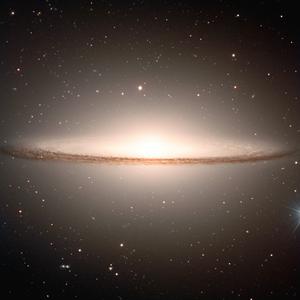
Galáxia do Sombrero
imagem
Legenda: Esta proeminente galáxia M 104 é frequentemente chamada de galáxia Sombrero devido à sua semelhança com o chapéu mexicano. Este aspecto é criado pelo disco fino visto quase de perfil, que parece iluminado pelo bojo dominante. Tanto o disco quanto o bojo possuem estrelas, mas as estrelas do bojo tendem a ser mais antigas, enquanto o disco também abriga grandes quantidades de poeira e gás, criando regiões sobreadas. A M 104 está localizada na constelação de Virgem, a aproximadamente 50 anos-luz de distância. Embora alguns dos pontos visíveis na imagem sejam estrelas em primeiro plano e outros galáxias ao fundo, a maioria são, na verdade, aglomerados globulares, aglomerados densos e massivos de estrelas, associados à Galáxia Sombrero.
Crédito: ESO/P. Barthel
Link do crédito
Termos do Glossário:
Disco Galaxy , Galáxia
Categorias
Galáxias
Licença: Creative Commons Attribution 4.0 International (CC BY 4.0) Creative Commons Attribution 4.0 International (CC BY 4.0) ícones
Arquivo
( imagem
4.93 MB)
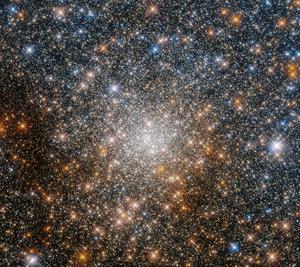
Estrelas em aglomerados globulares próximos ao centro da Via Láctea
imagem
Legenda: Esta imagem do Telescópio Espacial Hubble apresenta uma visão do interior do denso aglomerado globular Terzan 9, que consiste em milhões de estrelas localizadas perto do centro da nossa galáxia, a Via Láctea. Esse aglomerado globular situa-se no bojo galáctico central, em meio à poeira interestelar, que obscurece a luz promeniente destes aglomerados estelares. Esta imagem é uma combinação da luz visível e infravermelha do espectro eletromagnético. Imagens em vários comprimentos de onda da cor e do brilho das estrelas ajuda a determinar sua idade e, por sua vez, a idade do aglomerado estelar ao qual pertencem.
Crédito: ESA/Hubble & NASA, R. Cohen
Link do crédito
Termos do Glossário:
Aglomerado , Aglomerado Globular , Aglomerado de estrelas
Categorias
Estrelas
Licença: Domínio Público Domínio Público ícones
Arquivo
( imagem
403.47 kB)





