Documentos e recursos — Resultados da busca
Resultados da busca
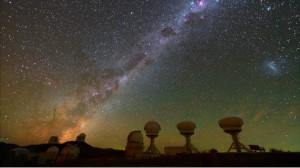
Southern Sky Over La Silla
vídeo
Criado para o OAE
Legenda: First place winner in the 2023 IAU OAE Astrophotography Contest, category of Time-lapses of rotation of Big Dipper or Southern Cross.
This video shows the Milky Way’s sprawling brilliance across the celestial expanse. Among the stars’ grand theatre, the Southern Cross constellation claims its place in the scene, distinguished by its distinctive cross shape as seen in the top of this video and slightly to the right just over the Milky Way, slowly disappearing as the video progresses. This celestial marker, a prominent feature in the southern hemisphere, holds cultural and navigational significance, having served as a navigational guidepost for centuries. Accompanying the Milky Way’s grandeur are the two Magellanic clouds, celestial companions seen dancing in the distant sky. The Carina Nebula adds its ethereal glow to the cosmic panorama, painting a radiant hue against the darkness. In the midst of this celestial ballet, a gentle green hue envelops the atmosphere, a phenomenon known as airglow, adding a touch of subtle luminescence to the night sky. The terrestrial also makes an appearance, with planes flying overhead and vehicles driving between observatory buildings. This time-lapse, taken from the La Silla Observatory in Chile, is a window to the captivating dance of stars, offering a glimpse into the awe-inspiring beauty of our galaxy and the celestial landmarks that grace the southern sky.
Crédito: José Rodrigues/IAU OAE (CC BY 4.0)
Termos do Glossário:
Polo Celeste , Esfera Celeste , Rotação da Terra , Observação , Céu , Cruzeiro do Sul
Categorias
Astronomia a Olho Nu
Tags:
astrophotography
Licença: Creative Commons Attribution 4.0 International (CC BY 4.0) Creative Commons Attribution 4.0 International (CC BY 4.0) ícones
Este arquivo no Zenodo ( vídeo 1.07 GB)
Between Two Skies
imagem
Criado para o OAE
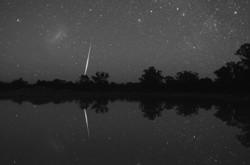
Legenda: Honourable mention in the 2022 IAU OAE Astrophotography Contest, category Still images of celestial patterns.
Taken from Narrabri, Australia, in April 2014, this photograph shows a meteor next to the Large Magellanic Cloud and the reflection of all this in the water.
The Magellanic Clouds are named after the Portuguese explorer Ferdinand Magellan, who made the first maps of the southern part of South America in the early 16th century but did not survive his expedition voyage. His shipmates called the two nebulae after him, and it was only in the 20th century that astronomy research discovered that they are in fact dwarf galaxies accompanying our own.
In the 18th century, the French mathematician J-N. Lacaille, who lived in South Africa for some years in order to draw maps of the sky and the land, invented some new constellations. He measured the positions of some faint stars and listed them in his star catalogue, but did not try to overlay beautiful drawings of real-world objects on the star patterns, so he could name them however he wanted. He was based in the trade station that is now the city of Cape Town and, from this bay, Table Mountain is visible. Lacaille learned from the navigators that they used the clouds around this mountain to predict whether or not the wind would blow in the correct direction and allow for sailing. Normally, there is a huge white cloud at the top of Table Mountain, so Lacaille considered the larger one of the two dwarf galaxies not a “Magellanic Cloud”, but the cloud at Table Mountain. Consequently, he invented the constellation “Mensa”, Table Mountain, in the small area of faint stars directly attached to this dwarf galaxy.
Crédito: Fabrizio Melandri/IAU OAE
Termos do Glossário:
Constelação , Estrela cadente , Grande Nuvem de Magalhães (LMC) , Pequena Nuvem de Magalhães (SMC)
Categorias
Galáxias
, Astronomia a Olho Nu
Licença: Creative Commons Attribution 4.0 International (CC BY 4.0) Creative Commons Attribution 4.0 International (CC BY 4.0) ícones
Este arquivo no Zenodo ( imagem 1.82 MB)

The Milky Way Over Anglers Reach
imagem
Criado para o OAE
Legenda: Winner in the 2022 IAU OAE Astrophotography Contest, category Still images of celestial patterns.
The Milky Way and several astronomical objects are seen in this image taken from the southern hemisphere, in Anglers Reach, Australia, in April 2022.
On the bottom-left side we can identify the constellation Scorpius with its brightest star, Antares, the reddish spot just above the arc. Some prominent but small southern constellations can also be seen: the dominating bright stars in the middle-left of the image in the Milky Way are the four bright stars of Crux (the Southern Cross) and to its left the two pointer stars, alpha and beta Centauri. Crux points towards the southern celestial pole, which is not marked by a bright star, and The pointer stars point towards Crux, distinguishing it from the asterism of the False Cross in the constellation Argo.
Crux features on the national flags of Australia, Brazil, Papua New Guinea, Samoa and New Zealand. As Crux lies in the brightest parts of the Milky Way, the dark cloud of the famous Coalsack Nebula is prominent next to the bright stars. It forms one of the dark constellations in South American, South African and Australian indigenous cultures. The huge Australian dark constellation of the Emu is almost completely above the horizon in this image, stretching from its head in the Coal Sack to the horizon.
In Greek antiquity, the stars of Crux also belonged to the constellation Centaurus, a hybrid creature with a human torso and head attached to a horse body with four legs. The Greek centaur represents Chiron, the wise teacher of all Greek heroes. Its brightest star is Rigil Kentaurus (Alpha Centauri), the front hoof of the centaur. Just below it, we find the small constellation Triangulum Australe. The triple star system of Alpha Centauri is our Sun’s nearest stellar neighbour.
Along the Milky Way in the middle-right of the picture we find the huge constellation Argo, the Ship. The smaller ancient constellation Argo was extended by Dutch navigators around 1600, and the number of stars in this constellation was then so big that the 18th-century French mathematician Lacaille needed to introduce subtitles for Argo in his star catalogue. In doing so, he invented the constellations Puppis, Carina and Vela. In Carina, the Keel of the ship, this reddish photograph clearly displays the Carina Nebula.
At the right edge of the image we can spot the brightest star in the night sky, Sirius, while the second brightest star, Canopus, the rudder of Argo, the Ship, dominates the area under the arch of the Milky Way.
Also below the Milky Way arc, we can see the Large Magellanic Cloud and the Small Magellanic Cloud, which are small satellite galaxies of our own Galaxy.
Crédito: Lucy Yunxi Hu/IAU OAE
Termos do Glossário:
Cor , Poeira , Via Láctea , Escorpião , Cruzeiro do Sul , Nuvem de poeira , Extinção interestelar , Grande Nuvem de Magalhães (LMC) , Pequena Nuvem de Magalhães (SMC) , Alpha Centauri
Categorias
Galáxias
, Via Láctea e Meio Interestelar
, Astronomia a Olho Nu
Licença: Creative Commons Attribution 4.0 International (CC BY 4.0) Creative Commons Attribution 4.0 International (CC BY 4.0) ícones
Este arquivo no Zenodo ( imagem 9.39 MB)

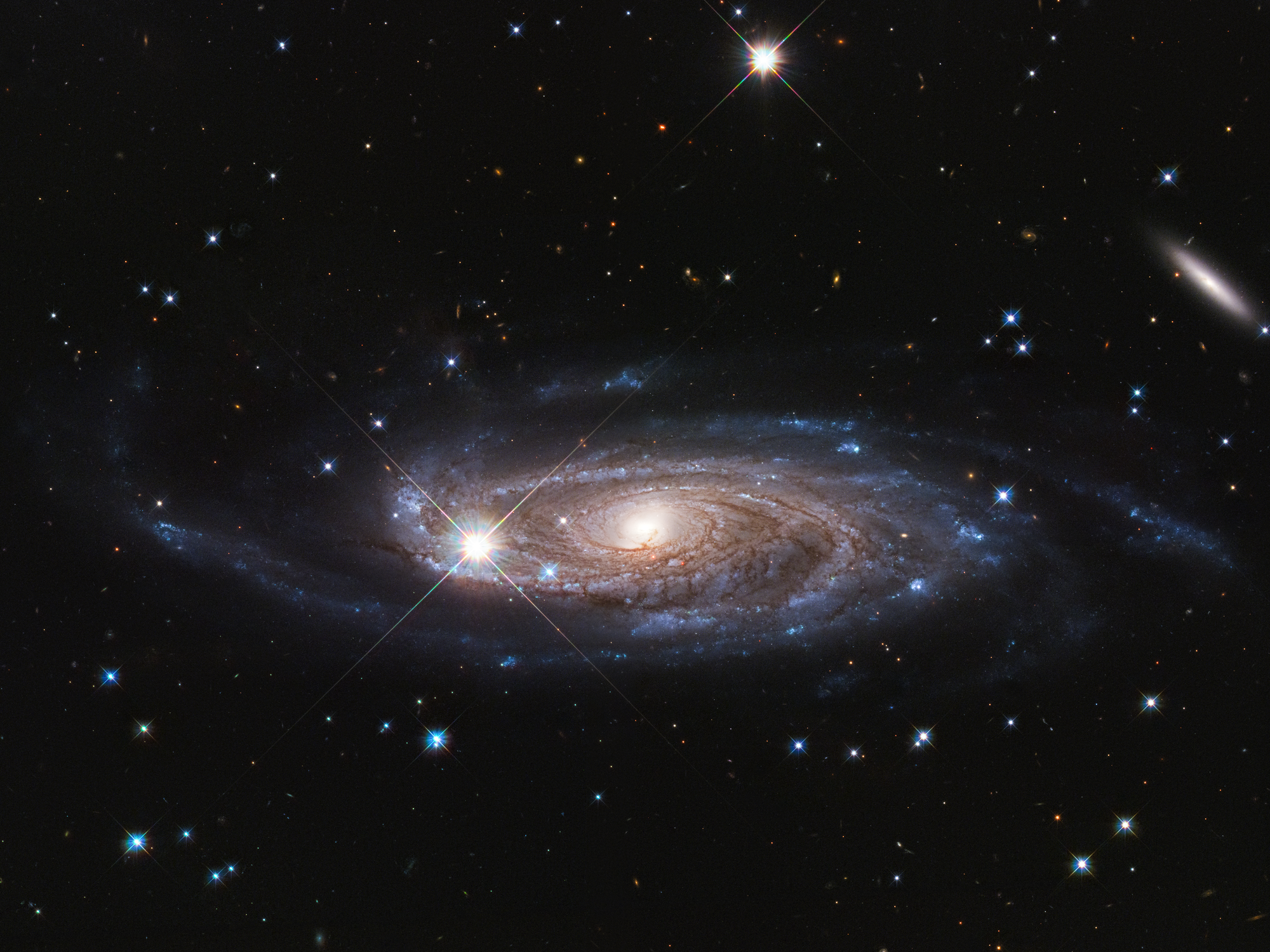
Galáxia espiral UGC 2885
imagem
Legenda: Esta imagem mostra a UGC 2885, uma galáxia espiral localizada na constelação de Perseus, a cerca de 230 milhões de anos-luz da Terra. As galáxias espirais possuem discos rotativos compostos por estrelas, gás e poeira, com braços espirais que se estendem a partir da região central. Em UGC 2885, esses braços são muito largos e fracos, revelando o grande tamanho da galáxia. Esta galáxia está inclinada em relação ao observador na Terra, o que significa que não aparece como a espiral circular de “bem efinida” que veríamos se fosse observada de frente, nem como uma linha fina com um bojo central caso fosse observada de prfil.
UGC 2885 é notável porque possui aproximadamente o dobro do diâmetro da Via Láctea. Ela foi estudada pela astrônoma Vera Rubin, cujas observações sobre como as galáxias giram — incluindo sistemas como este — desempenharam um papel fundamental na busca pela matéria escura. A estrela brilhante que aparece à esquerda do centro da galáxia é um objeto em primeiro plano não relacionado à galáxia.
Crédito: NASA, ESA, Benne Holwerda (Universidade de Louisville)
Link do crédito
Termos do Glossário:
Disco Galaxy , Galáxia espiral
Licença: Domínio Público Domínio Público ícones
Arquivo
( imagem
4.87 MB)

3D Universe: the Milky Way and friends atividade educacional astroEDU (link para o site do astroEDU) Origem: astroEDU Descrição: Use tactile models printed in 3D to explore our galactic neighborhood.
Termos do Glossário:
Galáxia de Andrômeda , Galáxia , Nuvens de Magalhães , Grande Nuvem de Magalhães (LMC) , Pequena Nuvem de Magalhães (SMC)
Categorias
Galáxias
, Física
Faixas etárias:
10-12
, 12-14
, 14-16
, 16-19
, 19+
Nível de ensino:
Ensino fundamental
, Médio
, Universidade
Áreas de aprendizagem:
Aprendizagem por descoberta guiada
, Aula interativa
, Modelagem
Custos:
Custo médio
Duração:
1 hour
Tamanho do grupo:
Grupo
Habilidades:
Analisar e interpretar dados
, Desenvolver e usar modelos
Autores Amelia Ortiz-Gil, Emilio Terol, Alberto Fernández-So
Licença: Creative Commons Attribution 4.0 International (CC BY 4.0) Creative Commons Attribution 4.0 International (CC BY 4.0) ícones