Documentos e recursos — Resultados da busca
Resultados da busca
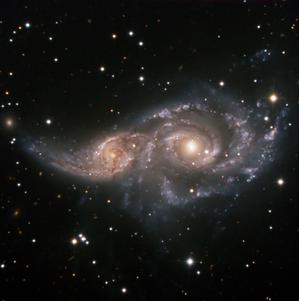
Fusão de galáxias espirais
imagem
Legenda: Esta imagem mostra duas galáxias espirais em interação, localizadas a aproximadamente 150 milhões de anos-luz de distância. As duas galáxias espirais estão envolvidas nesta dança, criando distorções visíveis em seus braços espirais devido à atração gravitacional. O que começa como um abraço nesta imagem terminará na fusão dessas duas galáxias em uma única galáxia, provavelmente elíptica.
Crédito: ESO
Link do crédito
Termos do Glossário:
Galáxia , Galáxia espiral
Categorias
Galáxias
Licença: Creative Commons Attribution 4.0 International (CC BY 4.0) Creative Commons Attribution 4.0 International (CC BY 4.0) ícones
Arquivo
( imagem
1.17 MB)
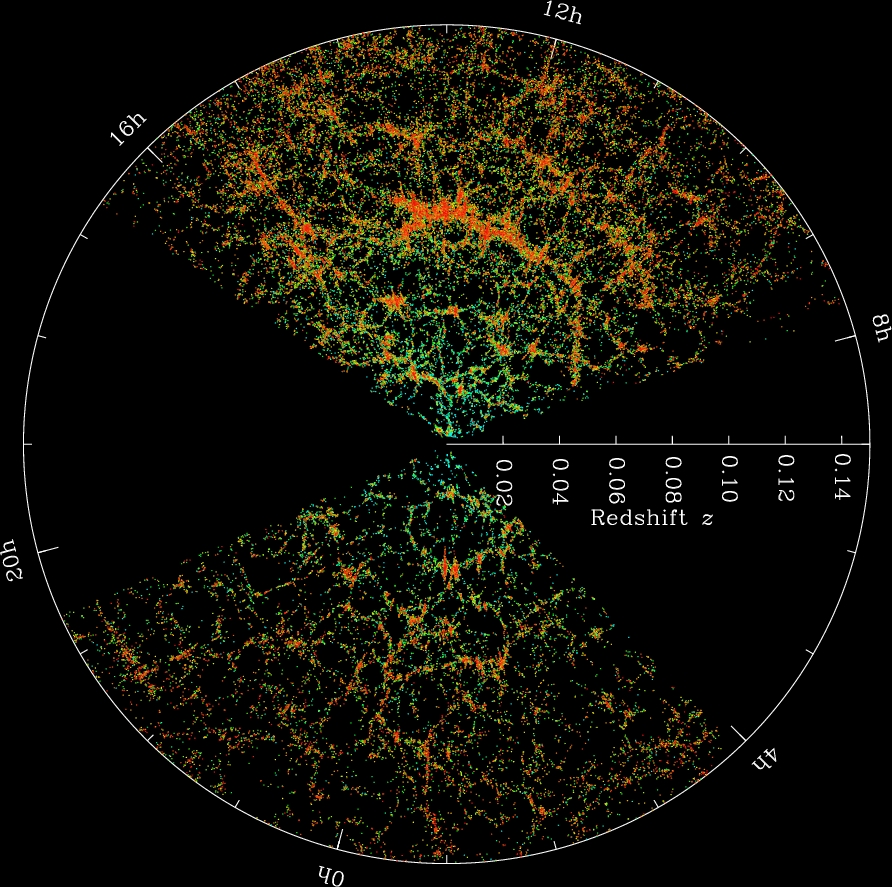
SDSS Redshift Map
imagem
Legenda: This image shows a map of the distribution of galaxies and is based on redshift data from the Sloan Digital Sky Survey (SDSS). Redshift measurements provides information on the distances, positions and motions of the galaxies.
The Earth is located at the center of the image, and each dot represents a galaxy. The outer circle represents a ""distance"" of about 2 billion light years. The idea of distance in cosmology is complex because the usual measurement of distance is the separation between two points in space at the same time. However, because of the speed of light, the further a distance, the farther back in time we are observing. The numbers on the outer circle are Right Ascension coordinates mapped onto a flat circle, and provides information on the position of the galaxies on the sky. The colours used represent the ages of the stars in the galaxies, the redder, more strongly clustered points represent galaxies comprising of older stars. The dark wedges that do not contain any dots are regions that were not mapped by the SDSS due to dust from the Milky Way galaxy obscuring the view.
Crédito: M. Blanton and Sloan Digital Sky Survey
Link do crédito
Termos do Glossário:
Matéria Escura , Desvio para o vermelho
Categorias
Cosmologia
Licença: Creative Commons Attribution 4.0 International (CC BY 4.0) Creative Commons Attribution 4.0 International (CC BY 4.0) ícones
Arquivo
( imagem
507.35 kB)