Documentos e recursos — Resultados da busca
Resultados da busca

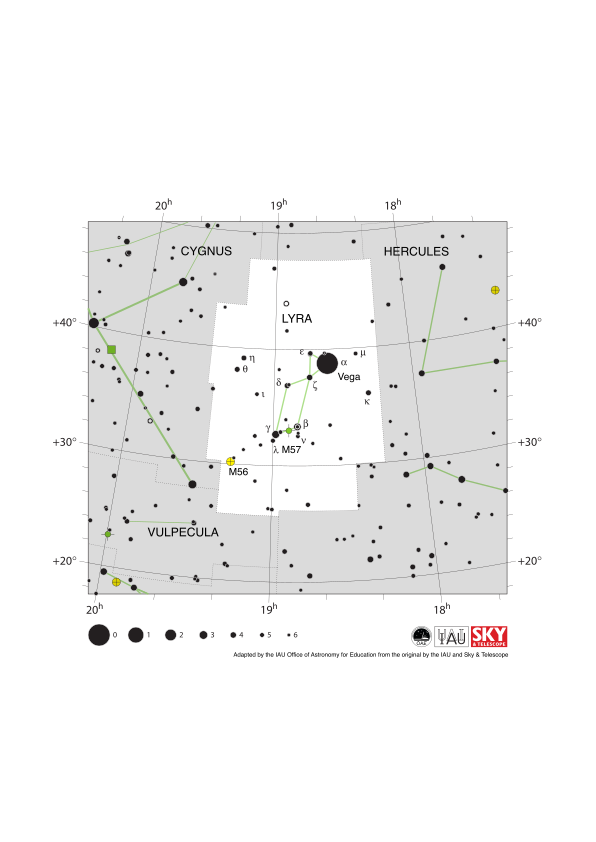
Lyra Constellation Map
imagem
Legenda: The constellation Lyra with its bright stars and surrounding constellations. Lyra is surrounded by (going clockwise from the top): Draco, Hercules, Vulpecula and Cygnus. Lyra is dominated by its brightest star Vega which is used to define the zero point of one of the most commonly used magnitude scales of stellar brightness. Vega forms one vertex of the prominent Summer Triangle asterism that is visible in northern hemisphere summer evenings.
Lyra is a northern constellation and thus is visible at some point in the year throughout the northern hemisphere. The whole constellation is also visible from all equatorial and some temperate regions of the southern hemisphere. Parts of the constellation are visible from the remaining southern temperate areas. Lyra is best viewed in the evenings in the northern hemisphere summer and southern hemisphere winter.
The famous planetary nebula M57, commonly known as the Ring Nebula, lies in Lyra. It is marked here with a green circle superimposed on a plus sign. The globular cluster M56 also lies in Lyra and is marked here with a yellow circle with a plus sign superimposed on it.
The y-axis of this diagram is in degrees of declination with north as up and the x-axis is in hours of right ascension with east to the left. The sizes of the stars marked here relate to the star's apparent magnitude, a measure of its apparent brightness. The larger dots represent brighter stars. The Greek letters mark the brightest stars in the constellation. These are ranked by brightness with the brightest star being labeled alpha, the second brightest beta, etc., although this ordering is not always followed exactly. The dotted boundary lines mark the IAU's boundaries of the constellations and the solid green lines mark one of the common forms used to represent the figures of the constellations. Neither the constellation boundaries, nor the lines joining the stars appear on the sky.
Crédito: Adapted by the IAU Office of Astronomy for Education from the original by the IAU and Sky & Telescope
Link do crédito
Termos do Glossário:
Magnitude aparente , Coordenadas celestes , Constelação , Declinação , Aglomerado Globular , Nebulosa Planetária , Ascensão Reta (AR) , Asterismo
Categorias
Astronomia a Olho Nu
Licença: Creative Commons Attribution 4.0 International (CC BY 4.0) Creative Commons Attribution 4.0 International (CC BY 4.0) ícones
Arquivo
( imagem
81.99 kB)
Arquivo PDF
(PDF file
160.41 kB)
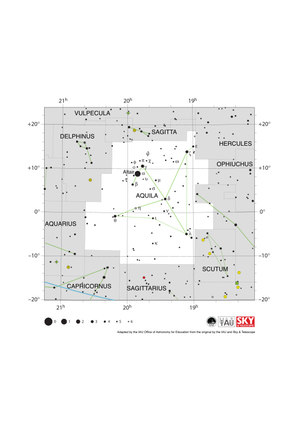
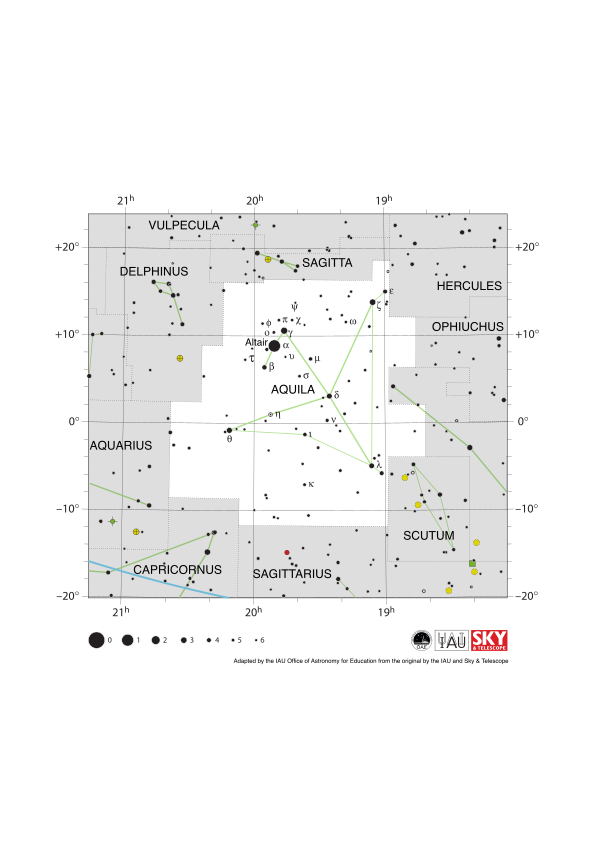
Aquila Constellation Map
imagem
Legenda: The constellation Aquila with its bright stars and surrounding constellations. Aquila is surrounded by (going clockwise from the top): Sagitta, Hercules, Ophiuchus, Serpens Cauda, Scutum, Sagittarius, Capricornus, Aquarius and Delphinus. Aquila is most notable for its brightest star Altair. This forms one vertex of the prominent Summer Triangle asterism that is visible in northern hemisphere summer evenings.
Aquila spans the celestial equator and thus some part of it is visible from all of the Earth at some point in the year. It is most visible in the evenings in the late northern hemisphere summer and late southern hemisphere winter.
The y-axis of this diagram is in degrees of declination with north as up and the x-axis is in hours of right ascension with east to the left. The sizes of the stars marked here relate to the star's apparent magnitude, a measure of its apparent brightness. The larger dots represent brighter stars. The Greek letters mark the brightest stars in the constellation. These are ranked by brightness with the brightest star being labeled alpha, the second brightest beta, etc., although this ordering is not always followed exactly. The dotted boundary lines mark the IAU's boundaries of the constellations and the solid green lines mark one of the common forms used to represent the figures of the constellations. The blue line in the lower right of the diagram is the ecliptic. Neither the constellation boundaries, nor the line marking the ecliptic, nor the lines joining the stars appear on the sky.
Crédito: Adapted by the IAU Office of Astronomy for Education from the original by IAU/Sky & Telescope
Link do crédito
Termos do Glossário:
Magnitude aparente , Capricórnio , Coordenadas celestes , Equador Celeste , Constelação , Declinação , Eclíptica , Ascensão Reta (AR) , Aquário , Asterismo
Categorias
Astronomia a Olho Nu
Licença: Creative Commons Attribution 4.0 International (CC BY 4.0) Creative Commons Attribution 4.0 International (CC BY 4.0) ícones
Arquivo
( imagem
95.28 kB)
Arquivo PDF
(PDF file
175.09 kB)
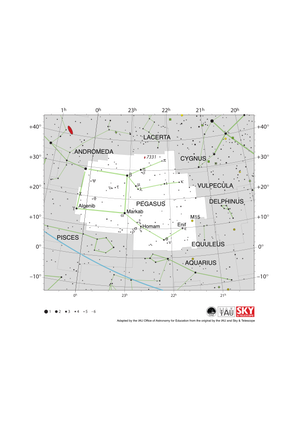
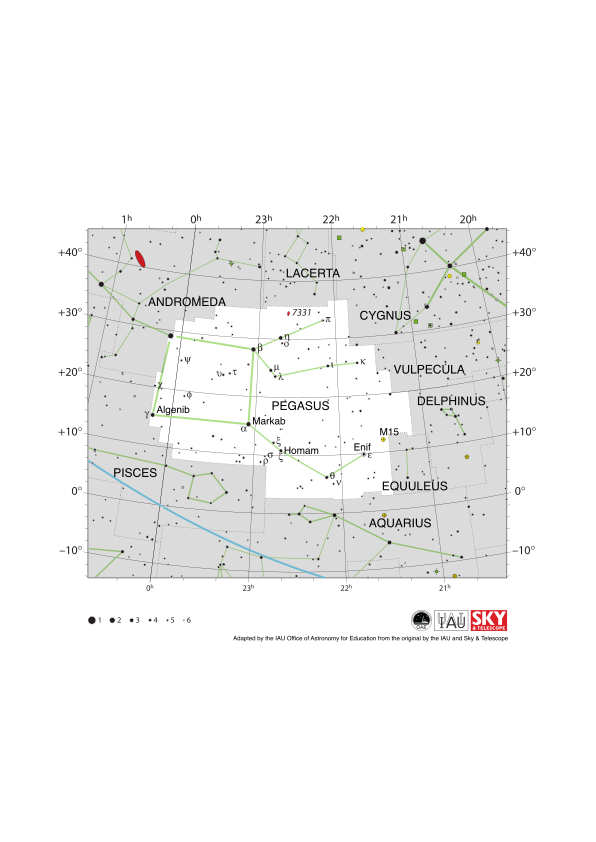
Pegasus Constellation Map
imagem
Legenda: The constellation Pegasus with its bright stars and surrounding constellations. Pegasus is surrounded by (going clockwise from the top): Lacerta, Cygnus, Vulpecula, Delphinus, Equuleus, Aquarius, Pisces and Andromeda. Pegasus is known for the prominent asterism the “Square of Pegasus” which consists of its three brightest stars plus the brightest star in Andromeda.
Pegasus is a northern constellation and thus the whole constellation is visible at some point in the year throughout the northern hemisphere. The whole constellation is also visible to southern hemisphere equatorial and temperate zones with parts of the constellation visible from all but the most antarctic regions. Pegasus is best viewed in the evening in the northern hemisphere autumn and southern hemisphere spring.
The globular cluster M15 lies in Pegasus and is marked here with a yellow circle with a plus sign superimposed on it. The spiral galaxy NGC 7331 also lies in Pegasus and is marked here with a red ellipse.
The y-axis of this diagram is in degrees of declination with north as up and the x-axis is in hours of right ascension with east to the left. The sizes of the stars marked here relate to the star's apparent magnitude, a measure of its apparent brightness. The larger dots represent brighter stars. The Greek letters mark the brightest stars in the constellation. These are ranked by brightness with the brightest star being labeled alpha, the second brightest beta, etc., although this ordering is not always followed exactly. The dotted boundary lines mark the IAU's boundaries of the constellations and the solid green lines mark one of the common forms used to represent the figures of the constellations. The blue line at the bottom of the diagram marks the ecliptic. Neither the constellation boundaries, nor the lines joining the stars, nor the ecliptic, appear on the sky.
Crédito: Adapted by the IAU Office of Astronomy for Education from the original by the IAU and Sky & Telescope
Link do crédito
Termos do Glossário:
Andrômeda , Magnitude aparente , Coordenadas celestes , Constelação , Declinação , Eclíptica , Aglomerado Globular , Peixes , Ascensão Reta (AR) , Galáxia espiral , Aquário , Asterismo
Categorias
Astronomia a Olho Nu
Licença: Creative Commons Attribution 4.0 International (CC BY 4.0) Creative Commons Attribution 4.0 International (CC BY 4.0) ícones
Arquivo
( imagem
122.04 kB)
Arquivo PDF
(PDF file
213.33 kB)
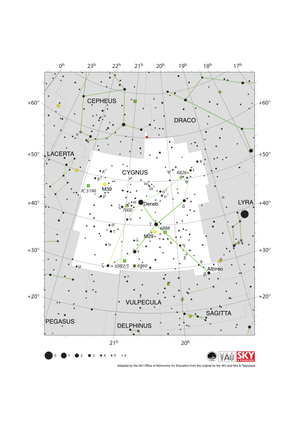
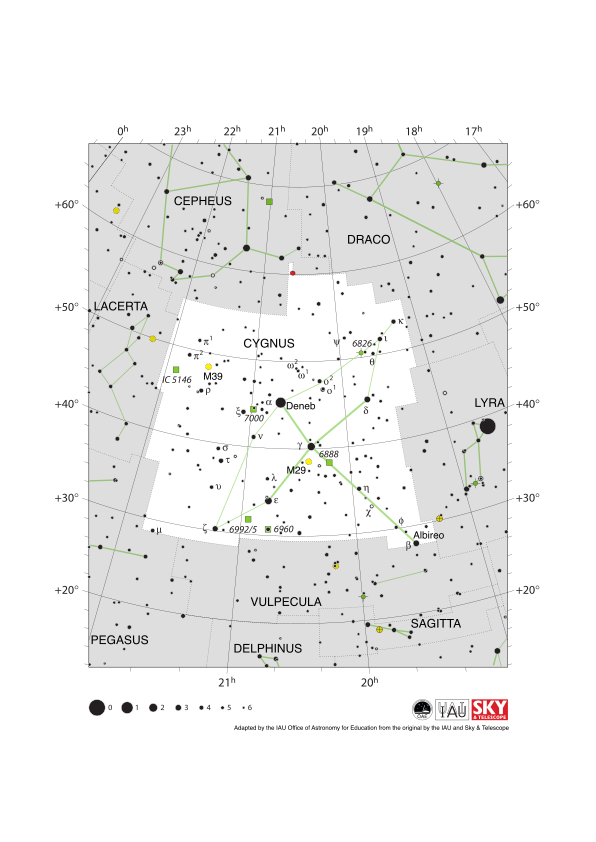
Cygnus Constellation Map
imagem
Legenda: The constellation Cygnus with its bright stars and surrounding constellations. Cygnus is surrounded by (going clockwise from the top): Cepheus, Draco, Lyra, Vulpecula, Pegasus and Lacerta. Cygnus is notable for its brightest star Deneb. This forms one vertex of the prominent Summer Triangle asterism that is visible in northern hemisphere summer evenings.
Cygnus is a northern constellation and thus the whole of the constellation is visible at some point in the year in the whole northern hemisphere. The whole constellation is also visible from equatorial regions of the southern hemisphere with parts of the constellation visible from temperate southern regions.
The plane of the Milky Way runs through Cygnus and thus the constellation is rich in nebulae and star clusters. These include the North America Nebula (NGC 7000) and the Crescent Nebula (NGC 6888). The Veil Nebula is a huge supernova remnant, parts of which are marked here as NGC 6960 and NGC 6992/5. All of the previously-mentioned nebulae are marked with green squares. The planetary nebula NGC 6826 is marked here with a green circle superimposed on a plus sign. The open star clusters M29 and M39 are marked here with yellow circles.
The y-axis of this diagram is in degrees of declination with north as up and the x-axis is in hours of right ascension with east to the left. The sizes of the stars marked here relate to the star's apparent magnitude, a measure of its apparent brightness. The larger dots represent brighter stars. The Greek letters mark the brightest stars in the constellation. These are ranked by brightness with the brightest star being labeled alpha, the second brightest beta, etc., although this ordering is not always followed exactly. The dotted boundary lines mark the IAU's boundaries of the constellations and the solid green lines mark one of the common forms used to represent the figures of the constellations. Neither the constellation boundaries, nor the lines joining the stars appear on the sky.
Crédito: Adapted by the IAU Office of Astronomy for Education from the original by the IAU and Sky & Telescope
Link do crédito
Termos do Glossário:
Magnitude aparente , Coordenadas celestes , Constelação , Declinação , Via Láctea , Nebulosa , Nebulosa Planetária , Ascensão Reta (AR) , Asterismo , Aglomerado aberto , Remanescente de supernova
Categorias
Astronomia a Olho Nu
Licença: Creative Commons Attribution 4.0 International (CC BY 4.0) Creative Commons Attribution 4.0 International (CC BY 4.0) ícones
Arquivo
( imagem
150.09 kB)
Arquivo PDF
(PDF file
216.56 kB)

Ursa Major Constellation Map
imagem
Legenda: The constellation Ursa Major along with its bright stars and its surrounding constellations. Ursa Major is surrounded by (going clockwise from the top): Draco, Camelopardalis, Lynx, Leo Minor, Leo, Coma Berenices, Canes Venatici and Boötes. Ursa Major is famous for the prominent asterism often known in English as the Big Dipper or the Plough. This prominent northern asterism has a wide variety of names from cultures across the world. While most constellations and asterisms are made up of unrelated stars that randomly appear close together on the sky, five of the stars in the Big Dipper are part of the Ursa Major Moving Group, a group of stars moving through space together that likely formed in the same location 300 million years ago. The two stars on the right-hand end of the Big Dipper on this diagram form a pair of pointer stars that can be used to locate Polaris, the northern pole star which lies in the constellation of Ursa Minor.
Ursa Major is a northern constellation and is visible from northern and equatorial regions. Parts of the constellation are visible from all but the most antarctic parts of the southern hemisphere but not all temperate regions of the southern hemisphere can see all of the Big Dipper. Conversely the Big Dipper and much of the rest of the constellation are circumpolar in arctic and many temperate regions of the northern hemisphere. Ursa Major is most visible in the evening in the northern hemisphere spring and southern hemisphere autumn.
Two prominent galaxies appear in the northern part of this constellation, the spiral galaxy M81 and M82, a possible spiral galaxy whose structure is difficult to observe from the Earth as it appears edge-on. Both are shown here as red ellipses. The planetary nebula M97 (the Owl Nebula) lies in the middle of the constellation and is marked by a green circle superimposed on a plus symbol.
The y-axis of this diagram is in degrees of declination with north as up and the x-axis is in hours of right ascension with east to the left. The sizes of the stars marked here relate to the star's apparent magnitude, a measure of its apparent brightness. The larger dots represent brighter stars. The Greek letters mark the brightest stars in the constellation. These are ranked by brightness with the brightest star being labeled alpha, the second brightest beta, etc., although this ordering is not always followed exactly. The dotted boundary lines mark the IAU's boundaries of the constellations and the solid green lines mark one of the common forms used to represent the figures of the constellations. Neither the constellation boundaries, nor the lines joining the stars appear on the sky.
Crédito: Adapted by the IAU Office of Astronomy for Education from the original by IAU/Sky & Telescope
Link do crédito
Termos do Glossário:
Magnitude aparente , A Grande Concha (Big Dipper, em inglês) , Coordenadas celestes , Estrelas circumpolares , Constelação , Declinação , Leo , Nebulosa Planetária , Ascensão Reta (AR) , Galáxia espiral , Asterismo
Categorias
Astronomia a Olho Nu
Licença: Creative Commons Attribution 4.0 International (CC BY 4.0) Creative Commons Attribution 4.0 International (CC BY 4.0) ícones
Arquivo
( imagem
143.67 kB)
Arquivo PDF
(PDF file
215.83 kB)