Documentos e recursos — Resultados da busca
Resultados da busca

A visão de Herschel de novas estrelas e nuvens moleculares
imagem
Legenda: Esta imagem mostra as regiões de formação estelar Westerhout 3, 4 e 5. Essa área contém enormes quantidades de gás e poeira. Esse gás e poeira ocultam os processos físicos que ocorrem nesta região de estudos que utilizam luz visível. Esta imagem foi captada em luz infravermelha pelo Observatório Espacial Herschel. Essa radiação infravermelha permitiu que o Herschel observasse profundamente o interior dessas regiões de formação estelar.
Em Westerhout 3, 4 e 5, enormes nuvens frias de hidrogênio molecular colapsaram em nós e filamentos densos. Dentro dessas novas estruturas, o gás é denso e frio o suficiente para colapsar e formar estrelas. Essas novas estrelas emitem poderosos ventos de partículas carregadas, como versões mais fortes do vento solar que nosso Sol emite. Esses ventos se combinaram para soprar bolhas enormes no gás e poeira ao redor. Elas são visíveis como grandes vazios mais escuros na imagem.
Crédito: ESA/Herschel/NASA/JPL-Caltech; agradecimento: R. Hurt (JPL-Caltech)
Link do crédito
Termos do Glossário:
Astronomia infravermelha , Formação estelar , Meio interestelar , Nuvem Molecular , Vento Estelar
Categorias
Via Láctea e Meio Interestelar
, Estrelas
Licença: Creative Commons Attribution 3.0 IGO Creative Commons Attribution 3.0 IGO ícones
Arquivo
( imagem
4.53 MB)
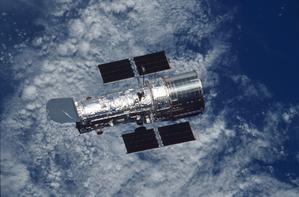
Telescópio Espacial Hubble sobre a Terra
imagem
Legenda: O Telescópio Espacial Hubble, da NASA/ESA, em órbita da Terra. Essa foto foi tirada pelos astronautas a bordo do ônibus espacial Columbia, logo após a Missão de Manutenção 3B do próprio telescópio espacial. O telescópio tem uma abertura que permite a entrada de luz (vista aqui à esquerda). A luz percorre a óptica do telescópio até chegar às câmeras e espectrógrafos localizados na outra extremidade do telescópio (visto aqui à direita). Os dados desses instrumentos são então enviados de volta à Terra por meio de uma antena. Os retângulos pretos em cada lado do observatório são os painéis solares que fornecem energia ao telescópio
Crédito: NASA/ESA
Link do crédito
Termos do Glossário:
Astronomia infravermelha , Observatório , Astronomia Óptica , Telescópio Espacial
Categorias
Telescópios, Instrumentos e Observatórios
Licença: Creative Commons Attribution 4.0 International (CC BY 4.0) Creative Commons Attribution 4.0 International (CC BY 4.0) ícones
Arquivo
( imagem
1.31 MB)
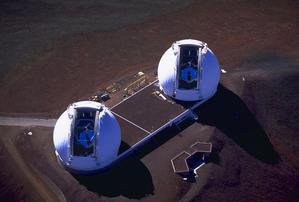
Telescópios Keck
imagem
Legenda: Os dois telescópios Keck em Mauna Kea, na ilha do Havaí. Esses dois telescópios são refletores com espelhos primários de 10 m de diâmetro.
Crédito: NASA/JPL
Link do crédito
Termos do Glossário:
Astronomia infravermelha , Observatório , Astronomia Óptica , Telescópio Refletor
Categorias
Telescópios, Instrumentos e Observatórios
Licença: Domínio Público Domínio Público ícones
Arquivo
( imagem
45.04 kB)

The Pillars of Creation in comparison
imagem
Legenda: The 'Pillars of Creation' are a renowned astronomical feature situated within the Eagle Nebula in the Serpens constellation. The illustration provides a direct comparison between images captured by the Hubble Space Telescope (HST) and the James Webb Space Telescope (JWST), showcasing the pillars, which span several light years in diameter, in both visible light (also known as optical light) and infrared light. On the left are the pillars as seen by Hubble in visual light, taken in 2014. It displays dark pillars against an opaque background, with only a handful of visible stars. Conversely, the counterpart on the right is Webb’s near-infrared view published in 2022, penetrating the dust and revealing numerous stars of varying sizes.
Their distance from Earth is approximately 6,500 to 7,000 light years. Within these pillars, new stars are constantly forming, making them a subject of extensive study by astronomers. Composed mostly of cool molecular hydrogen and small amounts of interstellar dust, they are subject to erosion by the intense ultraviolet radiation emitted by nearby massive and newborn stars, a process known as photoevaporation.
Crédito: NASA, ESA, CSA, STScI
Link do crédito
Termos do Glossário:
Astronomia infravermelha , Telescópio infravermelho , Astronomia Óptica , Formação estelar , Espectro visível , Nuvem de poeira
Categorias
Via Láctea e Meio Interestelar
, Estrelas
Licença: Creative Commons Attribution 2.0 Generic Creative Commons Attribution 2.0 Generic ícones
Arquivo
( imagem
12.03 MB)
Chilean observatories at home office, by Robert Barsa, Slovakia
imagem
Criado para o OAE
Legenda: Third place in the 2021 IAU OAE Astrophotography Contest, category Wide star fields.
This rich panoramic image shows a range of constellations, deep sky objects and planets. The brightest point of light with a pale reddish hue (left of center) is the planet Mars. In the bottom far left of the image, located just above the sloped roof of the building are two points of light appearing very close to each other, these are the planets Jupiter (brighter) and Saturn. To the far right of the image the two fuzzy cloud-like objects are the Large and Small Magellanic Clouds. These are satellite dwarf galaxies of the Milky Way located at a distance of approximately 160,000 and 200,000 light years, respectively. The Andromeda Galaxy, which is located at an approximate distance of 2.5 million light years, appears in this image as a small, angled smudge between Mars and the brightest glow on the horizon (closer to the horizon). The bright glow is not from the Sun or the Moon, but the city lights of San Pedro de Atacama.
Prominent constellations include: Orion – identified by the three stars forming Orion’s Belt; Taurus – a small triangle shaped collection of stars to the left of Orion and identified by the pale orange star (Aldebaran) at the vertex of the triangle; Canis Major – to the bottom right of Orion, identified by the bright star Sirius (the brightest star in the night sky) and three stars in the shape of a triangle just above the observatory dome in the foreground; Pegasus – identified by the trapezium shape diagonally below Mars. Other constellations include Andromeda, Perseus and Aries. Diverse cultures around the world have their own names and rich stories associated with these constellations and many others.
To the top right of Orion’s Belt is an angled line of stars (Orion’s Sword) within which is a pinkish smudge (looks like a fuzzy star when observed with the unaided eye) that is the Orion Nebula – a stellar nursery located 1500 light years from Earth – where stars are formed. To the left of Taurus is a compact fuzzy smudge, and that is the Pleiades star cluster. The variation in the colour of stars is the result of temperature of the stars, for example, the red orange star to the bottom left of Orion’s Belt is the red giant star Betelgeuse. Cooler stars appear redder, compared to the higher temperature white and bluish stars. The colours in the image are enhanced because of the higher sensitivity of the digital camera compared to the human eye.
Crédito: Robert Barsa/IAU OAE
Termos do Glossário:
Áries , Astronomia , Observatório
Categorias
Astronomia a Olho Nu
, Telescópios, Instrumentos e Observatórios
Licença: Creative Commons Attribution 4.0 International (CC BY 4.0) Creative Commons Attribution 4.0 International (CC BY 4.0) ícones
Este arquivo no Zenodo ( imagem 77.18 MB)





