Documentos e recursos — Resultados da busca
Resultados da busca

The Hunter in the Forest
imagem
Criado para o OAE
Legenda: Honourable mention in the 2022 IAU OAE Astrophotography Contest, category Still images of celestial patterns.
Taken in December 2016, this image shows a clear and starry sky over the Masaya Volcano National Park in Nicaragua.
The constellation Orion is the most prominent pattern in this image. Orion is associated with a great hunter according to Greek culture, and is seen here right in the middle. The reddish star in the centre is Betelgeuse, the second-brightest in this constellation and one of the brightest in the night sky. Above and to the right of Betelgeuse we find Bellatrix, another bright star, forming the right shoulder of the hunter. Extending a line from Bellatrix to the right, we find a crookedly aligned group of faint stars comprising Orion’s bow. We can also easily see a group of three aligned bright stars forming the belt of the hunter, an asterism recognised by many different cultures. Just below his belt we can see the silverish glittering that was interpreted as the metal of Orion’s sword or knife by the Greco-Roman tradition. It was alternatively interpreted as a fish roasted on a campfire by some cultures in Australia. In its centre, with binoculars we can see the Small and the Great Orion Nebula, together forming a giant cloud of dust and gas where new stars are being formed. To the lower-left of the silverish compound of tiny stars and nebulae, there is a bright star called Saiph, the Arabic term for “Sword” or “Sabre” because it was considered the tip of a huge knife with a curved upper part. To the right of this, there is the bright bluish star Rigel, an Arabic term which designates it as The Foot of Orion.
Orion’s Belt points up towards Aldebaran at the edge of the photograph and down towards Sirius among the branches of the trees; it is the brightest star in the night sky and is located in the constellation Canis Major. Earth’s atmosphere makes the bright Sirius twinkle in all colours. Seen from space it is pure white, but as its light travels through the air, it is scattered and distorted by the molecules. Therefore, the star appears to change colour like a diamond.
A line connecting the two shoulders of Orion points to another bright star in the lower-left corner of the photograph. This is Procyon, located in the constellation Canis Minor. Procyon has been used by the ancient Babylonians to indicate the heliacal rise of Cancer (whose stars are faint, and invisible in twilight) and to predict the rising of Sirius. Thus, for a very long time in ancient history Procyon was considered a single-star asterism. Perhaps only in Roman times were more stars used to create a constellation in this area of the sky, although this constellation has never been clearly recognisable.
Crédito: René Antonio Urroz Álvarez/IAU OAE
Termos do Glossário:
Constelação , Órion
Categorias
Astronomia a Olho Nu
, Estrelas
Licença: Creative Commons Attribution 4.0 International (CC BY 4.0) Creative Commons Attribution 4.0 International (CC BY 4.0) ícones
Este arquivo no Zenodo ( imagem 2.04 MB)
Warm Winter Night Over Spiš Region
imagem
Criado para o OAE
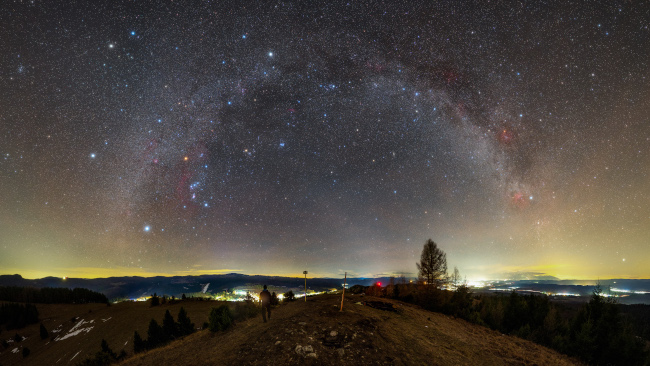
Legenda: Winner in the 2022 IAU OAE Astrophotography Contest, category Still images of celestial patterns.
This image, taken in Slovakia in January 2022, shows regions of the Milky Way and a rich variety of constellations. The summer constellations of the northern hemisphere are very low in the sky towards the bottom-right. The bright stars of Cygnus and Lyra shine through the artificial lights at the horizon. The huge array of northern winter and autumn constellations with many bright stars are associated with diverse cultural stories.
For the Lakota people in North America the belt of the Orion constellation represents the spine of a bison (“Tayamnicankh”). Orion, the Hunter of Greek mythology, is sometimes described chasing the Seven Sisters, the Pleiades. The Arabs transformed this view by considering the follower of the Pleiades only one star instead of a constellation. Aldebaran, the star in the right eye of Taurus, the Bull, comes from this interpretation, because the name Aldebaran derives from al-dabaran, The Follower.
At the bottom-right, on the horizon, we can see the milky lightcone of the Zodiacal light stretching from the constellation Pisces through Aries, almost reaching the Pleiades, indicating the path of the planets and the Moon in this area. The Pleiades and the Hyades together form a gate on this path, where the heavenly bodies occasionally pass before entering the Milky Way. The planets were considered sheep in ancient Babylon and the modern constellation Orion was considered the “True Shepherd” of the Sky, with his shepherd’s tool reaching the ecliptic. In Roman tradition, the bright white star above the Pleiades and the Milky Way is called Capella, the Goat, which can be traced back to an Egyptian constellation in this area.
Above the treetop in the middle-right part of the image, we see the autumn square, the Andromeda Galaxy and the W-shaped pattern of Cassiopeia. To the left of this group, in the central part of the visible Milky Way, is the constellation Perseus, with Cepheus in the dark area above Cassiopeia completing the celestial family. The Andromeda saga is a Greek story from the area that is now called Israel, and is rooted in Syrian traditions. The location of Andromeda was considered by the ancient Babylonians as the location of the goddess of sexual love, and by the Syrians as the location of the goddess of fertility. According to the saga, Andromeda was chained to a rock at the coast of Jaffa (Tel Aviv) in order to protect her land from a sea monster. The name of the hero who rescued her is Perseus, probably meaning “from Persia” (today’s Iran).
Noticeable in the valley are the lights from towns. The yellow light above the horizon indicates larger cities there, which are given away by their light pollution.
Crédito: Robert Barsa/IAU OAE
Termos do Glossário:
Constelação , Via Láctea , Peixes , Touro , Órion , Plêiades
Categorias
Via Láctea e Meio Interestelar
, Astronomia a Olho Nu
Licença: Creative Commons Attribution 4.0 International (CC BY 4.0) Creative Commons Attribution 4.0 International (CC BY 4.0) ícones
Este arquivo no Zenodo ( imagem 37.27 MB)
Most Brightest Stars of the Sky
imagem
Criado para o OAE
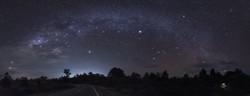
Legenda: Honourable mention in the 2022 IAU OAE Astrophotography Contest, category Still images of celestial patterns.
Taken in March 2016 in Bromo-Tengger-Semeru National Park, Java Island, Indonesia, this image shows the arch of the Milky Way and many prominent constellations, including many of the brightest stars in the night sky.
In the lower-left corner, we see Rigil Kentaurus and Hadar, the first one lower and the other higher up, both located in the large constellation Centaurus. As pointers they point towards Crux, the Southern Cross, whose long axis points towards the southern pole, which is located roughly at the horizon because the Island of Java is almost at the equator. Crux is almost entirely obscured by clouds, with only the four bright stars visible in the photograph. Confusingly, the asterism of the False Cross (consisting of stars in Argo, The Ship) is clearly prominent a bit further up the Milky Way.
The pinkish spot between the true and the False Cross is the Carina Nebula, located about 8500 light-years from Earth, in the constellation Carina, and invisible to the unaided eye. In Carina we can also find Canopus, the second-brightest star in the night sky, seen just below the Galaxy and above the road on the ground.
Even brighter is Sirius, the brightest star in the night sky. Sirius lies in the constellation Canis Major, The Great Dog, one of the dogs that follow Orion, the Hunter, who is depicted in the right half of this image, just above the clouds at the horizon. Orion’s Belt of three bright stars points to Sirius in the upper left and to Aldebaran in the lower right, just above the horizon.
Orion contains some of the brightest stars in the sky, making it the most colourful constellation as it hosts Rigel, the bright bluish star below the Galaxy toward the right, and Betelgeuse, the reddish bright star higher up and to the right of Rigel. Between them we find the three stars that comprise the belt of Orion, a famous asterism. Just next to the belt we find the Great Orion Nebula, a star-forming region whose bright centre is visible to the unaided eye and also in this image.
Above Betelgeuse but on the opposite side of the Galaxy, we see the bright star Procyon, whose name means literally “Before the Dog”. It is mythologically often considered a tiny one-star dog asterism accompanying Orion, and transformed into the modern constellation of Canis Minor.
In the upper-right corner, the Beehive Star Cluster in the constellation Cancer is easily recognisable. Below it, we find the constellation Gemini with the stars Pollux and Castor, which are not prominent in this image. In contrast, the bright white star Capella in the constellation Auriga, the Charioteer, shines through the clouds at the middle-right edge of the image.
Some light pollution is visible along the road.
Crédito: Giorgia Hofer/IAU OAE
Termos do Glossário:
Constelação , Gêmeos , Via Láctea , Cruzeiro do Sul , Câncer , Órion , Alpha Centauri
Categorias
Via Láctea e Meio Interestelar
, Astronomia a Olho Nu
Licença: Creative Commons Attribution 4.0 International (CC BY 4.0) Creative Commons Attribution 4.0 International (CC BY 4.0) ícones
Este arquivo no Zenodo ( imagem 12.70 MB)

Winter Constellations
vídeo
Criado para o OAE
Legenda: Second place in the 2022 IAU OAE Astrophotography Contest, category Time lapses of celestial patterns.
Sirius, the brightest star in the night sky, is shown rising, setting and passing by. Sometimes constellations and asterisms are also visible, including Orion, Taurus and the Pleiades. In the first scene, the aforementioned constellations are covered by a semi-transparent golden veil. The next scenes show it rising in a dark blue night sky. In one of the scenes, a planet brightly decorates the faint constellation Pisces.
The videos were taken above various landscapes and places of cultural heritage on Earth. Some of them simply show monuments in the desert, while others show palm trees with waving leaves.
Crédito: Amirreza Kamkar/IAU OAE
Termos do Glossário:
Constelação , Sirius , Touro , Órion , Plêiades
Licença: Creative Commons Attribution 4.0 International (CC BY 4.0) Creative Commons Attribution 4.0 International (CC BY 4.0) ícones
Este arquivo no Zenodo ( vídeo 200.21 MB)

The Kingdom of Orion
imagem
Criado para o OAE
Legenda: Winner in the 2022 IAU OAE Astrophotography Contest, category Still images of celestial patterns.
This image, taken in January 2022, pictures a landscape from Navarra, a province in the north of Spain with ruins from old civilizations in the foreground. Above that, we see a partially cloudy and starry sky with the most prominent stars belonging to the star pattern Orion. Composed of many bright stars with several interesting deep sky objects within its boundaries, Orion is one of the 88 officially recognised IAU constellations. It originates from Greek mythology where the hero Orion is the son of the sea god Poseidon. Orion is characterised as a giant hunter lurking just before he attacks an animal (it is unclear which animal he attacks, but, in the original Babylonian version of the Gilgamesh saga, it is the Bull of Heaven depicted as the constellation Taurus). The modern planetarium interpretation depicts him as a Roman warrior raising up his shield, but the two accompanying dogs, represented by the constellations of Canis Major and Canis Minor, are reminiscent of the Greek hunter.
Located at the celestial equator, the star pattern is visible all over the world and is interpreted differently in various mythologies, for example as three fishermen at a campfire in parts of Australia, as a butterfly in some parts of Africa, and as a stairway for the souls of ancestors in parts of South America. As Spain belonged to the Roman empire, the original constellations from earlier times are not known. There are some cave paintings on the Iberian peninsula that could possibly have astronomical references. However, there is uncertainty as to whether these painted figures on rocks depict star patterns.
Orion is best visible from November to January. Its most recognisable feature is the “belt”, an asterism composed of three bright, aligned stars (Alnitak, Alnilam and Mintaka), also recognised by different cultures. Just below this belt is the Orion Nebula, a famous and widely studied star-forming region located about 1500 light-years from Earth. The constellation's brightest stars are Rigel — a blue supergiant which is one of the brightest stars in the sky — and Betelgeuse — a massive red supergiant. The former serves as the left foot, and the latter as the right shoulder of the hunter. While Rigel is in the middle of its life, Betelgeuse is expected to explode within the next few tens of thousands of years. The Orionids, a meteor shower with typical rates of dozens of meteors per hour, whose parent body is Halley’s Comet, can be seen every year in the area of Orion, next to the border with the constellation of Gemini during the month of October.
Crédito: Carlos Zudaire/IAU OAE
Termos do Glossário:
Constelação , Supergigante Vermelha , Órion
Categorias
Astronomia a Olho Nu
, Estrelas
Licença: Creative Commons Attribution 4.0 International (CC BY 4.0) Creative Commons Attribution 4.0 International (CC BY 4.0) ícones
Este arquivo no Zenodo ( imagem 2.07 MB)


