Documentos e recursos — Resultados da busca
Resultados da busca

Mapa da Constelação de Cão Maior
imagem
Legenda: A constelação de Cão Maior com suas estrelas brilhantes e as constelações vizinhas. Cão Maior é cercada por (no sentido horário a partir do topo): Unicórnio, Lebre, Pomba e Popa. A constelação é dominada por Sirius, a estrela que aparece mais brilhante no céu noturno, que supera em muito todas as outras estrelas da constelação.
Cão Maior fica ao sul do equador celeste e é visível de todo o hemisfério sul, bem como das regiões equatoriais e temperadas do hemisfério norte. Sirius é visível de todas as regiões, com exceção das mais árticas. Cão Maior é mais visível à noite, no final do inverno no hemisfério norte e no final do verão no hemisfério sul.
Os aglomerados estelares abertos M41, NGC 2360 e NGC 2362 estão na constelação. Eles estão marcados com círculos amarelos.
O eixo y desse diagrama está em graus de declinação, com o norte para cima, e o eixo x está em horas de ascensão reta, com o leste à esquerda. Os tamanhos das estrelas marcadas aqui estão relacionados à magnitude aparente da estrela, uma medida de seu brilho aparente. Os pontos maiores representam estrelas mais brilhantes. As letras gregas marcam as estrelas mais brilhantes da constelação. Elas são classificadas por brilho, com a estrela mais brilhante sendo rotulada como alfa, a segunda mais brilhante como beta etc., embora essa ordem nem sempre seja seguida exatamente. As linhas de divisão pontilhadas marcam os limites das constelações da IAU e as linhas verdes sólidas marcam uma das formas comuns usadas para representar as figuras das constelações. Nem os limites da constelação nem as linhas que unem as estrelas aparecem no céu.
Crédito: Adaptado pelo Escritório de Astronomia para Educação da IAU a partir do original da IAU/Sky & Telescope
Link do crédito
Termos do Glossário:
Magnitude aparente , Coordenadas celestes , Equador Celeste , Constelação , Declinação , Ascensão Reta (AR) , Sirius , Aglomerado aberto
Categorias
Astronomia a Olho Nu
Licença: Creative Commons Attribution 4.0 International (CC BY 4.0) Creative Commons Attribution 4.0 International (CC BY 4.0) ícones
Arquivo
( imagem
115.73 kB)
Arquivo PDF
(PDF file
213.04 kB)
Octans Constellation Map
imagem
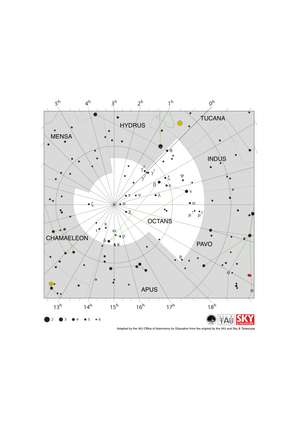
Legenda: The constellation Octans along with its bright stars and its surrounding constellations. Octans is surrounded by (going clockwise from the top): Hydrus, Indus, Pavo, Apus, Chameleon and Mensa. Octans is a relatively faint constellation that is notable as it lies at the south celestial pole. While the northern pole star is the relatively bright Polaris, sigma Octans, the southern pole star, is barely visible with the naked eye.
Octans lies at the south celestial pole and is thus visible from the whole southern hemisphere with some of the constellation visible from equatorial regions of the northern hemisphere. The constellation is circumpolar for most of the southern hemisphere. It is best viewed in the evening in the northern hemisphere autumn and southern hemisphere spring.
This diagram maps an area around the south celestial pole. Here lines of constant right ascension converge. The right ascension values of these lines (in hours) are marked on the x-axis above and below the diagram. The solid circle around the pole marks a line of -80° declination with the larger, incomplete circle to the right marking -70° declination. The sizes of the stars marked here relate to the star's apparent magnitude, a measure of its apparent brightness. The larger dots represent brighter stars. The Greek letters mark the brightest stars in the constellation. These are ranked by brightness with the brightest star being labeled alpha, the second brightest beta, etc., although this ordering is not always followed exactly. The dotted boundary lines mark the IAU's boundaries of the constellations and the solid green lines mark one of the common forms used to represent the figures of the constellations. Neither the constellation boundaries, nor the lines joining the stars appear on the sky.
Crédito: Adapted by the IAU Office of Astronomy for Education from the original by IAU/Sky & Telescope
Link do crédito
Termos do Glossário:
Magnitude aparente , Coordenadas celestes , Constelação , Declinação , Polaris , Ascensão Reta (AR) , Polo Celeste Sul (PCS)
Categorias
Astronomia a Olho Nu
Licença: Creative Commons Attribution 4.0 International (CC BY 4.0) Creative Commons Attribution 4.0 International (CC BY 4.0) ícones
Arquivo
( imagem
109.17 kB)
Arquivo PDF
(PDF file
161.98 kB)
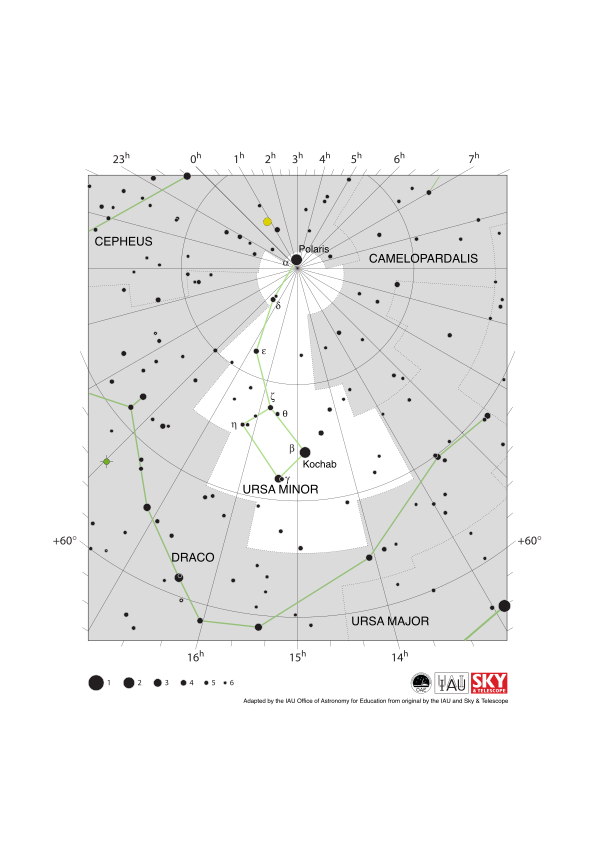
Ursa Minor Constellation Map
imagem
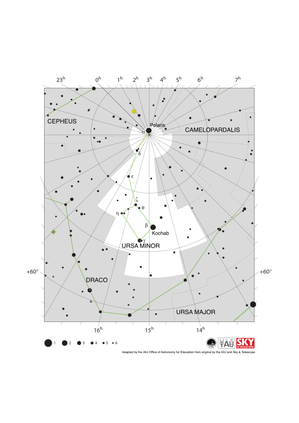
Legenda: The constellation Ursa Minor along with its bright stars and its surrounding constellations. Ursa Minor is surrounded by (going clockwise from the top): Cephus, Camelopardalis and Draco. Ursa Minor is notable as its brightest star, Polaris is the northern pole star.
Ursa Minor is visible from the entire northern hemisphere with some parts of the constellation being visible from equatorial regions of the southern hemisphere. It is also circumpolar for temperate and arctic regions of the northern hemisphere. Polaris, lying very close the north celestial pole is circumpolar for the whole of the northern hemisphere. The constellation is most visible in the evenings in the northern hemisphere summer and southern hemisphere winter.
This diagram maps an area around the north celestial pole. Here lines of constant right ascension converge. The right ascension values (in hours) of these lines are marked on the x-axis above and below the diagram. Some of the lines of constant declination (in degrees) are marked on the y-axis. The sizes of the stars marked here relate to the star's apparent magnitude, a measure of its apparent brightness. The larger dots represent brighter stars. The Greek letters mark the brightest stars in the constellation. These are ranked by brightness with the brightest star being labeled alpha, the second brightest beta, etc., although this ordering is not always followed exactly. The dotted boundary lines mark the IAU's boundaries of the constellations and the solid green lines mark one of the common forms used to represent the figures of the constellations. Neither the constellation boundaries, nor the lines joining the stars appear on the sky.
Crédito: Adapted by the IAU Office of Astronomy for Education from the original by IAU/Sky & Telescope
Link do crédito
Termos do Glossário:
Magnitude aparente , Coordenadas celestes , Estrelas circumpolares , Constelação , Declinação , Polo Celeste Norte (PCN) , Polaris , Ascensão Reta (AR)
Categorias
Astronomia a Olho Nu
Licença: Creative Commons Attribution 4.0 International (CC BY 4.0) Creative Commons Attribution 4.0 International (CC BY 4.0) ícones
Arquivo
( imagem
117.26 kB)
Arquivo PDF
(PDF file
165.62 kB)
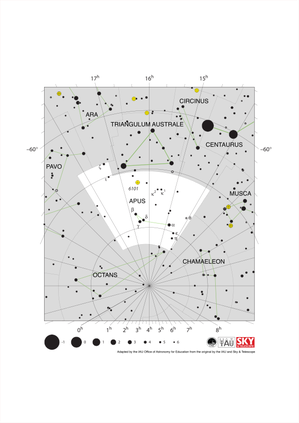
Apus Constellation Map
imagem
Legenda: The constellation Apus with its bright stars and surrounding constellations. Apus is surrounded by (going clockwise from the top): Triangulum Australe, Circinus, Musca, Chamaeleon, Octans, Pavo and Ara.
Apus is a southern constellation lying close to the south celestial pole. As such it is visible at some point in the year from the entire southern hemisphere but is only visible from the most equatorial regions of the northern hemisphere. Apus is circumpolar for all temperate and antarctic regions of the southern hemisphere. It is most visible in the evenings in the northern hemisphere summer and southern hemisphere autumn.
The globular cluster NGC 6101 can be found in Apus. It is marked here with a yellow circle with a plus symbol superimposed on it.
This diagram maps an area around the south celestial pole. Here lines of constant right ascension converge. The right ascension values (in hours) of these lines are marked on the x-axis above and below the diagram. Lines of constant declination (in degrees) are marked on the y-axis. The sizes of the stars marked here relate to the star's apparent magnitude, a measure of its apparent brightness. The larger dots represent brighter stars. The Greek letters mark the brightest stars in the constellation. These are ranked by brightness with the brightest star being labeled alpha, the second brightest beta, etc., although this ordering is not always followed exactly. The dotted boundary lines mark the IAU's boundaries of the constellations and the solid green lines mark one of the common forms used to represent the figures of the constellations. Neither the constellation boundaries, nor the lines joining the stars appear on the sky.
Crédito: Adapted by the IAU Office of Astronomy for Education from the original by IAU/Sky & Telescope
Link do crédito
Termos do Glossário:
Magnitude aparente , Coordenadas celestes , Estrelas circumpolares , Constelação , Declinação , Ascensão Reta (AR) , Polo Celeste Sul (PCS)
Categorias
Astronomia a Olho Nu
Licença: Creative Commons Attribution 4.0 International (CC BY 4.0) Creative Commons Attribution 4.0 International (CC BY 4.0) ícones
Arquivo
( imagem
128.00 kB)
Arquivo PDF
(PDF file
174.09 kB)
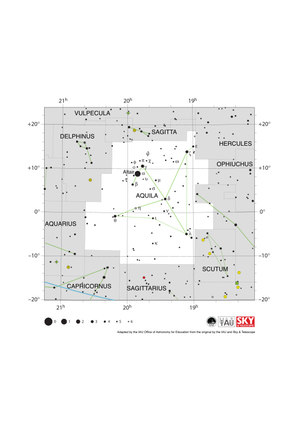
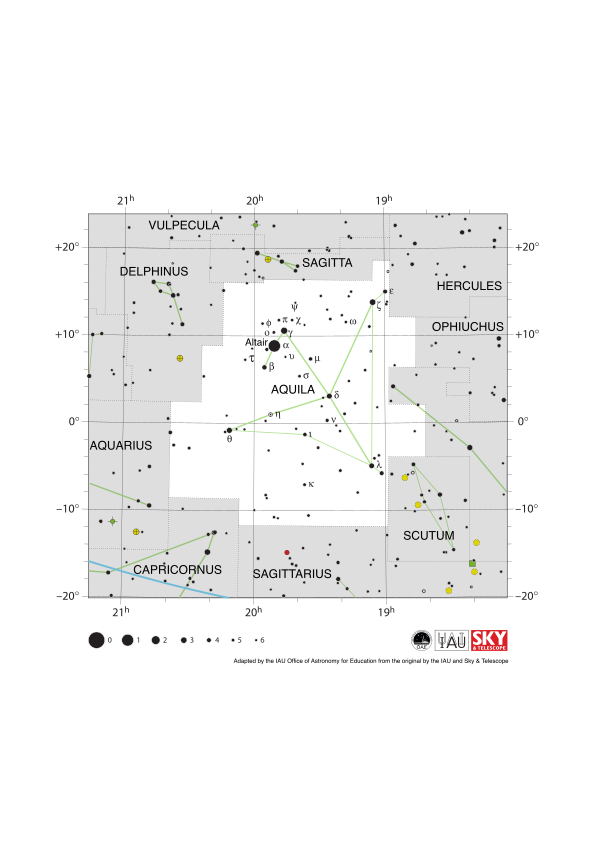
Aquila Constellation Map
imagem
Legenda: The constellation Aquila with its bright stars and surrounding constellations. Aquila is surrounded by (going clockwise from the top): Sagitta, Hercules, Ophiuchus, Serpens Cauda, Scutum, Sagittarius, Capricornus, Aquarius and Delphinus. Aquila is most notable for its brightest star Altair. This forms one vertex of the prominent Summer Triangle asterism that is visible in northern hemisphere summer evenings.
Aquila spans the celestial equator and thus some part of it is visible from all of the Earth at some point in the year. It is most visible in the evenings in the late northern hemisphere summer and late southern hemisphere winter.
The y-axis of this diagram is in degrees of declination with north as up and the x-axis is in hours of right ascension with east to the left. The sizes of the stars marked here relate to the star's apparent magnitude, a measure of its apparent brightness. The larger dots represent brighter stars. The Greek letters mark the brightest stars in the constellation. These are ranked by brightness with the brightest star being labeled alpha, the second brightest beta, etc., although this ordering is not always followed exactly. The dotted boundary lines mark the IAU's boundaries of the constellations and the solid green lines mark one of the common forms used to represent the figures of the constellations. The blue line in the lower right of the diagram is the ecliptic. Neither the constellation boundaries, nor the line marking the ecliptic, nor the lines joining the stars appear on the sky.
Crédito: Adapted by the IAU Office of Astronomy for Education from the original by IAU/Sky & Telescope
Link do crédito
Termos do Glossário:
Magnitude aparente , Capricórnio , Coordenadas celestes , Equador Celeste , Constelação , Declinação , Eclíptica , Ascensão Reta (AR) , Aquário , Asterismo
Categorias
Astronomia a Olho Nu
Licença: Creative Commons Attribution 4.0 International (CC BY 4.0) Creative Commons Attribution 4.0 International (CC BY 4.0) ícones
Arquivo
( imagem
95.28 kB)
Arquivo PDF
(PDF file
175.09 kB)