Documentos e recursos — Resultados da busca
Resultados da busca

Lua Cheia
imagem
Legenda: A lua cheia fotografada no Hemisfério Sul (Nova Zelândia). Durante esta fase, a metade iluminada da lua é totalmente visível da Terra.
Crédito: Dave Young / dcysurfer
Link do crédito
Termos do Glossário:
Lua Cheia , Fase lunar , Travamento de Maré
Categorias
Sistema Solar
Licença: Creative Commons Attribution 2.0 Generic Creative Commons Attribution 2.0 Generic ícones
Arquivo
( imagem
789.72 kB)
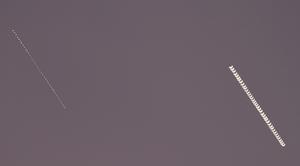
Venus and Mercury Trails
imagem
Criado para o OAE
Legenda: Honorable mention in the 2023 IAU OAE Astrophotography Contest, category of Still images of phases of Venus.
In this composite image, both Mercury (left) and Venus (right) can be seen heading into the sunset. The phases of each are beautifully captured as they descend. Not all planets or moons in the Solar System show phases as viewed from Earth. This phenomenon occurs because the orbits of Venus and Mercury are positioned between Earth’s orbit and the Sun, sometimes allowing us to see only part of the illuminated portion of each planet. These phases are similar to the phases we see of our own Moon.
Crédito: Marcella Giulia Pace (CC BY 4.0)
Termos do Glossário:
Mercúrio , Fase , Vênus
Categorias
Sistema Solar
Tags:
astrophotography
Licença: Creative Commons Attribution 4.0 International (CC BY 4.0) Creative Commons Attribution 4.0 International (CC BY 4.0) ícones
Este arquivo no Zenodo ( imagem 4.86 MB)
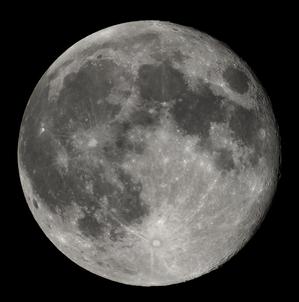
Lua cheia
imagem
Legenda: A imagem mostra a Lua quase cheia observada com um pequeno telescópio e uma câmera DSLR.
Crédito: Luc Viatour
Link do crédito
Termos do Glossário:
Lua Cheia , Fase lunar , Lua , Luas
Categorias
Sistema Solar
Licença: Creative Commons Attribution-ShareAlike 3.0 Unported Creative Commons Attribution-ShareAlike 3.0 Unported ícones
Arquivo
( imagem
924.21 kB)

Imagem em alta resolução da superfície do Sol
imagem
Legenda: Esta imagem em alta resolução de uma pequena porção da “superfície” visível mais externa do Sol (a fotosfera) abrange uma área de 36.500 por 36.500 km. Foi uma das primeiras imagens captadas pelo Telescópio Solar Daniel K. Inouye, durante a Fase de Verificação Científica do telescópio. Cada uma das células visíveis tem aproximadamente o tamanho do estado americano do Texas, da França, do Afeganistão ou da Somália. Nos centros mais brilhantes dessas células, o plasma proveniente das regiões subjacentes sobe à superfície, esfria e, em seguida, afunda novamente no local das faixas mais escuras que delimitam as células. Nessas faixas escuras, também podemos observar os pequenos e brilhantes pontos que marcam a presença dos campos magnéticos.
Crédito: NSO/NSF/AURA
Link do crédito
Termos do Glossário:
Fotosfera , Granulação
Categorias
O Sol
Licença: Creative Commons Attribution 4.0 International (CC BY 4.0) Creative Commons Attribution 4.0 International (CC BY 4.0) ícones
Arquivo
( imagem
17.04 MB)
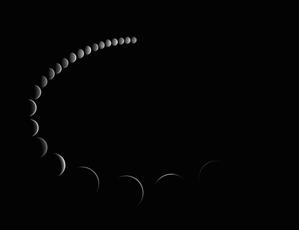
Phases of Venus
imagem
Criado para o OAE
Legenda: First place winner in the 2023 IAU OAE Astrophotography Contest, category of Still images of phases of Venus.
This is a mesmerising series of images of Venus captured from Surgères, Charente-Maritime, France, over a period of six months in 2015. The phases appear similar to the phases we see of our own Moon and occur for similar reasons. Only half of Venus is illuminated by the Sun and, from Earth, we can sometimes only see part of that illuminated half, depending on the relative positions of the Sun, Earth and Venus. Both Mercury and Venus exhibit phases because their orbit is between the Sun and the orbit of Earth. Depending on the position of Venus relative to the Sun and Earth, Venus goes through its phases over a period of time. This sequence of images beautifully showcases the transition from the ‘gibbous’ to the slender crescents. The use of infrared filters helped to capture Venus's dense perpetual cloud cover during daylight in sharp detail, providing a glimpse into the mysterious nature of the planet’s atmosphere.
Crédito: Stephane Gonzales/IAU OAE (CC BY 4.0)
Termos do Glossário:
Fase , Vênus
Categorias
Sistema Solar
Tags:
astrophotography
Licença: Creative Commons Attribution 4.0 International (CC BY 4.0) Creative Commons Attribution 4.0 International (CC BY 4.0) ícones
Este arquivo no Zenodo ( imagem 1.43 MB)





