Documentos e recursos — Resultados da busca
Resultados da busca
Equal Day 2026 Planets
imagem
Arquivo ( imagem 124.85 kB)
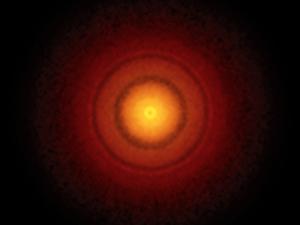
Planet formation around the star TW Hydrae
imagem
Legenda: This image shows the disk around the young star TW Hydrae. This star is only about 10 million years old, young enough that planets are still forming in a disk of gas and dust around it. This image was created using an array of submillimetre telescopes, each of which looks like a satellite dish. The signals from these telescopes were combined by a central processing computer to make this image. The lighter and darker patches show areas of the disk where there is more or less dust respectively. The dark rings and bright rings are evidence that the dust in the disk has been shepherded into some orbits and away from others. This is likely because there is one or more planets that are still forming hidden in the disk.
The whole image shows the disk around TW Hydrae out to a distance of about 70 astronomical units frm the central star. The two outer dark rings are separated from the central star by approximately the average distance between the Sun and Uranus and the average distance between the Sun and Pluto. The inner central hole appears to have been carved out by a planet orbiting TW Hydrae at a distance similar to the distance between the Earth and the Sun.
Crédito: S. Andrews (Harvard-Smithsonian CfA); B. Saxton (NRAO/AUI/NSF); ALMA (ESO/NAOJ/NRAO)
Link do crédito
Termos do Glossário:
Formação planetária
Categorias
Exoplanetas e Astrobiologia
Licença: Creative Commons Attribution 4.0 International (CC BY 4.0) Creative Commons Attribution 4.0 International (CC BY 4.0) ícones
Arquivo
( imagem
210.48 kB)
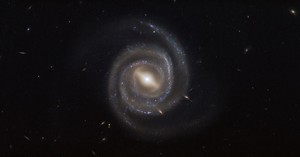
Hubble Image of Barred Spiral Galaxy UGC 6093
imagem
Legenda: This image from the Hubble Space Telescope shows the barred spiral galaxy UGC 6093. This galaxy has two spiral arms in its outer regions but the inner edge of each arm joins with the outer edge of a straight bar feature that goes across the galaxy's center.
This galaxy has been classified as an active galaxy due to the emissions of certain lines in its spectrum. This indicates that the supermassive black hole that lies in the center of the galaxy is accreting gas from its surroundings. Unlike some active galactic nuclei (AGN), the center of this galaxy does not shine especially brightly in the visible light so its status as an AGN is not immediately visible from this image.
Crédito: ESA/Hubble & NASA
Link do crédito
Termos do Glossário:
Núcleo Galáctico Ativo , Buraco negro supermassivo , Barra Galáctica , Linha espectral
Licença: Creative Commons Attribution 4.0 International (CC BY 4.0) Creative Commons Attribution 4.0 International (CC BY 4.0) ícones
Arquivo
( imagem
987.80 kB)
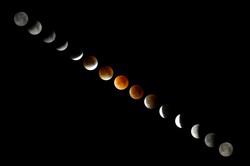
Red Moon, by Daniel Henrion, France
imagem
Criado para o OAE
Legenda: Third place in the 2021 IAU OAE Astrophotography Contest, category Total lunar eclipse.
Time-lapse images of a total supermoon lunar eclipse that took place on 28 September 2015. The photos show the Moon during the time it moved through the Earth´s umbra: Earth´s umbra touched the Moon´s outer limb at 1.07 a.m. UTC (upper left corner) and left the Moon´s surface at 4.27 a.m. UTC (lower right corner).
Crédito: Daniel Henrion/IAU OAE
Termos do Glossário:
Eclipse , Lua , Eclipse lunar total
Categorias
Astronomia a Olho Nu
, Sistema Solar
Licença: Creative Commons Attribution 4.0 International (CC BY 4.0) Creative Commons Attribution 4.0 International (CC BY 4.0) ícones
Este arquivo no Zenodo ( imagem 980.51 kB)
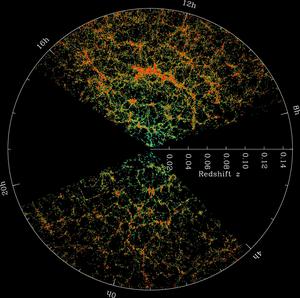
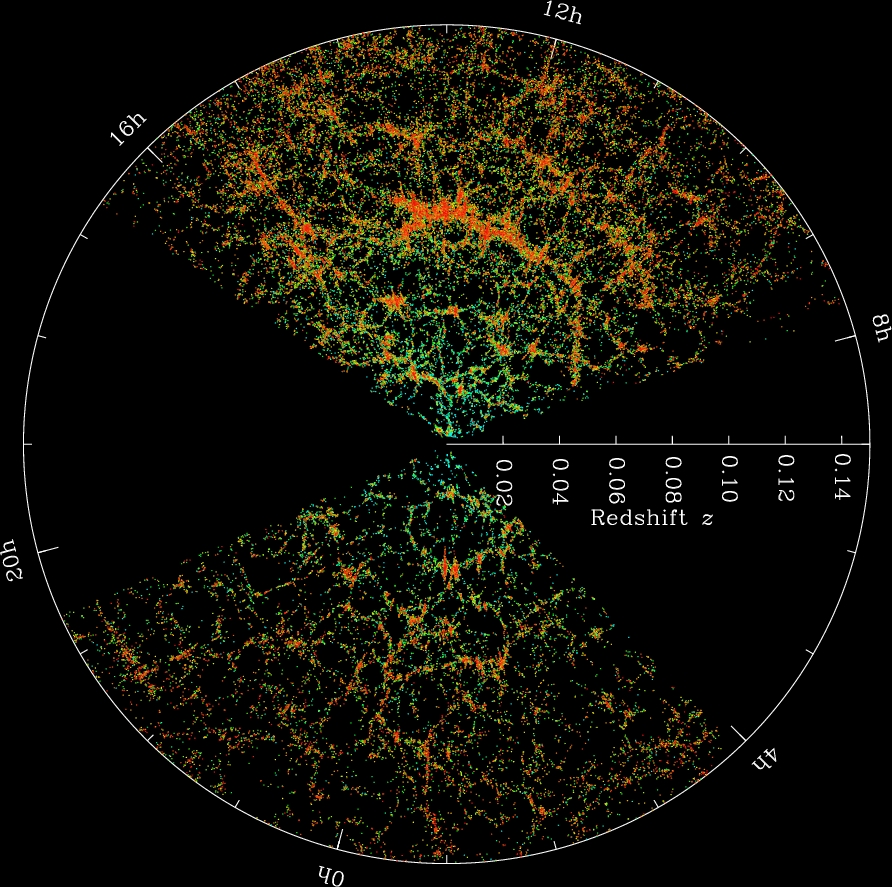
SDSS Redshift Map
imagem
Legenda: This image shows a map of the distribution of galaxies and is based on redshift data from the Sloan Digital Sky Survey (SDSS). Redshift measurements provides information on the distances, positions and motions of the galaxies.
The Earth is located at the center of the image, and each dot represents a galaxy. The outer circle represents a ""distance"" of about 2 billion light years. The idea of distance in cosmology is complex because the usual measurement of distance is the separation between two points in space at the same time. However, because of the speed of light, the further a distance, the farther back in time we are observing. The numbers on the outer circle are Right Ascension coordinates mapped onto a flat circle, and provides information on the position of the galaxies on the sky. The colours used represent the ages of the stars in the galaxies, the redder, more strongly clustered points represent galaxies comprising of older stars. The dark wedges that do not contain any dots are regions that were not mapped by the SDSS due to dust from the Milky Way galaxy obscuring the view.
Crédito: M. Blanton and Sloan Digital Sky Survey
Link do crédito
Termos do Glossário:
Matéria Escura , Desvio para o vermelho
Categorias
Cosmologia
Licença: Creative Commons Attribution 4.0 International (CC BY 4.0) Creative Commons Attribution 4.0 International (CC BY 4.0) ícones
Arquivo
( imagem
507.35 kB)