Documentos e recursos — Resultados da busca
Resultados da busca
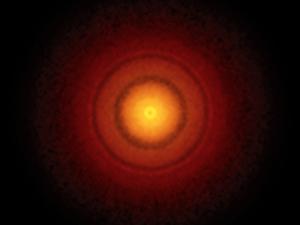
Planet formation around the star TW Hydrae
imagem
Legenda: This image shows the disk around the young star TW Hydrae. This star is only about 10 million years old, young enough that planets are still forming in a disk of gas and dust around it. This image was created using an array of submillimetre telescopes, each of which looks like a satellite dish. The signals from these telescopes were combined by a central processing computer to make this image. The lighter and darker patches show areas of the disk where there is more or less dust respectively. The dark rings and bright rings are evidence that the dust in the disk has been shepherded into some orbits and away from others. This is likely because there is one or more planets that are still forming hidden in the disk.
The whole image shows the disk around TW Hydrae out to a distance of about 70 astronomical units frm the central star. The two outer dark rings are separated from the central star by approximately the average distance between the Sun and Uranus and the average distance between the Sun and Pluto. The inner central hole appears to have been carved out by a planet orbiting TW Hydrae at a distance similar to the distance between the Earth and the Sun.
Crédito: S. Andrews (Harvard-Smithsonian CfA); B. Saxton (NRAO/AUI/NSF); ALMA (ESO/NAOJ/NRAO)
Link do crédito
Termos do Glossário:
Formação planetária
Categorias
Exoplanetas e Astrobiologia
Licença: Creative Commons Attribution 4.0 International (CC BY 4.0) Creative Commons Attribution 4.0 International (CC BY 4.0) ícones
Arquivo
( imagem
210.48 kB)

O planeta PDS 70b dentro de um disco protoplanetário
imagem
Legenda: Uma imagem do planeta PDS 70b. A jovem estrela PDS 70b é rodeada por um disco protoplanetário. Discos como este contêm gás, partículas finas semelhantes a areia que os astrônomos chamam de poeira e também corpos maiores, que variam de objetos do tamanho de seixos a protoplanetas (planetas que ainda estão se formando).
Esta imagem foi capturada em luz infravermelha usando óptica adaptativa. A óptica adaptativa é uma técnica que utiliza espelhos flexíveis e análise computacional para remover o efeito de desfocagem causado pela atmosfera terrestre. Isso permite que os astrônomos observem regiões próximas a estrelas como a PDS 70, que de outra forma seriam ofuscadas pela luz da estrela espalhada pela atmosfera terrestre. No centro há um círculo preto. Isso é causado por um coronógrafo, um pequeno dispositivo que bloqueia a luz da estrela central. Ele é cercado por um oval brilhante, luz infravermelha emitida pelo material no disco protoplanetário. À direita do círculo preto que cobre a estrela há um ponto brilhante. Trata-se de PDS 70b, um planeta gigante ainda em formação.
Crédito: ESO/ A. Müller, MPIA
Link do crédito
Termos do Glossário:
Formação planetária , Protoplaneta , Disco protoplanetário , Ótica Adaptativa
Categorias
Exoplanetas e Astrobiologia
Licença: Creative Commons Attribution 4.0 International (CC BY 4.0) Creative Commons Attribution 4.0 International (CC BY 4.0) ícones
Arquivo
( imagem
1.59 MB)

The Rotating Planet
vídeo
Criado para o OAE
Legenda: Second place winner in the 2023 IAU OAE Astrophotography Contest, category of Time-lapses of rotation of Big Dipper or Southern Cross.
A cosmic journey unfolds across continents in this time-lapse video which captures both iconic constellations from diverse corners of the world. Starting in China, the Big Dipper graces the night sky, a steadfast guide embedded in cultural narratives. Its luminance marks the beginning of this celestial odyssey. The two pointer stars on the end of the Big Dipper point to the North Star (Polaris) which appears to remain stationary as the sky rotates. From Nepal’s lofty peaks, the Big Dipper’s familiarity persists, a reliable fixture in the shifting panorama of the rotating planet. Moving to Chile, the Southern Cross adorns the firmament, emblematic of the southern skies. Frames from Chile showcase this constellation accompanied by the Milky Way Galaxy. In Namibia, a telescope from the H.E.S.S. Observatory appears in the video. Later, nestled beneath sheltering trees, the Big Dipper persists in its celestial prominence, appearing against a canvas of stars. Using varied techniques — fisheye lenses, static cameras, and Earth's movement-tracking — each frame unveils the Cross’s grandeur against diverse landscapes. These sequences — marked by star trails and Earth’s rotation—highlight the enduring presence of the Big Dipper and Southern Cross, bridging cultures and celestial beauty across hemispheres.
Crédito: Jianfeng Dai/IAU OAE (CC BY 4.0)
Termos do Glossário:
A Grande Concha (Big Dipper, em inglês) , Polo Celeste , Esfera Celeste , Rotação da Terra , Polo Celeste Norte (PCN) , Polaris , Cruzeiro do Sul , Polo Celeste Sul (PCS)
Categorias
Astronomia a Olho Nu
Tags:
astrophotography
Licença: Creative Commons Attribution 4.0 International (CC BY 4.0) Creative Commons Attribution 4.0 International (CC BY 4.0) ícones
Este arquivo no Zenodo ( vídeo 863.53 MB)
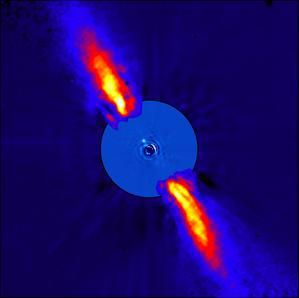
beta Pictoris b
imagem
Legenda: This composite of two images shows the planet beta Pictoris b and a disk of material both of which orbit the young star beta Pictoris. Both are taken in infrared light. The inner image was one of the first pictures taken of a planet around another star (an exoplanet). This image was made using a technique called adaptive optics which removes the blurring effect of the Earth's atmosphere that spreads out a star's light. The star's light is then concentrated tightly enough that it can be hidden behind a blocking circle (shown here in black) called a coronagraph. The ripples around this are artifacts of the imaging process. Beta Pictoris b, a gas giant planet about twelve times the mass of Jupiter, appears as a dot above and to the left of the black circle.
The outer image shows the thermal emission from the warm disk of material surrounding the young star beta Pictoris. As we are viewing this disk edge-on it appears as a line. This disk of gas and dust provided the material to form beta Pictoris b.
Crédito: ESO/A.-M. Lagrange et al.
Link do crédito
Termos do Glossário:
Exoplaneta , Formação planetária , Ótica Adaptativa
Categorias
Exoplanetas e Astrobiologia
Licença: Creative Commons Attribution 4.0 International (CC BY 4.0) Creative Commons Attribution 4.0 International (CC BY 4.0) ícones
Arquivo
( imagem
128.05 kB)

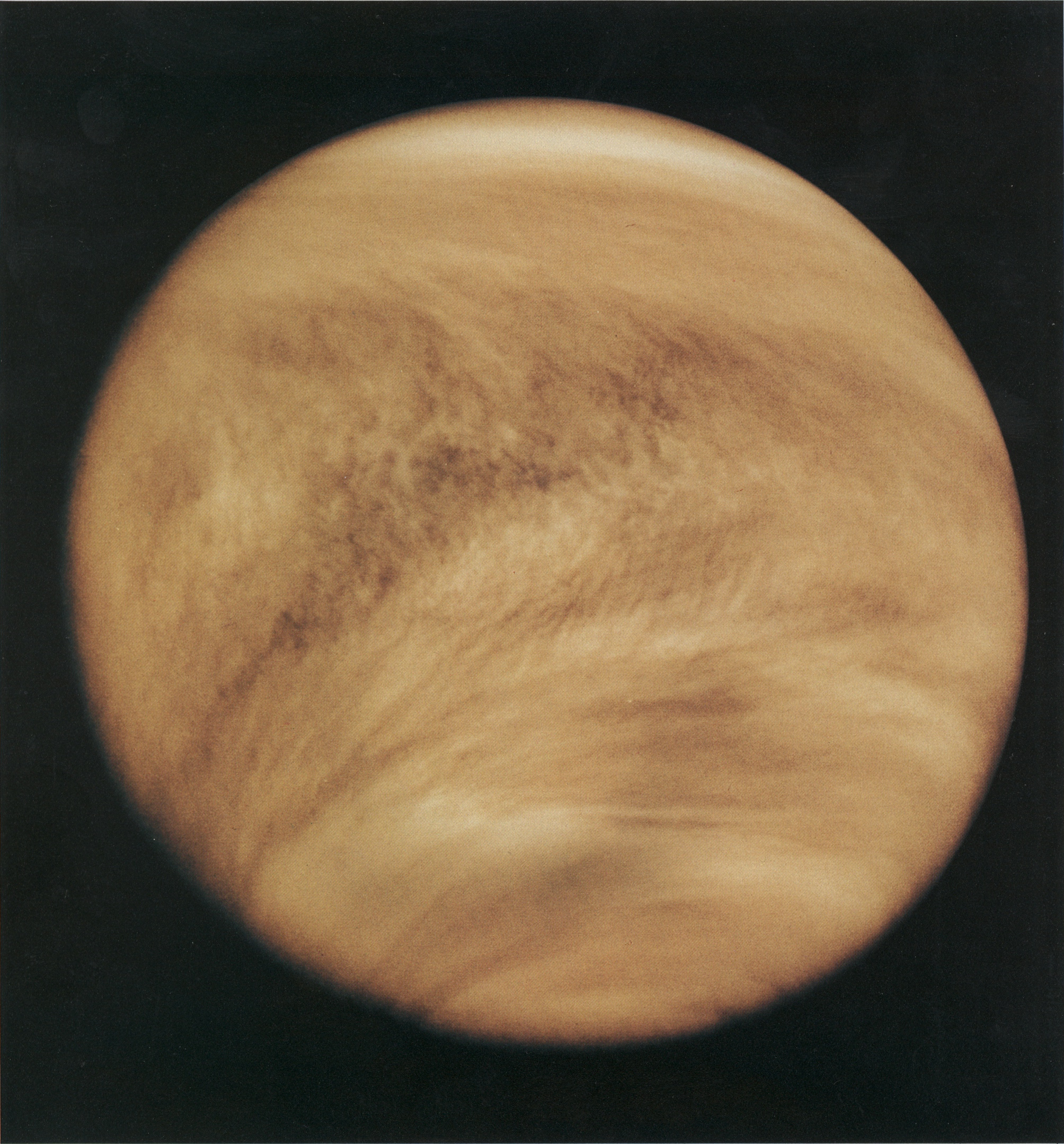
Atmosphere of Venus
imagem
Legenda: This image of Venus was captured in ultraviolet light by the Pioneer Venus Orbiter and highlights features of the planet’s thick atmosphere that are not visible in ordinary light. Venus has a dense, cloudy atmosphere composed mainly of carbon dioxide. In ultraviolet wavelengths, patterns in the upper cloud layers become visible, revealing swirling structures and bright and dark bands caused by differences in the composition and motion of the atmosphere. These ultraviolet features help scientists map wind patterns, atmospheric circulation, and cloud dynamics high above Venus’s surface.
Unlike Earth’s atmosphere, which is relatively transparent in visible light, Venus’s atmosphere is so thick that no direct view of the surface is possible from space without special instruments. The extreme pressure and temperature near Venus’s surface are consequences of this dense gaseous envelope, making Venus a dramatic example of how different planetary atmospheres can be. This image demonstrates how observing a planet’s atmosphere in different wavelengths, such as ultraviolet, reveals details about its structure and behaviour.
Crédito: NASA
Link do crédito
Termos do Glossário:
Atmosfera , Vênus
Licença: Domínio Público Domínio Público ícones
Arquivo
( imagem
8.09 MB)