Documentos e recursos — Resultados da busca
Resultados da busca

Canes Venatici Constellation Map
imagem
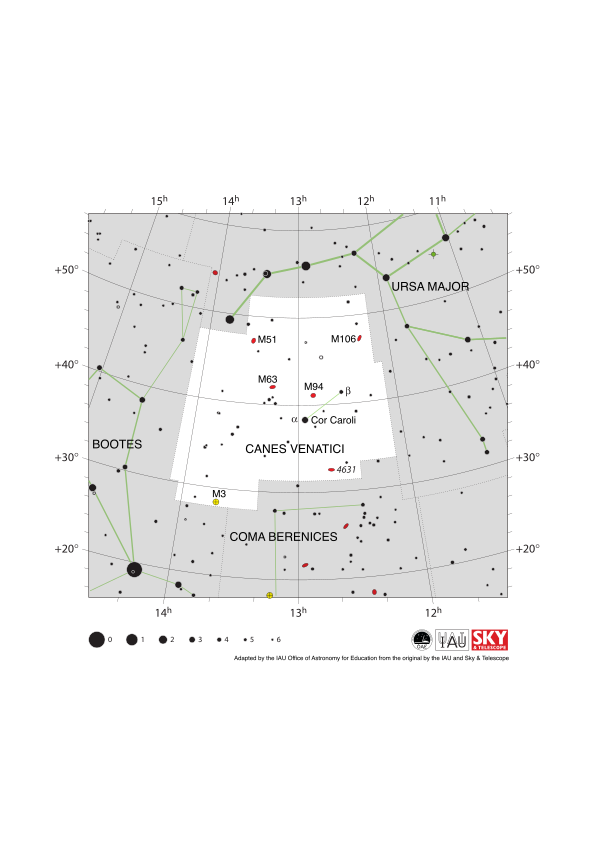
Legenda: The constellation Canes Venatici with its brighter stars and surrounding constellations. Canes Venatici is surrounded by (going clockwise from the top): Ursa Major, Coma Berenices and Boötes.
Canes Venatici is a northern constellation and thus the whole constellation is visible at some point in the year from the whole of the northern hemisphere. The whole of the constellation is also visible from equatorial regions of the southern hemisphere with parts of it visible from temperate southern regions. The constellation is best viewed in the northern hemisphere late spring and southern hemisphere late autumn.
The famous spiral galaxy commonly known as the Whirlpool Galaxy (M51) lies in Canes Venatici and is marked here with a red ellipse. Other notable spiral galaxies in the constellation include M63, M94, M106 and NGC 4631. All are marked here with red ellipses. The globular cluster M3 is marked here with a yellow circle with a plus symbol superimposed on it.
The y-axis of this diagram is in degrees of declination with north as up and the x-axis is in hours of right ascension with east to the left. The sizes of the stars marked here relate to the star's apparent magnitude, a measure of its apparent brightness. The larger dots represent brighter stars. The Greek letters mark the brightest stars in the constellation. These are ranked by brightness with the brightest star being labeled alpha, the second brightest beta, etc., although this ordering is not always followed exactly. The dotted boundary lines mark the IAU's boundaries of the constellations and the solid green lines mark one of the common forms used to represent the figures of the constellations. Neither the constellation boundaries, nor the lines joining the stars appear on the sky.
Crédito: Adapted by the IAU Office of Astronomy for Education from the original by the IAU and Sky & Telescope
Link do crédito
Termos do Glossário:
Magnitude aparente , Coordenadas celestes , Constelação , Declinação , Aglomerado Globular , Ascensão Reta (AR) , Galáxia espiral
Categorias
Astronomia a Olho Nu
Licença: Creative Commons Attribution 4.0 International (CC BY 4.0) Creative Commons Attribution 4.0 International (CC BY 4.0) ícones
Arquivo
( imagem
93.71 kB)
Arquivo PDF
(PDF file
165.31 kB)
Cetus Constellation Map
imagem
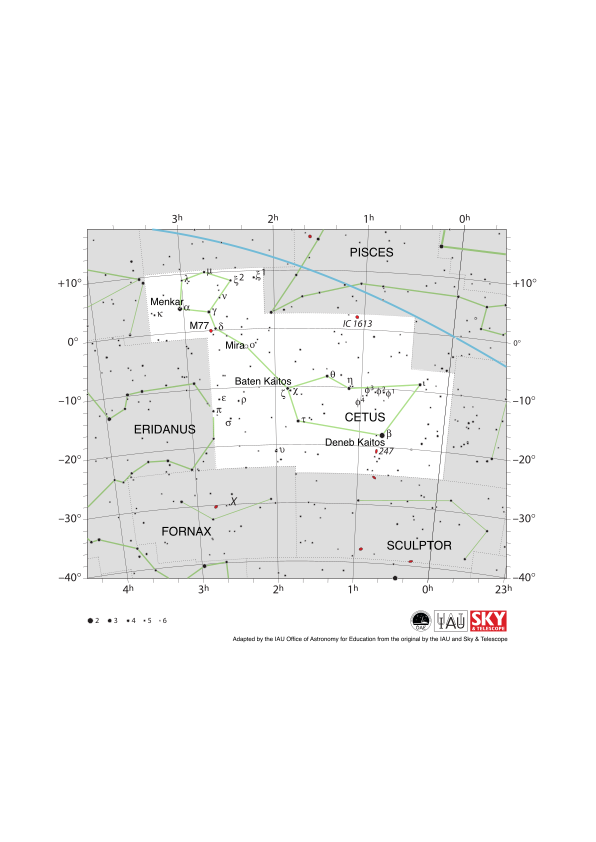
Legenda: The constellation Cetus along with its bright stars and surrounding constellations. Cetus is surrounded by (going clockwise from the top): Pisces, Aquarius, Sculptor, Fornax, Eridanus, Taurus and Aries. Cetus lies just south of the ecliptic (shown here as a blue line), this is the path the Sun appears to take across the sky over the course of a year. While the Sun does not pass through Cetus, the other planets of the solar system and the Moon can sometimes be found in Cetus. The star Omicron Ceti or Mira is a famous variable star. This red giant varies in brightness by a factor of 600 over the course of its eleven month period.
Cetus spans the celestial equator, thus some part of the constellation is visible from all the the Earth at some point in the year. The full constellation is visible from equatorial and temperate regions of both hemispheres. Cetus is most visible in the evenings in the northern hemisphere late autumn and the southern hemisphere late spring.
The barred spiral galaxy M77 lies in Cetus as does the spiral galaxy NGC 247 and the dwarf irregular galaxy IC 1613. All three are marked here with red ellipses.
The y-axis of this diagram is in degrees of declination with north as up and the x-axis is in hours of right ascension with east to the left. The sizes of the stars marked here relate to the star's apparent magnitude, a measure of its apparent brightness. The larger dots represent brighter stars. Mira is marked with an open circle as it is a variable star not always visible to the naked eye. The Greek letters mark the brightest stars in the constellation. These are ranked by brightness with the brightest star being labeled alpha, the second brightest beta, etc., although this ordering is not always followed exactly. The dotted boundary lines mark the IAU's boundaries of the constellations and the solid green lines mark one of the common forms used to represent the figures of the constellations. Neither the constellation boundaries, nor the line marking the ecliptic, nor the lines joining the stars appear on the sky.
Crédito: Adapted by the IAU Office of Astronomy for Education from the original by IAU/Sky & Telescope
Link do crédito
Termos do Glossário:
Magnitude aparente , Coordenadas celestes , Constelação , Declinação , Eclíptica , Ascensão Reta (AR) , Zodíaco , Estrela variável
Categorias
Astronomia a Olho Nu
Licença: Creative Commons Attribution 4.0 International (CC BY 4.0) Creative Commons Attribution 4.0 International (CC BY 4.0) ícones
Arquivo
( imagem
106.77 kB)
Arquivo PDF
(PDF file
206.60 kB)
Coma Berenices Constellation Map
imagem
Legenda: The constellation Coma Berenices with its brighter stars and surrounding constellations. Coma Berenices is surrounded by (going clockwise from the top): Canes Venatici, Ursa Major, Leo, Virgo and Boötes. This constellation has relatively few bright stars.
Coma Berenices is a northern constellation close to the celestial equator. As such the whole constellation is visible at some point in the year everywhere on Earth except the most antarctic regions. The constellation is best viewed in the evening in the northern hemisphere late spring and southern hemisphere late autumn.
Coma Berenices is home to a large cluster of galaxies known as the Coma Supercluster. However none of the galaxies in this cluster are marked on this diagram as they are too faint to observe with most amateur telescopes. The elliptical galaxy M85 and the spiral galaxy M100 are members of the nearer Virgo cluster of galaxies. These are marked with red ellipses as are the even nearer M64 and NGC 4565, both of which are spiral galaxies. The globular cluster M53, marked here with a yellow circle with a plus sign superimposed on it, also lies in Coma Berenices.
The y-axis of this diagram is in degrees of declination with north as up and the x-axis is in hours of right ascension with east to the left. The sizes of the stars marked here relate to the star's apparent magnitude, a measure of its apparent brightness. The larger dots represent brighter stars. The Greek letters mark the brightest stars in the constellation. These are ranked by brightness with the brightest star being labeled alpha, the second brightest beta, etc., although this ordering is not always followed exactly. The dotted boundary lines mark the IAU's boundaries of the constellations and the solid green lines mark one of the common forms used to represent the figures of the constellations. The blue line at the bottom right of the diagram marks the ecliptic. Neither the constellation boundaries, nor the line marking the ecliptic, nor the lines joining the stars appear on the sky.
Crédito: Adapted by the IAU Office of Astronomy for Education from the original by the IAU and Sky & Telescope
Link do crédito
Termos do Glossário:
Magnitude aparente , Coordenadas celestes , Aglomerado de galáxias , Constelação , Declinação , Eclíptica , Galáxia Elíptica , Leo , Ascensão Reta (AR) , Galáxia espiral , Virgem
Categorias
Astronomia a Olho Nu
Licença: Creative Commons Attribution 4.0 International (CC BY 4.0) Creative Commons Attribution 4.0 International (CC BY 4.0) ícones
Arquivo
( imagem
87.27 kB)
Arquivo PDF
(PDF file
161.42 kB)

Ursa Major Constellation Map
imagem
Legenda: The constellation Ursa Major along with its bright stars and its surrounding constellations. Ursa Major is surrounded by (going clockwise from the top): Draco, Camelopardalis, Lynx, Leo Minor, Leo, Coma Berenices, Canes Venatici and Boötes. Ursa Major is famous for the prominent asterism often known in English as the Big Dipper or the Plough. This prominent northern asterism has a wide variety of names from cultures across the world. While most constellations and asterisms are made up of unrelated stars that randomly appear close together on the sky, five of the stars in the Big Dipper are part of the Ursa Major Moving Group, a group of stars moving through space together that likely formed in the same location 300 million years ago. The two stars on the right-hand end of the Big Dipper on this diagram form a pair of pointer stars that can be used to locate Polaris, the northern pole star which lies in the constellation of Ursa Minor.
Ursa Major is a northern constellation and is visible from northern and equatorial regions. Parts of the constellation are visible from all but the most antarctic parts of the southern hemisphere but not all temperate regions of the southern hemisphere can see all of the Big Dipper. Conversely the Big Dipper and much of the rest of the constellation are circumpolar in arctic and many temperate regions of the northern hemisphere. Ursa Major is most visible in the evening in the northern hemisphere spring and southern hemisphere autumn.
Two prominent galaxies appear in the northern part of this constellation, the spiral galaxy M81 and M82, a possible spiral galaxy whose structure is difficult to observe from the Earth as it appears edge-on. Both are shown here as red ellipses. The planetary nebula M97 (the Owl Nebula) lies in the middle of the constellation and is marked by a green circle superimposed on a plus symbol.
The y-axis of this diagram is in degrees of declination with north as up and the x-axis is in hours of right ascension with east to the left. The sizes of the stars marked here relate to the star's apparent magnitude, a measure of its apparent brightness. The larger dots represent brighter stars. The Greek letters mark the brightest stars in the constellation. These are ranked by brightness with the brightest star being labeled alpha, the second brightest beta, etc., although this ordering is not always followed exactly. The dotted boundary lines mark the IAU's boundaries of the constellations and the solid green lines mark one of the common forms used to represent the figures of the constellations. Neither the constellation boundaries, nor the lines joining the stars appear on the sky.
Crédito: Adapted by the IAU Office of Astronomy for Education from the original by IAU/Sky & Telescope
Link do crédito
Termos do Glossário:
Magnitude aparente , A Grande Concha (Big Dipper, em inglês) , Coordenadas celestes , Estrelas circumpolares , Constelação , Declinação , Leo , Nebulosa Planetária , Ascensão Reta (AR) , Galáxia espiral , Asterismo
Categorias
Astronomia a Olho Nu
Licença: Creative Commons Attribution 4.0 International (CC BY 4.0) Creative Commons Attribution 4.0 International (CC BY 4.0) ícones
Arquivo
( imagem
143.67 kB)
Arquivo PDF
(PDF file
215.83 kB)
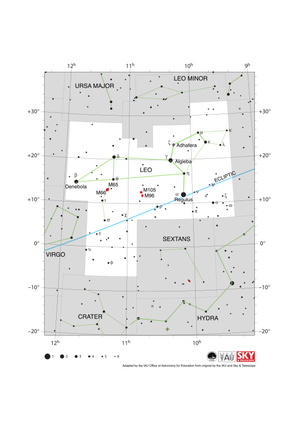
Leo Constellation Map
imagem
Legenda: The zodiac constellation Leo and its surrounding constellations. Starting from the top of the diagram and going clockwise, these are Leo Minor, Cancer, Sextans, Hydra, Crater, Virgo and Ursa Major. The brightest star in Leo, Regulus, lies almost exactly on the ecliptic (shown here as a blue line): the path the Sun appears to take across the sky over the course of a year. The Sun spends the period from mid August to mid September in Leo. The other planets in the Solar System can often be found in Leo.
Leo spans the celestial equator and is thus part of it is visible at some time in the year from all of planet Earth with some of the constellation obscured for the most arctic and antarctic regions of the world. Leo is most visible in the evenings in the northern hemisphere spring and southern hemisphere autumn.
Several objects can be seen in Leo, including M65 and M66 – two galaxies in the Leo Triplet, a trio of galaxies including NGC 3628, not listed here. In addition, M96, a spiral galaxy, can be seen as a fuzzy object using a small telescope, and Messier 105, an elliptical galaxy. Each of these objects are labelled on the map as red ellipses.
The y-axis of this diagram is in degrees of declination with north as up and the x-axis is in hours of right ascension with east to the left. The sizes of the stars marked here relate to the star's apparent magnitude, a measure of its apparent brightness. The larger dots represent brighter stars. The Greek letters mark the brightest stars in the constellation. These are ranked by brightness with the brightest star being labelled alpha, the second brightest beta, etc., although this ordering is not always followed exactly. The dotted boundary lines mark the IAU's boundaries of the constellations and the solid green lines mark one of the common forms used to represent the figures of the constellations. Neither the constellation boundaries, nor the line marking the ecliptic, nor the lines joining the stars appear on the sky.
Crédito: Adapted by the IAU Office of Astronomy for Education from the original by IAU/Sky & Telescope
Link do crédito
Termos do Glossário:
Magnitude aparente , Coordenadas celestes , Constelação , Declinação , Eclíptica , Galáxia Elíptica , Galáxia , Leo , Ascensão Reta (AR) , Galáxia espiral , Zodíaco , Câncer , Virgem
Categorias
Astronomia a Olho Nu
Licença: Creative Commons Attribution 4.0 International (CC BY 4.0) Creative Commons Attribution 4.0 International (CC BY 4.0) ícones
Arquivo
( imagem
114.25 kB)
Arquivo PDF
(PDF file
186.50 kB)