Documentos e recursos — Resultados da busca
Resultados da busca
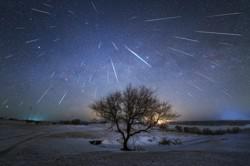
Geminid Meteor Shower from China, by Dai Jianfeng, China
imagem
Criado para o OAE
Legenda: First place in the 2021 IAU OAE Astrophotography Contest, category Meteor showers.
A meteor shower occurs when the Earth in its orbit around the Sun, passes through a debris trail left previously by a comet on its approach around the Sun. As the Earth enters this debris (small sand grain sized), they enter the atmosphere at high speeds and on parallel trajectories, burning completely leaving beautiful tracks (streaks) in the sky. These streaks can appear and disappear in the blink of an eye, or last much longer. On rare occasions the debris originates from asteroids, as in the case of the Geminid meteor shower, shown in this image, picturing many streaks of debris captured in the sky of China in 2017. Due to relative motions and perspective, the shower appears to come from one single point, known as the radiant point, beautifully pictured in this image. This is similar to driving in a car on a rainy day without any wind, looking out the front window it seems that the rain is coming directly towards the window, when in fact the rain is falling vertically downwards.
Crédito: Dai Jianfeng/IAU OAE
Termos do Glossário:
Meteoroide , Estrela cadente
Categorias
Astronomia a Olho Nu
Licença: Creative Commons Attribution 4.0 International (CC BY 4.0) Creative Commons Attribution 4.0 International (CC BY 4.0) ícones
Este arquivo no Zenodo ( imagem 26.78 MB)
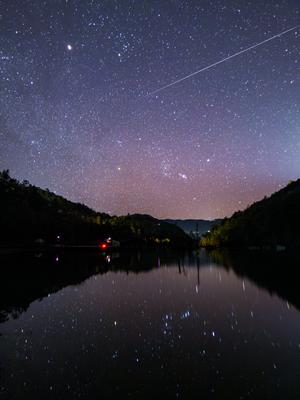
The Geminid Fireball
imagem
Criado para o OAE
Legenda: Honorable mention in the 2023 IAU OAE Astrophotography Contest, category of Still images taken exclusively with smartphones/mobile devices.
Captured with a smartphone on 13 December 2022, a Geminid meteor illuminated the sky above Blue Moon Valley in Yunnan, China, casting a breathtaking display against the serene backdrop of the Jade Dragon Snow Mountain. Renowned for their dazzling brightness and vivid hues, the Geminids are among the most vibrant meteor showers, originating from the asteroid 3200 Phaethon. Each year, as our planet traverses Phaethon’s debris trail, fragments of dust and rock vaporise in the atmosphere, creating the stunning phenomenon of the Geminid meteor shower. In this stunning night sky image, the twin stars of Gemini (Castor and Pollux) are obscured by the silhouetted trees on the left. Mirrored in the calm waters are the stars that make up the constellation of Orion, which can be seen rising towards the bottom-centre of the image, while the radiant Mars retains its brilliance as the foremost celestial beacon in the scene, all before the moonrise takes over.
Crédito: Jianfeng Dai/IAU OAE (CC BY 4.0)
Termos do Glossário:
Gêmeos , Estrela cadente
Categorias
Astronomia a Olho Nu
, Sistema Solar
Tags:
astrophotography
Licença: Creative Commons Attribution 4.0 International (CC BY 4.0) Creative Commons Attribution 4.0 International (CC BY 4.0) ícones
Este arquivo no Zenodo ( imagem 15.06 MB)

Iron Meteorite
imagem
Legenda: This iron meteorite was originally found in Harriman, Tennessee, USA and is now held in the collection of the Smithsonian Natural History Museum, Washington DC, USA. The total mass of the meteorite was about 30kg. Here we see the interior after the meteorite was cut into pieces.
Iron meteorites are largely composed of an iron-nickel. They also often have a crystalline structure which manifests here as a series of crossing shiny straight lines known as a Widmanstätten pattern. This is thought to have formed as the meteoroid (the object that would eventually fall through the Earth's atmosphere as a meteor and land on the ground as a meteorite) cooled very slowly in the vacuum of space in the early solar system. This led to the growth of this crystalline structure.
Crédito: Chuck Sutherland
Link do crédito
Termos do Glossário:
Meteoritos ferrosos , Meteoritos , Estrela cadente
Categorias
Planeta Terra
, Sistema Solar
Licença: Domínio Público Domínio Público ícones
Arquivo
( imagem
4.51 MB)
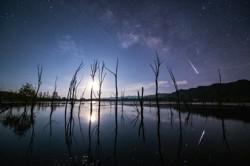
Lyrid of the Lake
imagem
Criado para o OAE
Legenda: Winner in the 2022 IAU OAE Astrophotography Contest, category Still images of celestial patterns.
Taken in the early hours of 24 April 2022, this image captures the sky of Yunnan Province, China, with a reflection on Lake Nian. The Milky Way is visible on the left side, while whitish Earth clouds are visible on the right. A Lyrid meteor crosses the sky along the Milky Way, its tail pointing back toward the shower's radiant in the constellation Lyra, which lies outside the image above the upper edge. The natural colours of the meteor are impressively clear.
A few constellations are also visible. In the top left corner we can recognise the small constellation of the Dolphin, in which five brightest stars comprise the asterism. This asterism forms the head-part of the larger Greek constellation of the Dolphin and was considered the Dolphin since Roman times, when Ptolemy formed the new constellation of Equuleus in the southern part of the original figure. In mediaeval China, this asterism was considered the Good and the Rotten Gourd, the good one being formed by the brighter rhombus on the top and the rotten one made of faint stars in the tail of the Roman dolphin.
The bright star to the right of the Dolphin and at the top of the image is Altair, the brightest star in the constellation Aquila. In Chinese uranology, Altair, together with some adjacent areas, forms the constellation of the Drum at the River. However, in Chinese folklore, the bright star stands for a boy in love with a girl, who is represented by the bright star Vega (in Lyra) on the other side of a huge celestial stream, the Milky Way. Vega is not visible in this image but the Lyrid meteor is like a teardrop of the unlucky girl who cannot reach her lover.
In the upper right of the image, the constellation Scorpius shines with its bright reddish star Antares. With some of its neighbouring stars, it was regarded in China as the asterism of The Heart, which was also one of the Lunar Mansions. It was considered the heart of the Azure Dragon, the super-constellation of spring, in ancient China.
Scorpius and Sagittarius, in the middle of the image, contain the brightest clouds of the Milky Way, the Galactic Centre, which also has clearly visible dark clouds in front of the bright ones.
There is no classical Greco-Roman constellation between Aquila and Scorpius, but in the 17th century, two Polish astronomers, the couple Jan and Elizabeta Hevelius, named this area of bright clouds in the Milky Way Scutum, the Shield, in memory of a Polish king. In China, however, this area directly outside the super-constellation (or heavenly enclosure) of the Celestial Market Place was seen as depicting Market Officers.
Crédito: Jianfeng Dai/IAU OAE
Termos do Glossário:
Via Láctea , Escorpião , Estrela cadente , Sagitário
Categorias
Via Láctea e Meio Interestelar
, Astronomia a Olho Nu
Licença: Creative Commons Attribution 4.0 International (CC BY 4.0) Creative Commons Attribution 4.0 International (CC BY 4.0) ícones
Este arquivo no Zenodo ( imagem 7.19 MB)
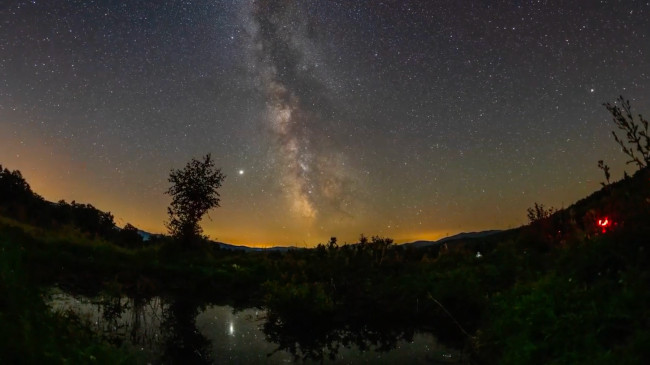
Flowing Night Sky
vídeo
Criado para o OAE
Legenda: Honourable mention in the 2022 IAU OAE Astrophotography Contest, category Time lapses of celestial patterns.
This time-lapse was shot from Slovakia in August 2020. By fixing the relative movement of the sky to Earth's rotation in some of the frames, we can experience a different perspective as a viewer.
The Milky Way, our home galaxy, is visible throughout the whole video. The bright objects near the Milky Way are Jupiter and Saturn, close together, Jupiter being the brighter one.
This video also shows the interaction of amateur astronomers observing the Perseids meteor shower with their telescopes pointed towards the sky. An unfortunate aspect of the art of astronomical observing, clouds can suddenly cover the whole sky. The fog occurs mostly because of the higher humidity after the rain.
Most of the light trails in the sky are made by satellites, but some of them, appearing just very briefly and not very noticeably, are meteors, as the video was shot around the peak of Perseids meteor shower.
Crédito: Robert Barsa/IAU OAE
Termos do Glossário:
Júpiter , Via Láctea , Saturno , Estrela cadente
Categorias
Via Láctea e Meio Interestelar
, Astronomia a Olho Nu
, Estrelas
Licença: Creative Commons Attribution 4.0 International (CC BY 4.0) Creative Commons Attribution 4.0 International (CC BY 4.0) ícones
Este arquivo no Zenodo ( vídeo 254.11 MB)





