Documentos e recursos — Resultados da busca
Resultados da busca

Lepus Constellation Map
imagem
Legenda: The constellation Lepus with its bright stars and surrounding constellations. Lepus is surrounded by (going clockwise from the top): Orion, Eridanus, Caelum, Columba, Canis Major and Monoceros.
Lepus is a southern constellation and thus the whole constellation can be viewed at some point in the year throughout the southern hemisphere. The whole constellation can also be viewed from temperate and equatorial regions of the northern hemisphere. Lepus is best viewed in the evening in the northern hemisphere winter and southern hemisphere summer.
The globular cluster M79 lies in Lepus. It is marked here with a yellow circle with a plus sign superimposed on it.
The y-axis of this diagram is in degrees of declination with north as up and the x-axis is in hours of right ascension with east to the left. The sizes of the stars marked here relate to the star's apparent magnitude, a measure of its apparent brightness. The larger dots represent brighter stars. The Greek letters mark the brightest stars in the constellation. These are ranked by brightness with the brightest star being labeled alpha, the second brightest beta, etc., although this ordering is not always followed exactly. The dotted boundary lines mark the IAU's boundaries of the constellations and the solid green lines mark one of the common forms used to represent the figures of the constellations. Neither the constellation boundaries, nor the lines joining the stars appear on the sky.
Crédito: Adapted by the IAU Office of Astronomy for Education from the original by the IAU and Sky & Telescope
Link do crédito
Termos do Glossário:
Magnitude aparente , Coordenadas celestes , Constelação , Declinação , Ascensão Reta (AR)
Categorias
Astronomia a Olho Nu
Licença: Creative Commons Attribution 4.0 International (CC BY 4.0) Creative Commons Attribution 4.0 International (CC BY 4.0) ícones
Arquivo
( imagem
87.88 kB)
Arquivo PDF
(PDF file
163.08 kB)

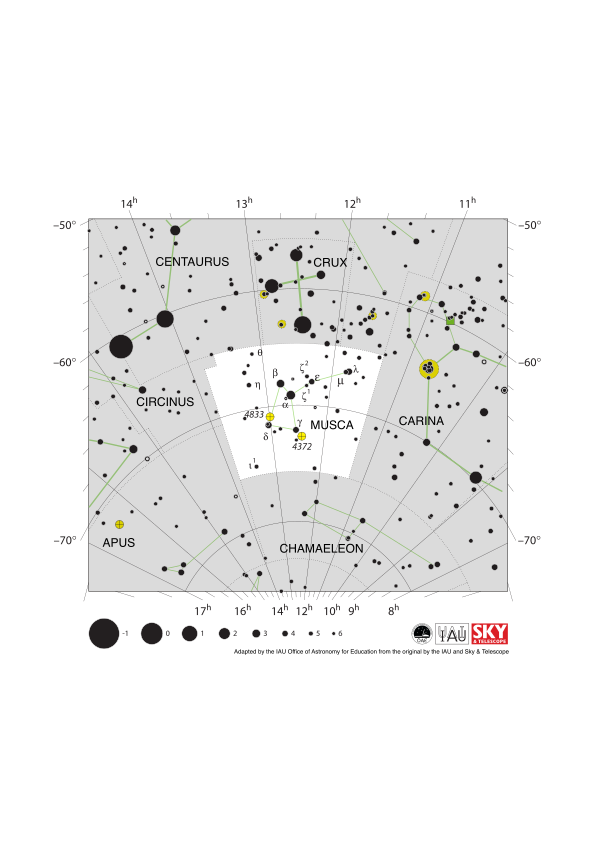
Musca Constellation Map
imagem
Legenda: The constellation Musca with its bright stars and surrounding constellations. Musca is surrounded by (going clockwise from the top): Crux, Centaurus, Carina, Chamaeleon, Apus and Circinus.
Musca is a southern constellation and thus the whole constellation is visible at some point in the year throughout the southern hemisphere. The whole constellation is visible to a thin strip of the northern hemisphere near the equator with parts of the constellation visible to other northern equatorial regions. Musca is circumpolar in temperate and antarctic regions of the southern hemisphere. Musca is best viewed in the evening in the northern hemisphere late spring and southern hemisphere late autumn.
The globular clusters NGC 4372 and NGC 4833 lie in Musca and are marked here with yellow circles with plus signs superimposed on them.
The y-axis of this diagram is in degrees of declination with north as up and the x-axis is in hours of right ascension with east to the left. The sizes of the stars marked here relate to the star's apparent magnitude, a measure of its apparent brightness. The larger dots represent brighter stars. The Greek letters mark the brightest stars in the constellation. These are ranked by brightness with the brightest star being labeled alpha, the second brightest beta, etc., although this ordering is not always followed exactly. The dotted boundary lines mark the IAU's boundaries of the constellations and the solid green lines mark one of the common forms used to represent the figures of the constellations. Neither the constellation boundaries, nor the lines joining the stars appear on the sky.
Crédito: Adapted by the IAU Office of Astronomy for Education from the original by the IAU and Sky & Telescope
Link do crédito
Termos do Glossário:
Magnitude aparente , Coordenadas celestes , Estrelas circumpolares , Constelação , Declinação , Ascensão Reta (AR) , Cruzeiro do Sul
Categorias
Astronomia a Olho Nu
Licença: Creative Commons Attribution 4.0 International (CC BY 4.0) Creative Commons Attribution 4.0 International (CC BY 4.0) ícones
Arquivo
( imagem
122.56 kB)
Arquivo PDF
(PDF file
177.89 kB)
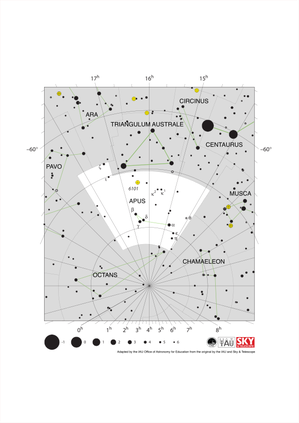
Apus Constellation Map
imagem
Legenda: The constellation Apus with its bright stars and surrounding constellations. Apus is surrounded by (going clockwise from the top): Triangulum Australe, Circinus, Musca, Chamaeleon, Octans, Pavo and Ara.
Apus is a southern constellation lying close to the south celestial pole. As such it is visible at some point in the year from the entire southern hemisphere but is only visible from the most equatorial regions of the northern hemisphere. Apus is circumpolar for all temperate and antarctic regions of the southern hemisphere. It is most visible in the evenings in the northern hemisphere summer and southern hemisphere autumn.
The globular cluster NGC 6101 can be found in Apus. It is marked here with a yellow circle with a plus symbol superimposed on it.
This diagram maps an area around the south celestial pole. Here lines of constant right ascension converge. The right ascension values (in hours) of these lines are marked on the x-axis above and below the diagram. Lines of constant declination (in degrees) are marked on the y-axis. The sizes of the stars marked here relate to the star's apparent magnitude, a measure of its apparent brightness. The larger dots represent brighter stars. The Greek letters mark the brightest stars in the constellation. These are ranked by brightness with the brightest star being labeled alpha, the second brightest beta, etc., although this ordering is not always followed exactly. The dotted boundary lines mark the IAU's boundaries of the constellations and the solid green lines mark one of the common forms used to represent the figures of the constellations. Neither the constellation boundaries, nor the lines joining the stars appear on the sky.
Crédito: Adapted by the IAU Office of Astronomy for Education from the original by IAU/Sky & Telescope
Link do crédito
Termos do Glossário:
Magnitude aparente , Coordenadas celestes , Estrelas circumpolares , Constelação , Declinação , Ascensão Reta (AR) , Polo Celeste Sul (PCS)
Categorias
Astronomia a Olho Nu
Licença: Creative Commons Attribution 4.0 International (CC BY 4.0) Creative Commons Attribution 4.0 International (CC BY 4.0) ícones
Arquivo
( imagem
128.00 kB)
Arquivo PDF
(PDF file
174.09 kB)

Puppis Constellation Map
imagem
Legenda: The constellation Puppis with its bright stars and surrounding constellations. Puppis is surrounded by (going clockwise from the top): Monoceros, Canis Major, Columba, Pictor, Carina, Vela, Pyxis and Hydra.
Puppis is a southern constellation and thus the whole constellation is visible at some point in the year throughout the southern hemisphere. The whole constellation is also visible to equatorial and some temperate regions of the northern hemisphere with parts of the constellation visible to all but the most arctic regions. Puppis is best viewed in the evenings in the northern hemisphere winter and southern hemisphere summer.
The open clusters M46, M93 and NGC 2477 lie in Puppis and are marked here with yellow circles. The globular cluster M47 also lies in Puppis and is marked here with a yellow circle with a cross superimposed on it.
The y-axis of this diagram is in degrees of declination with north as up and the x-axis is in hours of right ascension with east to the left. The sizes of the stars marked here relate to the star's apparent magnitude, a measure of its apparent brightness. The larger dots represent brighter stars. The Greek letters mark the brightest stars in the constellation. These are ranked by brightness with the brightest star being labeled alpha, the second brightest beta, etc., although this ordering is not always followed exactly. Puppis was previously part of the larger Argo Navis constellation along with Vela and Carina. As the letter designations for stars were created before this division took place, Greek letter designations are now divided between the three constellations with Puppis having stars designated epsilon and zeta but no alpha, beta, gamma or delta. The dotted boundary lines mark the IAU's boundaries of the constellations and the solid green lines mark one of the common forms used to represent the figures of the constellations. Neither the constellation boundaries, nor the lines joining the stars appear on the sky.
Crédito: Adapted by the IAU Office of Astronomy for Education from the original by the IAU and Sky & Telescope
Link do crédito
Termos do Glossário:
Magnitude aparente , Coordenadas celestes , Constelação , Declinação , Ascensão Reta (AR)
Categorias
Astronomia a Olho Nu
Licença: Creative Commons Attribution 4.0 International (CC BY 4.0) Creative Commons Attribution 4.0 International (CC BY 4.0) ícones
Arquivo
( imagem
145.30 kB)
Arquivo PDF
(PDF file
218.05 kB)

Vela Constellation Map
imagem
Legenda: The constellation Vela with its bright stars and surrounding constellations. Vela is surrounded by (going clockwise from the top): Pyxis, Puppis, Carina, Crux, Centaurus and Antlia.
Vela is a southern constellation and thus the whole constellation is visible at some point in the year throughout the southern hemisphere. The whole constellation is also visible from equatorial regions of the northern hemisphere with parts of the constellation visible from most temperate northern hemisphere regions. Vela is best viewed in the evening in the northern hemisphere spring and southern hemisphere autumn.
The planetary nebula NGC 3132 lies in Vela and is marked here with a green circle superimposed on a plus sign. The globular cluster NGC 3201 also lies in Vela and is marked here with a yellow circle with a plus sign superimposed on it. A yellow circle marks the position of the open cluster IC 2391.
The y-axis of this diagram is in degrees of declination with north as up and the x-axis is in hours of right ascension with east to the left. The sizes of the stars marked here relate to the star's apparent magnitude, a measure of its apparent brightness. The larger dots represent brighter stars. The Greek letters mark the brightest stars in the constellation. These are ranked by brightness with the brightest star being labeled alpha, the second brightest beta, etc., although this ordering is not always followed exactly. Vela was previously part of the larger Argo Navis constellation along with Puppis and Carina. As the letter designations for stars were created before this division took place, Greek letter designations are now divided between the three constellations with Vela having stars designated gamma and delta but no alpha or beta. The dotted boundary lines mark the IAU's boundaries of the constellations and the solid green lines mark one of the common forms used to represent the figures of the constellations. Neither the constellation boundaries, nor the lines joining the stars appear on the sky.
Crédito: Adapted by the IAU Office of Astronomy for Education from the original by the IAU and Sky & Telescope
Link do crédito
Termos do Glossário:
Magnitude aparente , Coordenadas celestes , Constelação , Declinação , Ascensão Reta (AR)
Categorias
Astronomia a Olho Nu
Licença: Creative Commons Attribution 4.0 International (CC BY 4.0) Creative Commons Attribution 4.0 International (CC BY 4.0) ícones
Arquivo
( imagem
122.85 kB)
Arquivo PDF
(PDF file
196.41 kB)