Documentos e recursos — Resultados da busca
Resultados da busca
Mapa da Constelação de Andrômeda
imagem
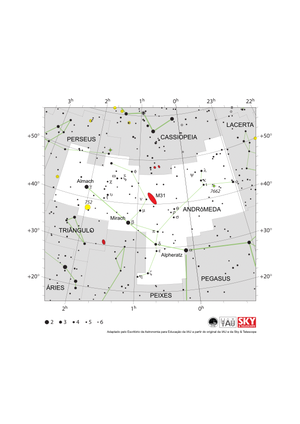
Legenda: A constelação de Andrômeda mostrando as estrelas brilhantes e as constelações vizinhas. Andrômeda é cercada por (no sentido horário a partir do topo) Cassiopeia, Lacerta, Pegasus, Peixes, Áries, Triângulo e Perseu. A estrela mais brilhante de Andrômeda (Alpheratz) está na parte inferior da constelação. Juntamente com três estrelas em Pegasus, ela forma o asterismo conhecido como o "Grande Quadrado de Pegasus". As próximas duas estrelas brilhantes da constelação (Mirach e Almach) formam uma linha que se estende a nordeste de Alpheratz.
Andrômeda é uma constelação do norte e é mais visível nas noites de outono do Hemisfério Norte. É visível de todo o hemisfério norte e da maioria das regiões temperadas do hemisfério sul, mas não é visível das regiões antárticas e subantárticas.
O objeto mais famoso de Andrômeda, a Galáxia de Andrômeda, está marcado aqui com uma elipse vermelha e seu número de catálogo Messier M31.
O círculo amarelo à esquerda marca a posição do aglomerado aberto NGC 752 e o círculo verde à direita marca a NGC 7662 (a nebulosa bola de neve azul), uma nebulosa planetária.
O eixo y desse diagrama está em graus de declinação, com o norte para cima, e o eixo x está em horas de ascensão reta, com o leste à esquerda. Os tamanhos das estrelas marcadas aqui estão relacionados à magnitude aparente da estrela, uma medida de seu brilho aparente. Os pontos maiores representam estrelas mais brilhantes. As letras gregas marcam as estrelas mais brilhantes da constelação. Elas são classificadas por brilho, com a estrela mais brilhante sendo rotulada como alfa, a segunda mais brilhante como beta etc., embora essa ordem nem sempre seja seguida exatamente.
Crédito: Adaptado pelo Escritório de Astronomia para Educação da IAU a partir do original da IAU/Sky & Telescope
Link do crédito
Termos do Glossário:
Andrômeda , Galáxia de Andrômeda , Magnitude aparente , Constelação , Declinação , Nebulosa Planetária , Ascensão Reta (AR) , Aglomerado aberto
Categorias
Astronomia a Olho Nu
Licença: Creative Commons Attribution 4.0 International (CC BY 4.0) Creative Commons Attribution 4.0 International (CC BY 4.0) ícones
Arquivo
( imagem
110.93 kB)
Arquivo PDF
(PDF file
198.23 kB)
Coma Berenices Constellation Map
imagem
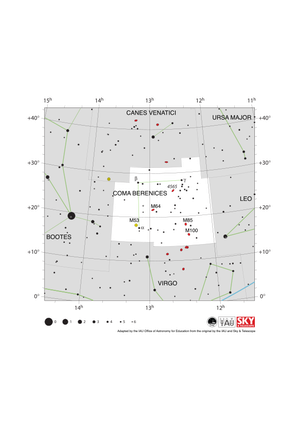
Legenda: The constellation Coma Berenices with its brighter stars and surrounding constellations. Coma Berenices is surrounded by (going clockwise from the top): Canes Venatici, Ursa Major, Leo, Virgo and Boötes. This constellation has relatively few bright stars.
Coma Berenices is a northern constellation close to the celestial equator. As such the whole constellation is visible at some point in the year everywhere on Earth except the most antarctic regions. The constellation is best viewed in the evening in the northern hemisphere late spring and southern hemisphere late autumn.
Coma Berenices is home to a large cluster of galaxies known as the Coma Supercluster. However none of the galaxies in this cluster are marked on this diagram as they are too faint to observe with most amateur telescopes. The elliptical galaxy M85 and the spiral galaxy M100 are members of the nearer Virgo cluster of galaxies. These are marked with red ellipses as are the even nearer M64 and NGC 4565, both of which are spiral galaxies. The globular cluster M53, marked here with a yellow circle with a plus sign superimposed on it, also lies in Coma Berenices.
The y-axis of this diagram is in degrees of declination with north as up and the x-axis is in hours of right ascension with east to the left. The sizes of the stars marked here relate to the star's apparent magnitude, a measure of its apparent brightness. The larger dots represent brighter stars. The Greek letters mark the brightest stars in the constellation. These are ranked by brightness with the brightest star being labeled alpha, the second brightest beta, etc., although this ordering is not always followed exactly. The dotted boundary lines mark the IAU's boundaries of the constellations and the solid green lines mark one of the common forms used to represent the figures of the constellations. The blue line at the bottom right of the diagram marks the ecliptic. Neither the constellation boundaries, nor the line marking the ecliptic, nor the lines joining the stars appear on the sky.
Crédito: Adapted by the IAU Office of Astronomy for Education from the original by the IAU and Sky & Telescope
Link do crédito
Termos do Glossário:
Magnitude aparente , Coordenadas celestes , Aglomerado de galáxias , Constelação , Declinação , Eclíptica , Galáxia Elíptica , Leo , Ascensão Reta (AR) , Galáxia espiral , Virgem
Categorias
Astronomia a Olho Nu
Licença: Creative Commons Attribution 4.0 International (CC BY 4.0) Creative Commons Attribution 4.0 International (CC BY 4.0) ícones
Arquivo
( imagem
87.27 kB)
Arquivo PDF
(PDF file
161.42 kB)

Norma Constellation Map
imagem
Legenda: The constellation Norma with its brighter stars and surrounding constellations. Norma is surrounded by (going clockwise from the top): Scorpius, Lupus, Circinus, Triangulum Australe and Ara. Norma is a faint constellation with relatively few bright stars.
Norma is a southern constellation and thus the whole constellation is visible at some point in the year throughout the southern hemisphere. The whole constellation is also visible from equatorial regions of the northern hemisphere with parts of the constellation visible from some northern hemisphere temperate regions. Norma is best viewed in the evening in the northern hemisphere summer and southern hemisphere winter.
The open clusters NGC 6025 and NGC 6087 lie in Norma and are marked here with yellow circles.
The y-axis of this diagram is in degrees of declination with north as up and the x-axis is in hours of right ascension with east to the left. The sizes of the stars marked here relate to the star's apparent magnitude, a measure of its apparent brightness. The larger dots represent brighter stars. The Greek letters mark the brightest stars in the constellation. These are ranked by brightness with the brightest star being labeled alpha, the second brightest beta, etc., although this ordering is not always followed exactly. The dotted boundary lines mark the IAU's boundaries of the constellations and the solid green lines mark one of the common forms used to represent the figures of the constellations. Neither the constellation boundaries, nor the lines joining the stars appear on the sky.
Crédito: Adapted by the IAU Office of Astronomy for Education from the original by the IAU and Sky & Telescope
Link do crédito
Termos do Glossário:
Magnitude aparente , Coordenadas celestes , Constelação , Declinação , Ascensão Reta (AR) , Escorpião , Aglomerado aberto
Categorias
Astronomia a Olho Nu
Licença: Creative Commons Attribution 4.0 International (CC BY 4.0) Creative Commons Attribution 4.0 International (CC BY 4.0) ícones
Arquivo
( imagem
108.17 kB)
Arquivo PDF
(PDF file
166.47 kB)

Scutum Constellation Map
imagem
Legenda: The constellation Scutum with its brighter stars and surrounding constellations. Scutum is surrounded by (going clockwise from the top): Serpens Cauda, Sagittarius and Aquila.
Scutum is a southern constellation and thus the whole constellation is visible at some point in the year throughout the southern hemisphere. The whole constellation is also visible from equatorial and temperate regions of the northern hemisphere with parts of the constellation visible from all but the most arctic regions.
Two open clusters lie in Scutum: M11, commonly known as the Wild Duck Cluster; and M26. Both of these are marked here with yellow circles.
The y-axis of this diagram is in degrees of declination with north as up and the x-axis is in hours of right ascension with east to the left. The sizes of the stars marked here relate to the star's apparent magnitude, a measure of its apparent brightness. The larger dots represent brighter stars. The Greek letters mark the brightest stars in the constellation. These are ranked by brightness with the brightest star being labeled alpha, the second brightest beta, etc., although this ordering is not always followed exactly. The dotted boundary lines mark the IAU's boundaries of the constellations and the solid green lines mark one of the common forms used to represent the figures of the constellations. The blue line at the bottom of the diagram marks the ecliptic. Neither the constellation boundaries, nor the lines joining the stars, nor the ecliptic, appear on the sky.
Crédito: Adapted by the IAU Office of Astronomy for Education from the original by the IAU and Sky & Telescope
Link do crédito
Termos do Glossário:
Magnitude aparente , Coordenadas celestes , Constelação , Declinação , Ascensão Reta (AR) , Aglomerado aberto
Categorias
Astronomia a Olho Nu
Licença: Creative Commons Attribution 4.0 International (CC BY 4.0) Creative Commons Attribution 4.0 International (CC BY 4.0) ícones
Arquivo
( imagem
96.44 kB)
Arquivo PDF
(PDF file
162.71 kB)

Triangulum Australe Constellation Map
imagem
Legenda: The constellation Triangulum Australe with its bright stars and surrounding constellations. Triangulum Australe is surrounded by (going clockwise from the top): Norma, Circinus, Apus and Ara.
Triangulum Australe is a southern constellation and thus the whole constellation is visible at some point in the year throughout the southern hemisphere. The whole constellation is also visible from some equatorial regions of the northern hemisphere with parts of the constellation visible from the remaining northern equatorial regions. Triangulum Australe is best viewed in the evening in the northern hemisphere summer and southern hemisphere winter.
The open cluster NGC 6025 lies in Triangulum Australe and is marked here with a yellow circle.
The y-axis of this diagram is in degrees of declination with north as up and the x-axis is in hours of right ascension with east to the left. The sizes of the stars marked here relate to the star's apparent magnitude, a measure of its apparent brightness. The larger dots represent brighter stars. The Greek letters mark the brightest stars in the constellation. These are ranked by brightness with the brightest star being labeled alpha, the second brightest beta, etc., although this ordering is not always followed exactly. The dotted boundary lines mark the IAU's boundaries of the constellations and the solid green lines mark one of the common forms used to represent the figures of the constellations. Neither the constellation boundaries, nor the lines joining the stars appear on the sky.
Crédito: Adapted by the IAU Office of Astronomy for Education from the original by the IAU and Sky & Telescope
Link do crédito
Termos do Glossário:
Magnitude aparente , Coordenadas celestes , Constelação , Declinação , Ascensão Reta (AR) , Aglomerado aberto
Categorias
Astronomia a Olho Nu
Licença: Creative Commons Attribution 4.0 International (CC BY 4.0) Creative Commons Attribution 4.0 International (CC BY 4.0) ícones
Arquivo
( imagem
112.83 kB)
Arquivo PDF
(PDF file
166.92 kB)


