Documentos e recursos — Resultados da busca
Resultados da busca
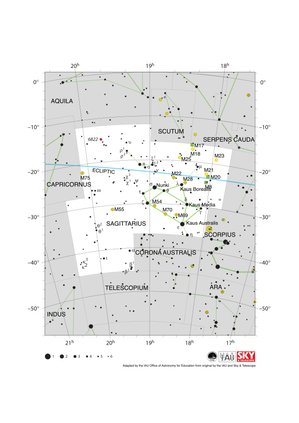
Sagittarius Constellation Map
imagem
Legenda: The constellation Sagittarius along with its bright stars and surrounding constellations. Sagittarius is surrounded by (going clockwise from the top) Aquila, Scutum, Serpens Cauda, Ophiuchus, Scorpius, Corona Australis, Telescopium, Microscopium and Capricornus. The brighter stars in Sagittarius form a distinctive teapot shape. Sagittarius lies on the ecliptic (shown here as a blue line), this is the path the Sun appears to take across the sky over the course of a year. The Sun is in Sagittarius from mid December to mid January. The other planets of the Solar System can often be found in Sagittarius.
Sagittarius lies south of the celestial equator. The famous teapot asterism is visible for all but the most arctic regions of the world but the most southerly parts of the constellation are not visible in northern parts of Asia, Europe and North America. Sagittarius is most visible in the evenings in the northern hemisphere summer and southern hemisphere winter.
The supermassive black hole Sagittarius A* which lies at the center of our Milky Way Galaxy is sits on the western (here right-hand) edge of Sagittarius. Due to it covering an area at the center of our Galaxy, Sagittarius is home to many star clusters including open clusters (marked here with yellow circles) and globular clusters (marked here with yellow circles with + signs superimposed on them). Three nebulae are also marked here with green squares.
The y-axis of this diagram is in degrees of declination with north as up and the x-axis is in hours of right ascension with east to the left. The sizes of the stars marked here relate to the star's apparent magnitude, a measure of its apparent brightness. The larger dots represent brighter stars. The Greek letters mark the brightest stars in the constellation. These are ranked by brightness with the brightest star being labeled alpha, the second brightest beta, etc., although this ordering is not always followed exactly. The dotted boundary lines mark the IAU's boundaries of the constellations and the solid green lines mark one of the common forms used to represent the figures of the constellations. Neither the constellation boundaries, nor the line marking the ecliptic, nor the lines joining the stars appear on the sky.
Crédito: Adapted by the IAU Office of Astronomy for Education from the original by IAU/Sky & Telescope
Link do crédito
Termos do Glossário:
Magnitude aparente , Capricórnio , Coordenadas celestes , Constelação , Declinação , Eclíptica , Aglomerado Globular , Via Láctea , Nebulosa , Ascensão Reta (AR) , Sagitário A* , Escorpião , Buraco negro supermassivo , Zodíaco , Asterismo , Aglomerado aberto , Sagitário
Categorias
Astronomia a Olho Nu
Licença: Creative Commons Attribution 4.0 International (CC BY 4.0) Creative Commons Attribution 4.0 International (CC BY 4.0) ícones
Arquivo
( imagem
150.62 kB)
Arquivo PDF
(PDF file
219.78 kB)
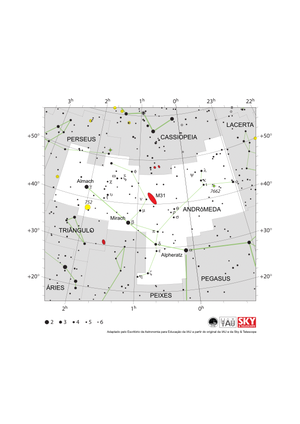
Mapa da Constelação de Andrômeda
imagem
Legenda: A constelação de Andrômeda mostrando as estrelas brilhantes e as constelações vizinhas. Andrômeda é cercada por (no sentido horário a partir do topo) Cassiopeia, Lacerta, Pegasus, Peixes, Áries, Triângulo e Perseu. A estrela mais brilhante de Andrômeda (Alpheratz) está na parte inferior da constelação. Juntamente com três estrelas em Pegasus, ela forma o asterismo conhecido como o "Grande Quadrado de Pegasus". As próximas duas estrelas brilhantes da constelação (Mirach e Almach) formam uma linha que se estende a nordeste de Alpheratz.
Andrômeda é uma constelação do norte e é mais visível nas noites de outono do Hemisfério Norte. É visível de todo o hemisfério norte e da maioria das regiões temperadas do hemisfério sul, mas não é visível das regiões antárticas e subantárticas.
O objeto mais famoso de Andrômeda, a Galáxia de Andrômeda, está marcado aqui com uma elipse vermelha e seu número de catálogo Messier M31.
O círculo amarelo à esquerda marca a posição do aglomerado aberto NGC 752 e o círculo verde à direita marca a NGC 7662 (a nebulosa bola de neve azul), uma nebulosa planetária.
O eixo y desse diagrama está em graus de declinação, com o norte para cima, e o eixo x está em horas de ascensão reta, com o leste à esquerda. Os tamanhos das estrelas marcadas aqui estão relacionados à magnitude aparente da estrela, uma medida de seu brilho aparente. Os pontos maiores representam estrelas mais brilhantes. As letras gregas marcam as estrelas mais brilhantes da constelação. Elas são classificadas por brilho, com a estrela mais brilhante sendo rotulada como alfa, a segunda mais brilhante como beta etc., embora essa ordem nem sempre seja seguida exatamente.
Crédito: Adaptado pelo Escritório de Astronomia para Educação da IAU a partir do original da IAU/Sky & Telescope
Link do crédito
Termos do Glossário:
Andrômeda , Galáxia de Andrômeda , Magnitude aparente , Constelação , Declinação , Nebulosa Planetária , Ascensão Reta (AR) , Aglomerado aberto
Categorias
Astronomia a Olho Nu
Licença: Creative Commons Attribution 4.0 International (CC BY 4.0) Creative Commons Attribution 4.0 International (CC BY 4.0) ícones
Arquivo
( imagem
110.93 kB)
Arquivo PDF
(PDF file
198.23 kB)





