Documentos e recursos — Resultados da busca
Resultados da busca
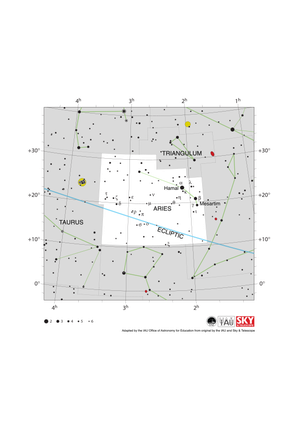
Aries Constellation Map
imagem
Legenda: The constellation Aries along with its bright stars and surrounding constellations. Aries is surrounded by (going clockwise from the top) Triangulum, Pisces, Cetus, Taurus and Perseus. Aries lies on the ecliptic (shown here as a blue line), this is the path the Sun appears to take across the sky over the course of a year. The Sun is in Aries from mid April to mid May. The other planets of the Solar System can often be found in Aries.
Aries lies just north of the celestial equator and is thus visible at some time in the year from all of planet Earth except for the most antarctic regions of the world. Aries is most visible in the evenings in the northern hemisphere winter and southern hemisphere summer.
The y-axis of this diagram is in degrees of declination with north as up and the x-axis is in hours of right ascension with east to the left. The sizes of the stars marked here relate to the star's apparent magnitude, a measure of its apparent brightness. The larger dots represent brighter stars. The Greek letters mark the brightest stars in the constellation. These are ranked by brightness with the brightest star being labeled alpha, the second brightest beta, etc., although this ordering is not always followed exactly. The dotted boundary lines mark the IAU's boundaries of the constellations and the solid green lines mark one of the common forms used to represent the figures of the constellations. Neither the constellation boundaries, nor the line marking the ecliptic, nor the lines joining the stars appear on the sky.
Crédito: Adapted by the IAU Office of Astronomy for Education from the original by IAU/Sky & Telescope
Link do crédito
Termos do Glossário:
Magnitude aparente , Áries , Coordenadas celestes , Constelação , Declinação , Eclíptica , Peixes , Ascensão Reta (AR) , Touro , Zodíaco
Categorias
Astronomia a Olho Nu
Licença: Creative Commons Attribution 4.0 International (CC BY 4.0) Creative Commons Attribution 4.0 International (CC BY 4.0) ícones
Arquivo
( imagem
96.59 kB)
Arquivo PDF
(PDF file
178.36 kB)
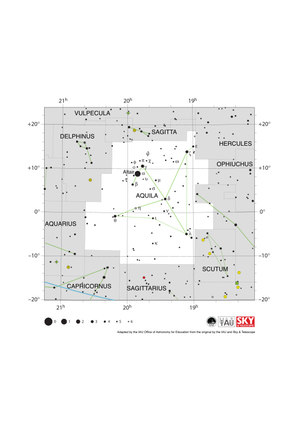
Aquila Constellation Map
imagem
Legenda: The constellation Aquila with its bright stars and surrounding constellations. Aquila is surrounded by (going clockwise from the top): Sagitta, Hercules, Ophiuchus, Serpens Cauda, Scutum, Sagittarius, Capricornus, Aquarius and Delphinus. Aquila is most notable for its brightest star Altair. This forms one vertex of the prominent Summer Triangle asterism that is visible in northern hemisphere summer evenings.
Aquila spans the celestial equator and thus some part of it is visible from all of the Earth at some point in the year. It is most visible in the evenings in the late northern hemisphere summer and late southern hemisphere winter.
The y-axis of this diagram is in degrees of declination with north as up and the x-axis is in hours of right ascension with east to the left. The sizes of the stars marked here relate to the star's apparent magnitude, a measure of its apparent brightness. The larger dots represent brighter stars. The Greek letters mark the brightest stars in the constellation. These are ranked by brightness with the brightest star being labeled alpha, the second brightest beta, etc., although this ordering is not always followed exactly. The dotted boundary lines mark the IAU's boundaries of the constellations and the solid green lines mark one of the common forms used to represent the figures of the constellations. The blue line in the lower right of the diagram is the ecliptic. Neither the constellation boundaries, nor the line marking the ecliptic, nor the lines joining the stars appear on the sky.
Crédito: Adapted by the IAU Office of Astronomy for Education from the original by IAU/Sky & Telescope
Link do crédito
Termos do Glossário:
Magnitude aparente , Capricórnio , Coordenadas celestes , Equador Celeste , Constelação , Declinação , Eclíptica , Ascensão Reta (AR) , Aquário , Asterismo
Categorias
Astronomia a Olho Nu
Licença: Creative Commons Attribution 4.0 International (CC BY 4.0) Creative Commons Attribution 4.0 International (CC BY 4.0) ícones
Arquivo
( imagem
95.28 kB)
Arquivo PDF
(PDF file
175.09 kB)
Eridanus Constellation Map
imagem
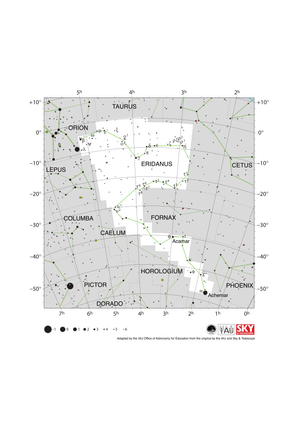
Legenda: The constellation Eridanus with its bright stars and surrounding constellations. Eridanus is surrounded by (going clockwise from the top): Taurus, Cetus, Fornax, Phoenix, Tucana, Hydrus, Horologium, Caelum, Lepus and Orion.
Eridanus is a large constellation that spans a wide range in declination. A small portion of the constellation is in the northern hemisphere with the southern-most point lying at a declination of almost -60°. As it spans the celestial equator, parts of the constellation are visible to the whole Earth at some point in the year. The whole constellation can be observed from northern and southern equatorial regions, southern temperate regions and most of Antarctica. Eridanus is best viewed in the evening in the northern hemisphere winter and southern hemisphere summer.
The y-axis of this diagram is in degrees of declination with north as up and the x-axis is in hours of right ascension with east to the left. The sizes of the stars marked here relate to the star's apparent magnitude, a measure of its apparent brightness. The larger dots represent brighter stars. The Greek letters mark the brightest stars in the constellation. These are ranked by brightness with the brightest star being labeled alpha, the second brightest beta, etc., although this ordering is not always followed exactly. The dotted boundary lines mark the IAU's boundaries of the constellations and the solid green lines mark one of the common forms used to represent the figures of the constellations. Neither the constellation boundaries, nor the lines joining the stars appear on the sky.
Crédito: Adapted by the IAU Office of Astronomy for Education from the original by the IAU and Sky & Telescope
Link do crédito
Termos do Glossário:
Magnitude aparente , Coordenadas celestes , Constelação , Declinação , Ascensão Reta (AR) , Touro , Órion
Categorias
Astronomia a Olho Nu
Licença: Creative Commons Attribution 4.0 International (CC BY 4.0) Creative Commons Attribution 4.0 International (CC BY 4.0) ícones
Arquivo
( imagem
148.42 kB)
Arquivo PDF
(PDF file
243.47 kB)
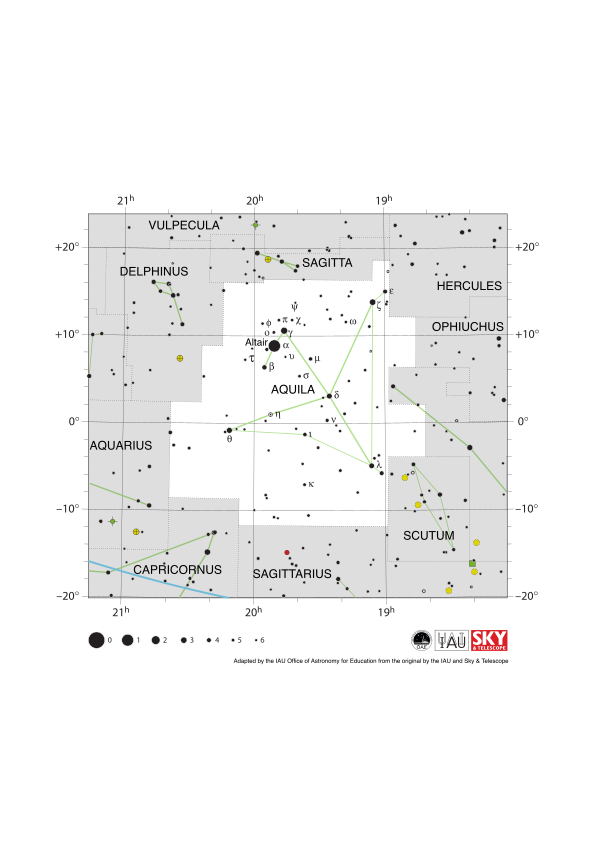
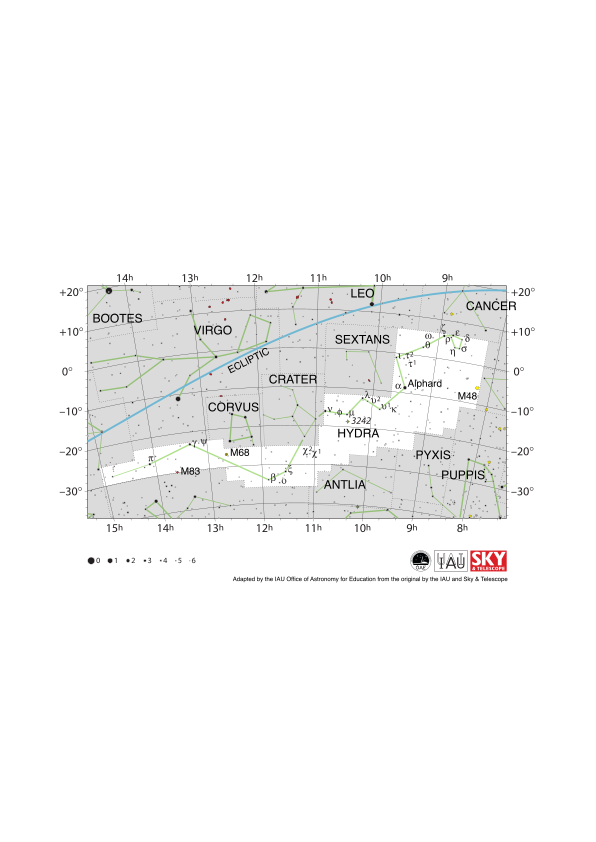
Hydra Constellation Map
imagem
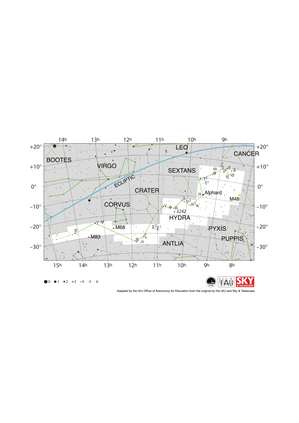
Legenda: The constellation Hydra with its bright stars and surrounding constellations. Hydra is surrounded by (going clockwise from the top): Leo, Cancer, Canis Minor, Monoceros, Puppis, Pyxis, Antlia, Centaurus, Lupus, Libra, Virgo, Corvus, Crater and Sextans.
Hydra is a large constellation that covers over a quarter of the celestial sphere in right ascension. It also spans the celestial equator and thus part of the constellation is visible from everywhere on the Earth at some point in the year. All parts of the constellation are visible at some point for all but the most antarctic parts of the southern hemisphere and to equatorial and most temperate regions of the northern hemisphere. However the wide span of the constellation means that all of it may not be visible at the same time in many of these regions. Hydra is best viewed in the northern hemisphere spring and southern hemisphere autumn.
The famous spiral galaxy M83, also known as the Pinwheel Galaxy, lies in Hydra. It is marked here with a red ellipse. The planetary nebula NGC 3242 can also be found in Hydra. It is marked here with a green circle with a plus sign superimposed on it. The open cluster M48 is marked here with a yellow circle while the globular cluster M68 is marked with a yellow circle with a plus sign superimposed on it.
The y-axis of this diagram is in degrees of declination with north as up and the x-axis is in hours of right ascension with east to the left. The sizes of the stars marked here relate to the star's apparent magnitude, a measure of its apparent brightness. The larger dots represent brighter stars. The Greek letters mark the brightest stars in the constellation. These are ranked by brightness with the brightest star being labeled alpha, the second brightest beta, etc., although this ordering is not always followed exactly. The dotted boundary lines mark the IAU's boundaries of the constellations and the solid green lines mark one of the common forms used to represent the figures of the constellations. The blue line on the diagram marks the ecliptic. Neither the constellation boundaries, nor the line marking the ecliptic, nor the lines joining the stars appear on the sky.
Crédito: Adapted by the IAU Office of Astronomy for Education from the original by the IAU and Sky & Telescope
Link do crédito
Termos do Glossário:
Magnitude aparente , Coordenadas celestes , Constelação , Declinação , Eclíptica , Aglomerado Globular , Libra , Nebulosa Planetária , Ascensão Reta (AR) , Galáxia espiral , Câncer , Aglomerado aberto , Virgem
Categorias
Astronomia a Olho Nu
Licença: Creative Commons Attribution 4.0 International (CC BY 4.0) Creative Commons Attribution 4.0 International (CC BY 4.0) ícones
Arquivo
( imagem
114.60 kB)
Arquivo PDF
(PDF file
253.49 kB)
Capricornus Constellation Map
imagem
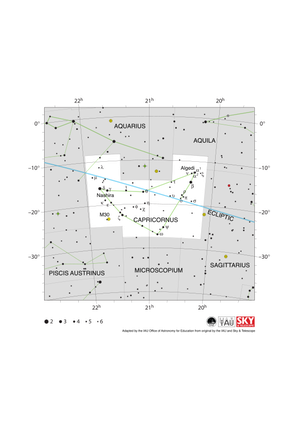
Legenda: The constellation Capricornus (commonly called Capricorn) including its bright stars and surrounding constellations. Capricornus is surrounded by (going clockwise from the top) Aquarius, Aquila, Sagittarius, Microscopium and Piscis Austrinus. Capricornus lies on the ecliptic (shown here as a blue line), this is the path the Sun appears to take across the sky over the course of a year. The Sun is in Capricornus from mid January to mid February. The other planets of the Solar System can often be found in Capricornus.
Capricornus lies just south of the celestial equator and is visible to all observers south of the Arctic Circle. Capricornus is most visible in the evenings in the northern hemisphere autumn and southern hemisphere spring.
In the south east (lower left on this diagram) of the constellation one can find the globular cluster M30 (shown here as a yellow circle with a plus sign superimposed on it).
The y-axis of this diagram is in degrees of declination with north as up and the x-axis is in hours of right ascension with east to the left. The sizes of the stars marked here relate to the star's apparent magnitude, a measure of its apparent brightness. The larger dots represent brighter stars. The Greek letters mark the brightest stars in the constellation. These are ranked by brightness with the brightest star being labeled alpha, the second brightest beta, etc., although this ordering is not always followed exactly. The dotted boundary lines mark the IAU's boundaries of the constellations and the solid green lines mark one of the common forms used to represent the figures of the constellations. Neither the constellation boundaries, nor the line marking the ecliptic, nor the lines joining the stars appear on the sky.
Crédito: Adapted by the IAU Office of Astronomy for Education from the original by IAU/Sky & Telescope
Link do crédito
Termos do Glossário:
Magnitude aparente , Capricórnio , Coordenadas celestes , Constelação , Declinação , Eclíptica , Aglomerado Globular , Ascensão Reta (AR) , Zodíaco , Aquário , Sagitário , Trópico de Capricórnio
Categorias
Astronomia a Olho Nu
Licença: Creative Commons Attribution 4.0 International (CC BY 4.0) Creative Commons Attribution 4.0 International (CC BY 4.0) ícones
Arquivo
( imagem
97.98 kB)
Arquivo PDF
(PDF file
180.85 kB)