Documentos e recursos — Resultados da busca
Resultados da busca
Carina Constellation Map
imagem
Legenda: The constellation Carina along with its bright stars and surrounding constellations. Carina is surrounded by (going clockwise from the top): Vela, Puppis, Pictor, Volans, Chamaeleon, Musca and Centaurus. Carina is notable for Canopus, the second brightest star in the night sky and for the famous variable star Eta Carinae. This latter object is a binary star system of two young very massive stars. Its brightness has varied greatly over the past few centuries. At one point it outshone Canopus before dimming by a factor of four thousand to become invisible to the naked eye. In recent years it has brightened enough to again be visible without the aid of a telescope.
Carina is a southern constellation and thus the whole constellation is visible at some point in the year to the entire southern hemisphere. The whole constellation is also visible from equatorial regions of the northern hemisphere with parts of the constellation visible from northern temperate regions.
The open clusters NGC 2516, NGC 3532 and IC 2602 lie in Carina. These are marked here by yellow circles. The Carina Nebula, also known as NGC 3372, lies in the constellation. This large nebula contains many massive young stars, including Eta Carinae.
This diagram maps an area around the south celestial pole. Here lines of constant right ascension converge. The right ascension values of these lines are marked on the x-axis above and below the diagram. Some of the lines of constant declination are marked on the y-axis. The sizes of the stars marked here relate to the star's apparent magnitude, a measure of its apparent brightness. The larger dots represent brighter stars. The Greek letters mark the brightest stars in the constellation. These are ranked by brightness with the brightest star being labeled alpha, the second brightest beta, etc., although this ordering is not always followed exactly. Carina was previously part of the larger Argo Navis constellation along with Vela and Puppis. As the letter designations for stars were created before this division took place, Greek letter designations are now divided between the three constellations with Carina having stars designated alpha and beta but no gamma or delta. The dotted boundary lines mark the IAU's boundaries of the constellations and the solid green lines mark one of the common forms used to represent the figures of the constellations. Neither the constellation boundaries, nor the lines joining the stars appear on the sky.
Crédito: Adapted by the IAU Office of Astronomy for Education from the original by the IAU and Sky & Telescope
Link do crédito
Termos do Glossário:
Magnitude aparente , Estrela binária , Coordenadas celestes , Constelação , Declinação , Nebulosa , Ascensão Reta (AR) , Aglomerado aberto , Estrela variável
Categorias
Astronomia a Olho Nu
Licença: Creative Commons Attribution 4.0 International (CC BY 4.0) Creative Commons Attribution 4.0 International (CC BY 4.0) ícones
Arquivo
( imagem
144.72 kB)
Arquivo PDF
(PDF file
214.81 kB)

Gemini Constellation Map
imagem
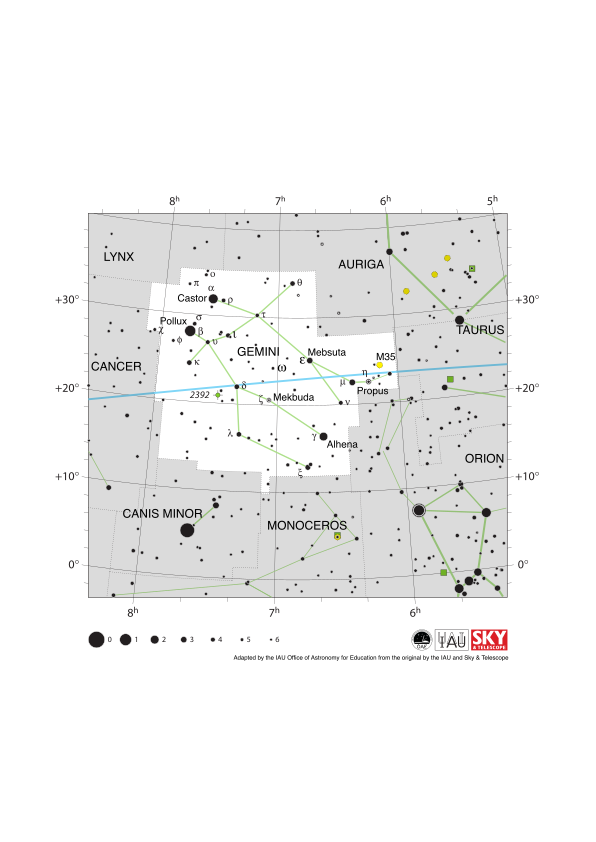
Legenda: The zodiac constellation Gemini and its surrounding constellations. Starting from the top of the diagram and going clockwise, these are Auriga, Taurus, Lynx, Orion, Monoceros, Canis Minor and Cancer. The brightest stars in Gemini, Castor and Pollux appear in the upper lefthand corner (north-east) of the diagram. In Greek mythology, the stars in this constellation are thought to resemble twins with their arms wrapped around each other, with Castor and Pollux indicating their heads. Gemini lies on the ecliptic (shown here as a blue line), this is the path the Sun appears to take across the sky over the course of a year. The Sun is in Gemini from late June to late July. The other planets of the Solar System can often be found in Gemini.
Gemini lies north of the celestial equator and is visible in all but the antarctic regions of the world. Gemini is most visible in the evenings in the northern hemisphere winter and southern hemisphere summer.
Just to the right of the foot of the Castor twin is an open cluster of stars (labelled as a yellow circle with a dotted line border), Messier 35, also known as the Shoe-Buckle Cluster. This cluster is spread out over an area roughly the size of the full moon. In addition to this cluster of stars, there is a planetary nebula (labelled as a green circle with four radial spikes) – NGC 2392 – near the celestial equator and just to the left of the Pollux twin. Two variable stars (Mekbuda and Propus; labelled as two concentric circles) can be found in the “legs” of each twin, but are so faint that an observer would need dark skies to see them.
The y-axis of this diagram is in degrees of declination with north as up and the x-axis is in hours of right ascension with east to the left. The sizes of the stars marked here relate to the star's apparent magnitude, a measure of its apparent brightness. The larger dots represent brighter stars. The Greek letters mark the brightest stars in the constellation. These are ranked by brightness with the brightest star being labelled alpha, the second brightest beta, etc., although this ordering is not always followed exactly. The dotted boundary lines mark the IAU's boundaries of the constellations and the solid green lines mark one of the common forms used to represent the figures of the constellations. Neither the constellation boundaries, nor the line marking the ecliptic, nor the lines joining the stars appear on the sky.
Crédito: Adapted by the IAU Office of Astronomy for Education from the original by IAU/Sky & Telescope
Link do crédito
Termos do Glossário:
Magnitude aparente , Coordenadas celestes , Constelação , Declinação , Eclíptica , Gêmeos , Ascensão Reta (AR) , Touro , Zodíaco
Categorias
Astronomia a Olho Nu
Licença: Creative Commons Attribution 4.0 International (CC BY 4.0) Creative Commons Attribution 4.0 International (CC BY 4.0) ícones
Arquivo
( imagem
111.96 kB)
Arquivo PDF
(PDF file
187.83 kB)
Virgo Constellation Map
imagem
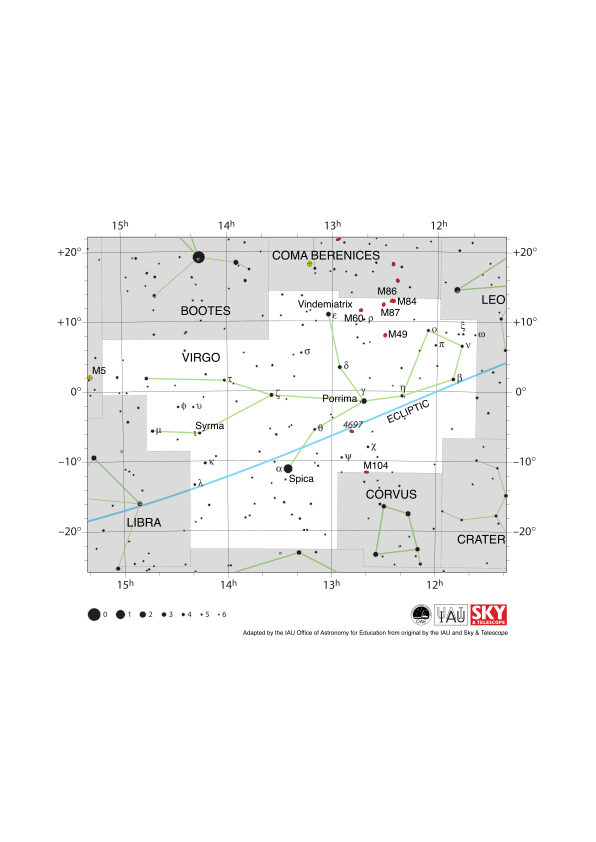
Legenda: The zodiac constellation Virgo and its surrounding constellations. Starting from the top of the diagram and going clockwise, these are Coma Berenices, Leo, Crater, Corvus, Libra, and Bootes. The brightest star in Virgo, Spica, lies just below the ecliptic (shown here as a blue line) in the middle of the map. One way of locating this star in the night sky is to follow the handle of the Big Dipper to the star Arcturus in Bootes and go along a line straight down to Spica (“arc to Arcturus and spike to Spica”). This star lies just below the ecliptic. The ecliptic is the path the Sun appears to take across the sky over the course of a year. The Sun is in Virgo from mid September to late October. The other planets of the Solar System can often be found in Virgo.
Virgo spans the celestial equator and is thus part of it is visible at some time in the year from all of planet Earth with some of the constellation obscured for the most arctic and antarctic regions of the world. Virgo is most visible in the evenings in the northern hemisphere spring and southern hemisphere autumn.
The constellation Virgo appears as a person lying with their back roughly against the ecliptic, arms outstretched, and feet pointed east. Several deep-sky objects are visible in Virgo, including NGC4697, M49, M87, M86, M84, and M60, all of which are labelled as red ellipses on the map. These are all spiral and elliptical galaxies located several millions of lightyears from Earth. Most notably, M87 is host to the supermassive black hole (Pōwehi) that was imaged by the Event Horizon Telescope in 2019. All of these galaxies are members of the Virgo Cluster, the nearest cluster of galaxies to the Milky Way.
The y-axis of this diagram is in degrees of declination with north as up and the x-axis is in hours of right ascension with east to the left. The sizes of the stars marked here relate to the star's apparent magnitude, a measure of its apparent brightness. The larger dots represent brighter stars. The Greek letters mark the brightest stars in the constellation. These are ranked by brightness with the brightest star being labelled alpha, the second brightest beta, etc., although this ordering is not always followed exactly. The dotted boundary lines mark the IAU's boundaries of the constellations and the solid green lines mark one of the common forms used to represent the figures of the constellations. Neither the constellation boundaries, nor the line marking the ecliptic, nor the lines joining the stars appear on the sky.
Crédito: Adapted by the IAU Office of Astronomy for Education from the original by IAU/Sky & Telescope
Link do crédito
Termos do Glossário:
Magnitude aparente , A Grande Concha (Big Dipper, em inglês) , Coordenadas celestes , Aglomerado de galáxias , Constelação , Declinação , Eclíptica , Galáxia Elíptica , Leo , Libra , Ascensão Reta (AR) , Galáxia espiral , Buraco negro supermassivo , Zodíaco , Virgem
Categorias
Astronomia a Olho Nu
Licença: Creative Commons Attribution 4.0 International (CC BY 4.0) Creative Commons Attribution 4.0 International (CC BY 4.0) ícones
Arquivo
( imagem
94.70 kB)
Arquivo PDF
(PDF file
188.33 kB)

Ursa Major Constellation Map
imagem
Legenda: The constellation Ursa Major along with its bright stars and its surrounding constellations. Ursa Major is surrounded by (going clockwise from the top): Draco, Camelopardalis, Lynx, Leo Minor, Leo, Coma Berenices, Canes Venatici and Boötes. Ursa Major is famous for the prominent asterism often known in English as the Big Dipper or the Plough. This prominent northern asterism has a wide variety of names from cultures across the world. While most constellations and asterisms are made up of unrelated stars that randomly appear close together on the sky, five of the stars in the Big Dipper are part of the Ursa Major Moving Group, a group of stars moving through space together that likely formed in the same location 300 million years ago. The two stars on the right-hand end of the Big Dipper on this diagram form a pair of pointer stars that can be used to locate Polaris, the northern pole star which lies in the constellation of Ursa Minor.
Ursa Major is a northern constellation and is visible from northern and equatorial regions. Parts of the constellation are visible from all but the most antarctic parts of the southern hemisphere but not all temperate regions of the southern hemisphere can see all of the Big Dipper. Conversely the Big Dipper and much of the rest of the constellation are circumpolar in arctic and many temperate regions of the northern hemisphere. Ursa Major is most visible in the evening in the northern hemisphere spring and southern hemisphere autumn.
Two prominent galaxies appear in the northern part of this constellation, the spiral galaxy M81 and M82, a possible spiral galaxy whose structure is difficult to observe from the Earth as it appears edge-on. Both are shown here as red ellipses. The planetary nebula M97 (the Owl Nebula) lies in the middle of the constellation and is marked by a green circle superimposed on a plus symbol.
The y-axis of this diagram is in degrees of declination with north as up and the x-axis is in hours of right ascension with east to the left. The sizes of the stars marked here relate to the star's apparent magnitude, a measure of its apparent brightness. The larger dots represent brighter stars. The Greek letters mark the brightest stars in the constellation. These are ranked by brightness with the brightest star being labeled alpha, the second brightest beta, etc., although this ordering is not always followed exactly. The dotted boundary lines mark the IAU's boundaries of the constellations and the solid green lines mark one of the common forms used to represent the figures of the constellations. Neither the constellation boundaries, nor the lines joining the stars appear on the sky.
Crédito: Adapted by the IAU Office of Astronomy for Education from the original by IAU/Sky & Telescope
Link do crédito
Termos do Glossário:
Magnitude aparente , A Grande Concha (Big Dipper, em inglês) , Coordenadas celestes , Estrelas circumpolares , Constelação , Declinação , Leo , Nebulosa Planetária , Ascensão Reta (AR) , Galáxia espiral , Asterismo
Categorias
Astronomia a Olho Nu
Licença: Creative Commons Attribution 4.0 International (CC BY 4.0) Creative Commons Attribution 4.0 International (CC BY 4.0) ícones
Arquivo
( imagem
143.67 kB)
Arquivo PDF
(PDF file
215.83 kB)

Centaurus Constellation Map
imagem
Legenda: The constellation Centaurus with its bright stars and surrounding constellations. Centaurus is surrounded by (going clockwise from the top): Hydra, Antlia, Vela, Carina, Musca, Crux, Circinus, Lupus and Libra. Centaurus is a large constellation most notable for its brightest star Alpha Centauri. Alpha Centauri is a triple star system and is the nearest star system to the Solar System. When viewed with the naked eye, the two brightest components of Alpha Centauri appear as one star. The combined light from these two stars makes Alpha Centauri appear as the third brightest star in the night sky. The third component of the Alpha Centauri system Proxima Centauri, the nearest star to the Sun, is too faint to be viewed with the naked eye.
Centaurus is a southern constellation and thus the whole constellation is visible from the southern hemisphere at some point in the year. The whole constellation is also visible from equatorial regions of the northern hemisphere with parts of the constellation visible from temperate northern regions. The constellation is best viewed in the evening in the late northern hemisphere spring and late southern hemisphere autumn.
The globular cluster Omega Centauri, also known as NGC 5319, lies in Centaurus. Bright enough to be seen with the naked eye, this cluster was initially given a designation as a star in the constellation before its true nature was realised. It is marked here with a yellow circle with a plus sign superimposed on it. As is the globular cluster NGC 5286. The open cluster NGC 3766 is marked here with a yellow circle. NGC 5128, also known as Centaurus A, is the closest active galaxy to Earth. The supermassive black hole at the heart of this galaxy has launched two huge jets of matter which emit in many different wavelengths including x-ray and radio emission. NGC 5128 is marked with a red ellipse here, as is the edge-on spiral galaxy NGC 4945.
The y-axis of this diagram is in degrees of declination with north as up and the x-axis is in hours of right ascension with east to the left. The sizes of the stars marked here relate to the star's apparent magnitude, a measure of its apparent brightness. The larger dots represent brighter stars. The Greek letters mark the brightest stars in the constellation. These are ranked by brightness with the brightest star being labeled alpha, the second brightest beta, etc., although this ordering is not always followed exactly. The dotted boundary lines mark the IAU's boundaries of the constellations and the solid green lines mark one of the common forms used to represent the figures of the constellations. The blue line in the top left is the ecliptic. Neither the constellation boundaries, nor the line marking the ecliptic, nor the lines joining the stars appear on the sky.
Crédito: Adapted by the IAU Office of Astronomy for Education from the original by the IAU and Sky & Telescope
Link do crédito
Termos do Glossário:
Magnitude aparente , Coordenadas celestes , Constelação , Declinação , Aglomerado Globular , Ascensão Reta (AR) , Aglomerado aberto , Alpha Centauri
Categorias
Astronomia a Olho Nu
Licença: Creative Commons Attribution 4.0 International (CC BY 4.0) Creative Commons Attribution 4.0 International (CC BY 4.0) ícones
Arquivo
( imagem
152.88 kB)
Arquivo PDF
(PDF file
255.96 kB)