Documentos e recursos — Resultados da busca
Resultados da busca

Lua Cheia
imagem
Legenda: A lua cheia fotografada no Hemisfério Sul (Nova Zelândia). Durante esta fase, a metade iluminada da lua é totalmente visível da Terra.
Crédito: Dave Young / dcysurfer
Link do crédito
Termos do Glossário:
Lua Cheia , Fase lunar , Travamento de Maré
Categorias
Sistema Solar
Licença: Creative Commons Attribution 2.0 Generic Creative Commons Attribution 2.0 Generic ícones
Arquivo
( imagem
789.72 kB)

Mare Crisium - Mar de Crises
imagem
Legenda: A imagem mostra o Mare Crisium lunar, o "Mar das Crises", conforme observado pelo Lunar Reconnaissance Orbiter, da NASA, em 2015. O tamanho da foto é de 750 × 750 km, aproximadamente o tamanho da Alemanha. O Mare Crisium está localizado na bacia Crisium da Lua, próximo ao grande Mare Tranquillitatis no lado visível da Lua. Ele é visível da Terra e é caracterizado por uma superfície relativamente lisa e plana cercada por penhascos e planaltos. A bacia que agora contém o Mare Crisium foi formada por um evento de grande impacto, provavelmente durante o período Nectariano, há aproximadamente 3,9 bilhões de anos. Durante esse período da história lunar, as principais bacias, incluindo a base do Crisium, foram formadas por grandes eventos de impacto. Mais tarde na história lunar, a bacia foi inundada por lava, formando a planície escura e plana que vemos hoje. Sua superfície está cerca de 1,8 quilômetro abaixo do nível típico da superfície lunar. O estudo dos mares lunares fornece informações sobre a história vulcânica e os processos de impacto que afetaram a Lua e outros objetos celestes.
Crédito: NASA, Lunar Reconnaissance Orbiter
Link do crédito
Termos do Glossário:
Lua , Mares lunares
Categorias
Sistema Solar
Licença: Domínio Público Domínio Público ícones
Arquivo
( imagem
6.78 MB)

Record-Breaking Off-Earth Driving: Rovers on Mars & the Moon
imagem
Legenda: Part of the Simplifying Astronomy for Arabic Speakers project, this infographic highlights the longest distances traveled by rovers on Mars and the Moon, showcasing space exploration’s progress.
Top Rovers & Their Achievements
Mars: NASA’s Opportunity holds the record, covering 45.16 km between 2004–2018.
Moon: The Soviet Lunokhod 2 leads with 39 km, followed by Apollo rovers:
Apollo 17: 35.74 km
Apollo 15: 27.8 km
Apollo 16: 27.1 km
Mars vs. Moon: Different Challenges
1. Martian Terrain – Mars has a thin atmosphere, dust storms, and rugged landscapes, requiring durable, long-term rovers.
2. Lunar Terrain – The Moon’s cratered surface lacks an atmosphere, allowing easier movement but with shorter mission durations.
3. Mission Longevity – Mars rovers operate for years, while Apollo lunar rovers were used briefly.
Future Rovers & Expectations
Curiosity may reach 42.195 km, making it one of Mars' most traveled rovers.
Yutu-2 (China) continues exploring the Moon since 2019.
Conclusion
These record-breaking distances showcase technological advancements in planetary exploration. With continued innovation, future rovers will go even further, paving the way for ambitious human missions beyond Earth!
Crédito: Ali Al-Edhari ; adapted from the original by NASA/JPL-Caltech
Termos do Glossário:
Veículo Explorador (Rover)
Categorias
Exploração Espacial
Idioma: Arabic
Comando: Arabic
Licença: Creative Commons Attribution 4.0 International (CC BY 4.0) Creative Commons Attribution 4.0 International (CC BY 4.0) ícones
Arquivo
( imagem
1.66 MB)
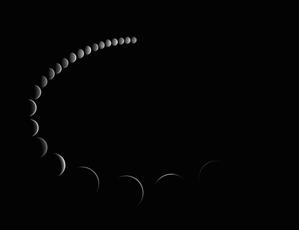
Phases of Venus
imagem
Criado para o OAE
Legenda: First place winner in the 2023 IAU OAE Astrophotography Contest, category of Still images of phases of Venus.
This is a mesmerising series of images of Venus captured from Surgères, Charente-Maritime, France, over a period of six months in 2015. The phases appear similar to the phases we see of our own Moon and occur for similar reasons. Only half of Venus is illuminated by the Sun and, from Earth, we can sometimes only see part of that illuminated half, depending on the relative positions of the Sun, Earth and Venus. Both Mercury and Venus exhibit phases because their orbit is between the Sun and the orbit of Earth. Depending on the position of Venus relative to the Sun and Earth, Venus goes through its phases over a period of time. This sequence of images beautifully showcases the transition from the ‘gibbous’ to the slender crescents. The use of infrared filters helped to capture Venus's dense perpetual cloud cover during daylight in sharp detail, providing a glimpse into the mysterious nature of the planet’s atmosphere.
Crédito: Stephane Gonzales/IAU OAE (CC BY 4.0)
Termos do Glossário:
Fase , Vênus
Categorias
Sistema Solar
Tags:
astrophotography
Licença: Creative Commons Attribution 4.0 International (CC BY 4.0) Creative Commons Attribution 4.0 International (CC BY 4.0) ícones
Este arquivo no Zenodo ( imagem 1.43 MB)
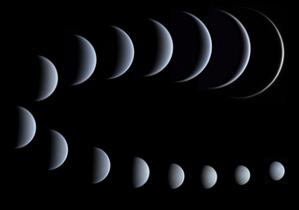
A Matter of Perspective
imagem
Criado para o OAE
Legenda: Second place winner in the 2023 IAU OAE Astrophotography Contest, category of Still images of phases of Venus.
This exquisite series of images, captured from Santo Domingo, Dominican Republic, between 17 December 2019 and 25 May 2020, shows the phases of Venus as seen from Earth. As Venus and Earth orbit the Sun, we observe different portions of Venus’s sunlit half, similar to the Moon’s phases. The sequence clearly shows Venus as distant, small, bright and gibbous in the lower frames, and ends with Venus reaching the biggest apparent size of all planets (upper frames), very close to the Sun with a small elongation, and appearing as a thin crescent. In the last frame, only 2.8% of the planet’s surface is illuminated.
Crédito: Christofer Baez/IAU OAE (CC BY 4.0)
Termos do Glossário:
Fase , Vênus
Categorias
Sistema Solar
Tags:
astrophotography
Licença: Creative Commons Attribution 4.0 International (CC BY 4.0) Creative Commons Attribution 4.0 International (CC BY 4.0) ícones
Este arquivo no Zenodo ( imagem 339.56 kB)


