Documentos e recursos — Resultados da busca
Resultados da busca
To guard the Stars and the Sea Together
imagem
Criado para o OAE
Legenda: Winner in the 2022 IAU OAE Astrophotography Contest, category Still images of celestial patterns.
This image composition is amazing. In the far background of the landscape we see a chain of mountains that seems to mirror the structure of the Milky Way in the sky above. The strong daylight-like colours of the landscape are caused by the Moon, the bright light at the top of the image.
Taken in Kinabalu, Malaysia, in February 2019, this image shows the alignment of planets and the Moon, conveying the idea of the ecliptic as the central line of the Zodiac, the plane within which all planets orbit the Sun. The ecliptic is the central line of the Zodiac, so the region of about five to 10 degrees either side of the ecliptic is where the constellations of the Zodiac are located. Starting from the horizon towards the bottom left of the image we can see the planets Venus, Saturn and Jupiter. The planets have different cultural significance for people around the world, and are deeply embedded in social, religious and practical aspects of life. For example, Wardaman traditions of Indigenous Australians associate the planets with ancestor spirits who traverse the Celestial Road (ecliptic). The appearance and disappearance of planets in the sky are associated with various ceremonies. For example, when Venus starts being the “Morning star” after having been the “Evening star”, this marks the Banumbirr ceremony for the Yolnu people of Arnhem Land, in Australia.
The image also shows the constellations Scorpius, Aquila, Lupus and Triangulum Australe, the asterism of the Teapot, and the two pointer stars Alpha and Beta Centauri. The constellations, asterisms and individual stars within them have significance in many different cultures.
Malaysia, being close to the equator, has had connections to the north as well as to the south and almost the whole sky is visible over the course of the year. The star Antares is seen by the Kokatha people of the Western Desert as Kogolongo, the red tailed black cockatoo, while the Boorong refer to it as Djuit, the red-rumped parrot. The two stars which form the stinger of Scorpius (Shaula and Lesath), are called Karik Karik, the Australian Kestrel.
Crédito: Likai Lin/IAU OAE
Termos do Glossário:
Constelação , Júpiter , Lua , Saturno , Escorpião , Vênus , Zodíaco , Asterismo , Alpha Centauri
Categorias
Astronomia a Olho Nu
Licença: Creative Commons Attribution 4.0 International (CC BY 4.0) Creative Commons Attribution 4.0 International (CC BY 4.0) ícones
Este arquivo no Zenodo ( imagem 3.77 MB)
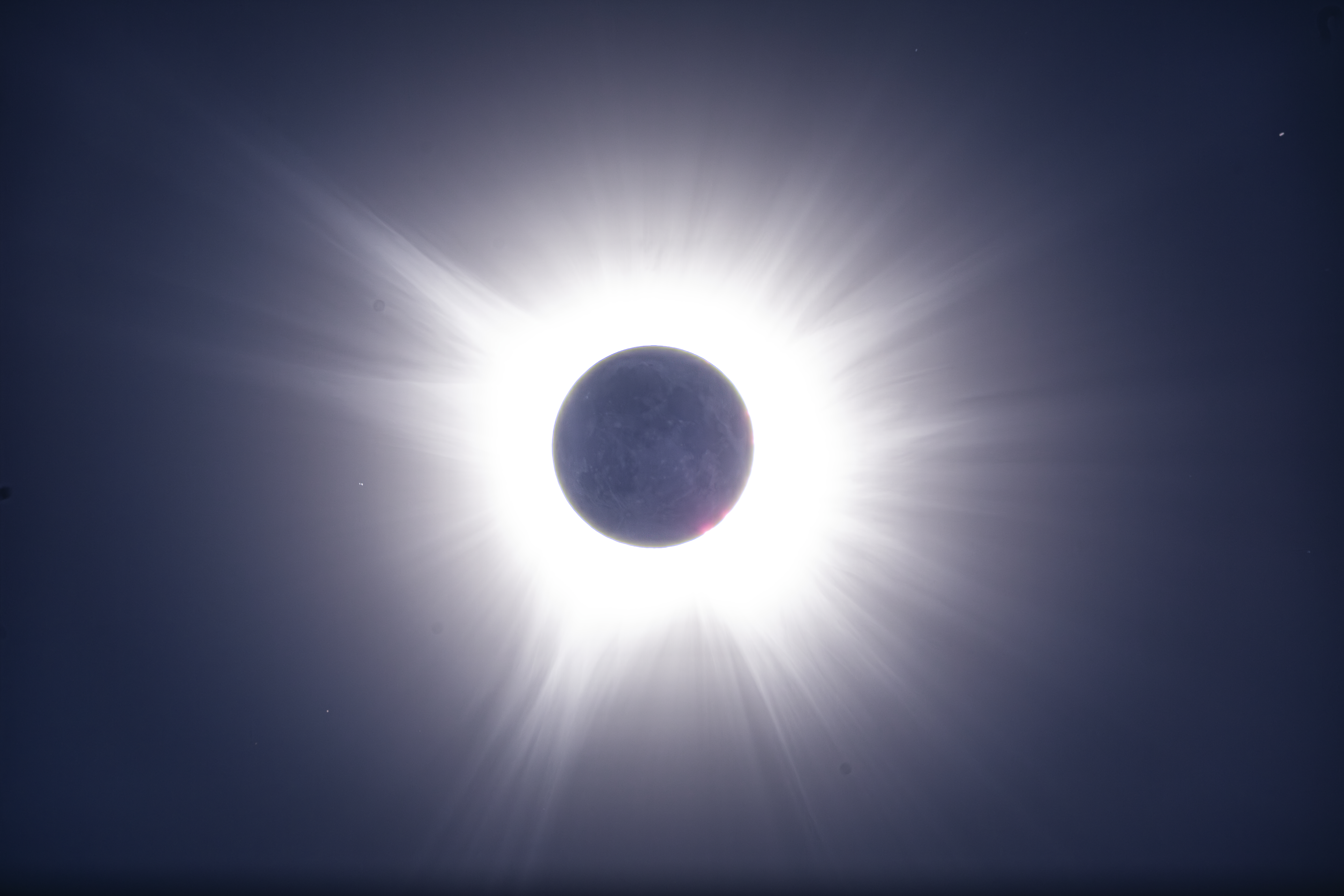
Moon covering the Sun
imagem
Legenda: Moon covering the Sun during the total solar eclipse of April 8th, 2024. The solar corona is also visible at totality. Image taken in Arkansas, USA. This image was processed using a Larson-Sekanina-style technique. Multiple exposures ranging from 1/500 second to 4 seconds were stacked and combined with a rotational gradient filter to reveal fine structural detail across the corona's extreme brightness range. This is done because the inner corona saturates at longer exposures, while the outer corona and the Moon are only visible at those same longer exposures.
Crédito: Carolin Liefke
Licença: Creative Commons Attribution 4.0 International (CC BY 4.0) Creative Commons Attribution 4.0 International (CC BY 4.0) ícones
Arquivo
( imagem
15.25 MB)
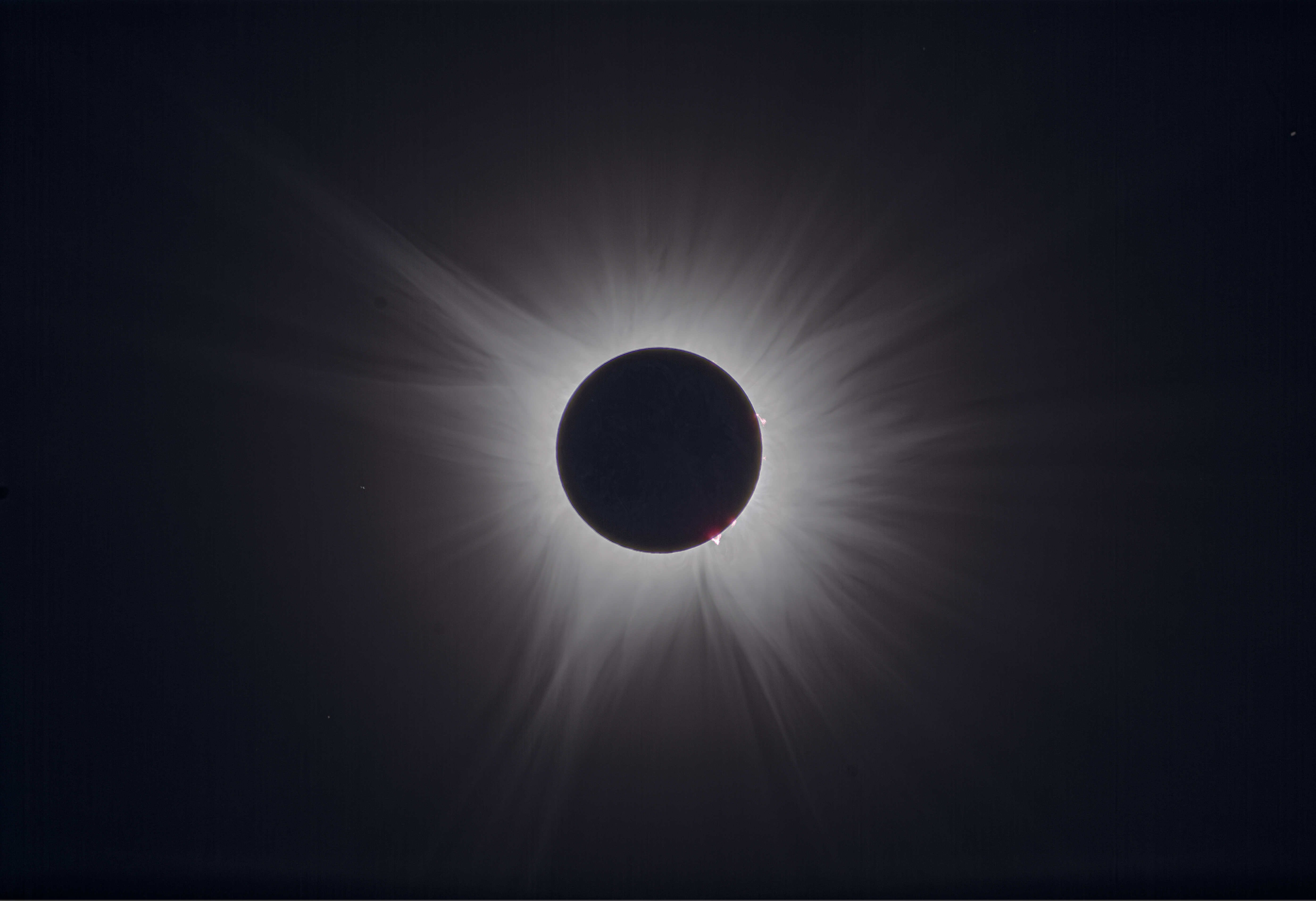
Solar corona
imagem
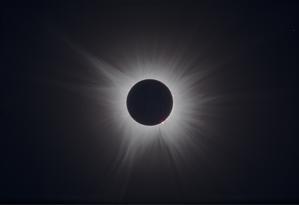
Legenda: Solar corona composite during the totality of the April 8th, 2024 solar eclipse. Solar prominences are also visible on the right side edge. This image was processed using a Larson-Sekanina-style technique. Multiple exposures ranging from 1/500 second to 4 seconds were stacked and combined with a rotational gradient filter to reveal fine structural detail across the corona's extreme brightness range. This is done because the inner corona saturates at longer exposures, while the outer corona and the Moon are only visible at those same longer exposures. The 4-second exposure was excluded from this image, since only the Moon was captured in this frame.
Crédito: Carolin Liefke
Tags:
Solar corona
, Solar eclipse
, Sun
Licença: Creative Commons Attribution 4.0 International (CC BY 4.0) Creative Commons Attribution 4.0 International (CC BY 4.0) ícones
Arquivo
( imagem
8.75 MB)
Sailing the Celestial Seas
imagem
Criado para o OAE
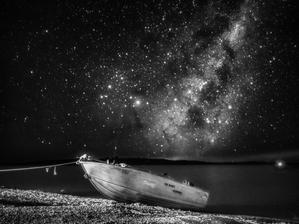
Legenda: Honorable mention in the 2023 IAU OAE Astrophotography Contest, category of Still images taken exclusively with smartphones/mobile devices.
In this black and white snapshot taken in April 2022 with a smartphone, a solitary boat rests on the shores of Lake Eucumbene, Australia, framed by the brilliant display of stars comprising the Milky Way. The prominent glow of the galactic centre stands out against the night sky, its intricate patterns of stars and nebulae casting a striking contrast. Each shimmering dot represents a distant sun, possibly orbited by uncharted planets, underscoring the vastness and complexity of our sprawling home galaxy.
Crédito: Lucy Yunxi Hu/IAU OAE (CC BY 4.0)
Termos do Glossário:
Via Láctea , Navegação
Categorias
Astronomia a Olho Nu
Tags:
astrophotography
Licença: Creative Commons Attribution 4.0 International (CC BY 4.0) Creative Commons Attribution 4.0 International (CC BY 4.0) ícones
Este arquivo no Zenodo ( imagem 7.11 MB)
Venus and Mercury Trails
imagem
Criado para o OAE
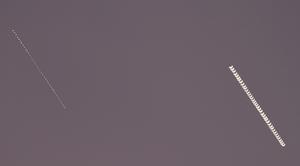
Legenda: Honorable mention in the 2023 IAU OAE Astrophotography Contest, category of Still images of phases of Venus.
In this composite image, both Mercury (left) and Venus (right) can be seen heading into the sunset. The phases of each are beautifully captured as they descend. Not all planets or moons in the Solar System show phases as viewed from Earth. This phenomenon occurs because the orbits of Venus and Mercury are positioned between Earth’s orbit and the Sun, sometimes allowing us to see only part of the illuminated portion of each planet. These phases are similar to the phases we see of our own Moon.
Crédito: Marcella Giulia Pace (CC BY 4.0)
Termos do Glossário:
Mercúrio , Fase , Vênus
Categorias
Sistema Solar
Tags:
astrophotography
Licença: Creative Commons Attribution 4.0 International (CC BY 4.0) Creative Commons Attribution 4.0 International (CC BY 4.0) ícones
Este arquivo no Zenodo ( imagem 4.86 MB)