Documents & Resources - Search Results
Search results

Astronomical Unit
image
Created for the OAE
Caption: An astronomical unit (AU) is a convenient unit of distance equal to exactly 149,597,870.7 kilometers (km). This is approximately the average distance between the Earth and the Sun, which was a previous definition of the AU. The AU is often used to measure distances in the Solar System and in other planetary or stellar systems.
Credit: Danielle Futselaar/IAU OAE
Termes del glossari:
Astronomical Unit
Categories:
Solar System
License: Creative Commons Reconeixement 4.0 Internacional (CC BY 4.0) Creative Commons Reconeixement 4.0 Internacional (CC BY 4.0) icons
Arxiu
( image
264.08 kB)
PDF File
(PDF file
216.10 kB)
Also available in black and white
Arxiu
( image
171.33 kB)
PDF File
(
55.68 kB)

Opposition and Conjunction
image
Created for the OAE
Caption: This diagram shows the Earth's orbit around the Sun and the orbits of two other planets, one orbiting the Sun outside the Earth's orbit and one orbiting the Sun inside the Earth's orbit. At different times in the orbits of both of these planets, their positions appear to line up with the Earth and the Sun. At these points each planet would appear close to the Sun when viewed from Earth. When this happens each planet is said to be in conjunction with the Sun.
For the planet that orbits the Sun within the Earth's orbit it can be in conjunction with the Sun twice in its orbit, once when it is between the Sun and the Earth and once when it is on the other side of the Sun from the Earth. When the planet is in conjunction between the the Sun and Earth it is said to be in inferior conjunction and when it is in conjunction on the far side of the Sun from the Earth it is said to be in superior conjunction.
For the planet orbiting the Sun outside the Earth's orbit, it can sometimes be on the other side of the sky. At this point the Earth lies between the planet and the Sun. The planet in this case is said to be in opposition.
Opposition and conjunction are not just limited to planets and other types of solar system objects such as dwarf planets, comets and asteroids can also be in opposition and conjunction. However only those objects that have an orbit that takes them outside the Earth's orbit can be in opposition.
Conjunction is also used to refer to alignments in the sky between planets in the Solar System. For example when Jupiter and Venus appear very close on the sky when viewed from Earth they are said to be in conjunction with each other.
Credit: Aneta Margraf/IAU OAE
Termes del glossari:
Conjunction , Opposition
Categories:
Naked Eye Astronomy
, Observational Astronomy
, Solar System
License: Creative Commons Reconeixement 4.0 Internacional (CC BY 4.0) Creative Commons Reconeixement 4.0 Internacional (CC BY 4.0) icons
Arxiu
( image
251.82 kB)
PDF File
(PDF file
148.69 kB)
Also available in black and white
Arxiu
( image
109.06 kB)
PDF File
(
173.49 kB)
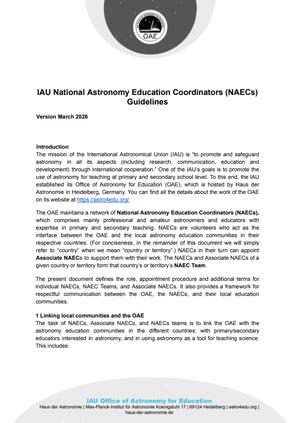
NAEC Guidelines
PDF file document
Created for the OAE
Description: This document outlines the structure, roles, and responsibilities of NAECs. It provides guidance on how NAEC teams are formed, how they operate, and how they contribute to the global network supported by the IAU Office of Astronomy for Education.
Version March 2026
Language: English
Script: Latin
Arxiu
(PDF file
402.14 kB)

TTP Poster 2025
PDF file document
Created for the OAE
Language: English
Script: Latin
Arxiu
(PDF file
923.74 kB)

A moment of codesign in the Sabir project. Credits: OAE Center Italy
image
Created for the OAE
Artists: Stefano Sandrelli Arxiu ( image 2.95 MB)


