Documents & Resources - Search Results
Search results

Lunar Phase Northern Hemisphere
image
Created for the OAE
Caption: The phases of the Moon when viewed from the Northern Hemisphere. Here north is up and east is left. The Moon orbits the Earth every 29.5 days. It is tidally locked to the Earth meaning its rotation period is the same as its orbital period and the same side of the Moon always faces the Earth. At any particular time, half of the Moon is illuminated by the Sun and half is in shadow. Over the course of the Moon’s orbit around the Earth every part of the Moon is illuminated for half of the orbit and is in shadow for the other half of the orbit.
When the Moon sits between the Earth and the Sun its illuminated half faces away from the Earth and we only see the half that is in shadow. This phase of the Moon is known as new moon. As the Moon moves in its orbit, a small but growing sliver of the illuminated half of the Moon begins to be seen from the Earth. This illuminated sliver appears on the western side of the Moon’s face when viewed from Earth. This phase is known as waxing crescent moon. By a quarter of the way through the Moon’s orbit around the Earth the Moon appears 90° away from the Sun and half of the Moon’s illuminated half points toward the Earth. This phase is known as first quarter moon. As the orbit continues more than half of the Moon seen from Earth is now illuminated with a dark crescent. This phase is known as waxing gibbous moon. Once we reach the halfway point in the Moon’s orbit round the Earth the Moon is now on the opposite side of the Earth from the Sun and we see all of the Moon’s illuminated half. As the whole of the side of the Moon that faces the Earth is now illuminated this is referred to as full moon.
For the remaining half of the Moon’s orbit the half of the moon that faces the Earth begins to move into shadow. Hence the illuminated portion of the Moon that we see from Earth begins to shrink or wane. The western edge of the face of the Moon when viewed from Earth begins to appear dark and this grows through subsequent phases. The phases are repeated in reverse order: waning gibbous, third quarter, waning crescent and finally back to new moon.
Note the surface features of the Moon are illustrative and do not accurately represent the Moon’s true surface.
Credit: Aneta Margraf/IAU OAE
Termes del glossari:
Full Moon , Lunar Phase , New Moon , Quarter Moon , Waning Crescent , Waning Gibbous , Waxing Crescent , Waxing Gibbous , Crescent Moon , Gibbous Moon
Categories:
Naked Eye Astronomy
License: Creative Commons Reconeixement 4.0 Internacional (CC BY 4.0) Creative Commons Reconeixement 4.0 Internacional (CC BY 4.0) icons
Arxiu
( image
1.26 MB)
PDF File
(PDF file
416.48 kB)
Also available in black and white
Arxiu
( image
160.02 kB)
PDF File
(
422.82 kB)

Annual Parallax
image
Created for the OAE
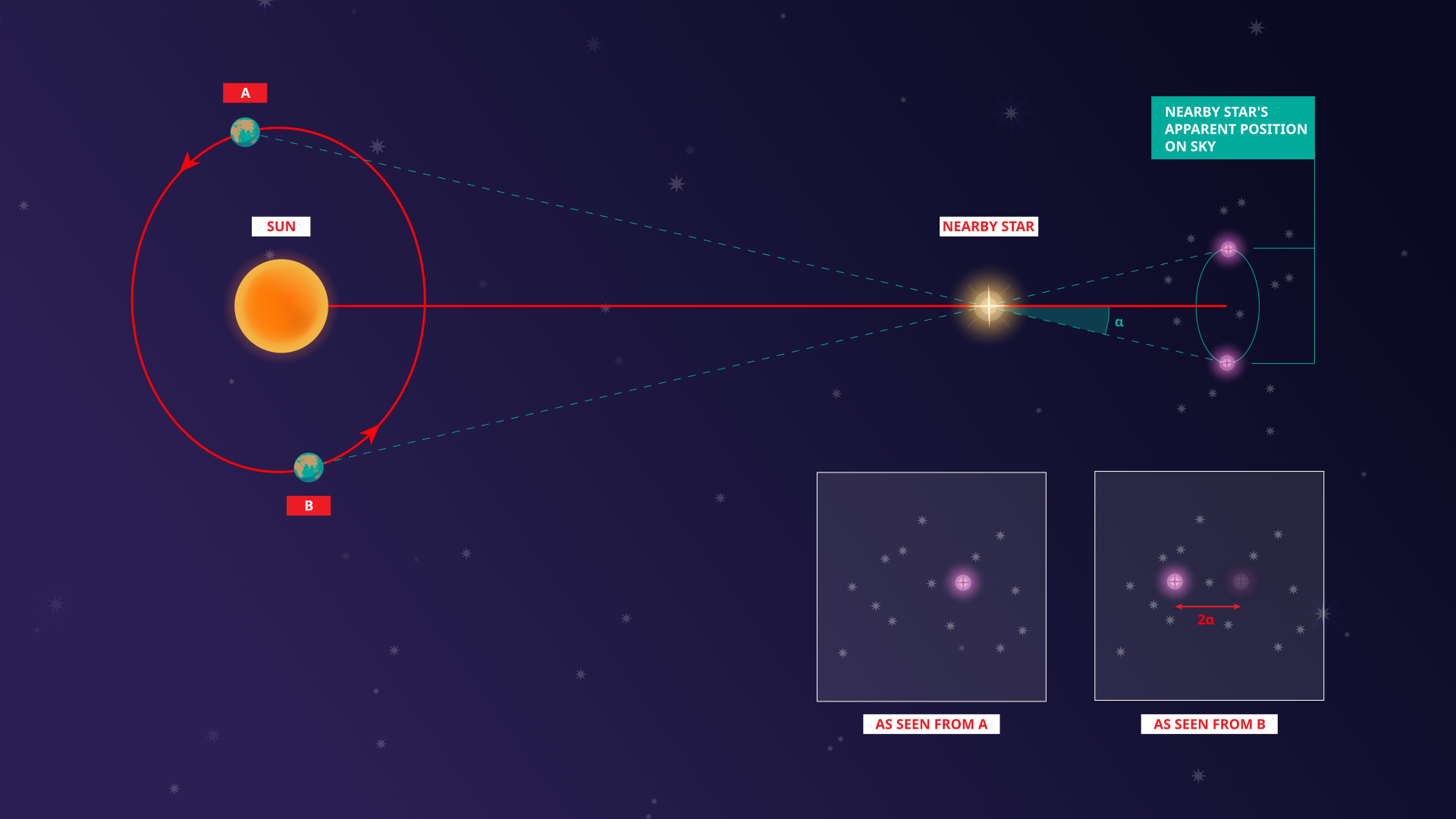
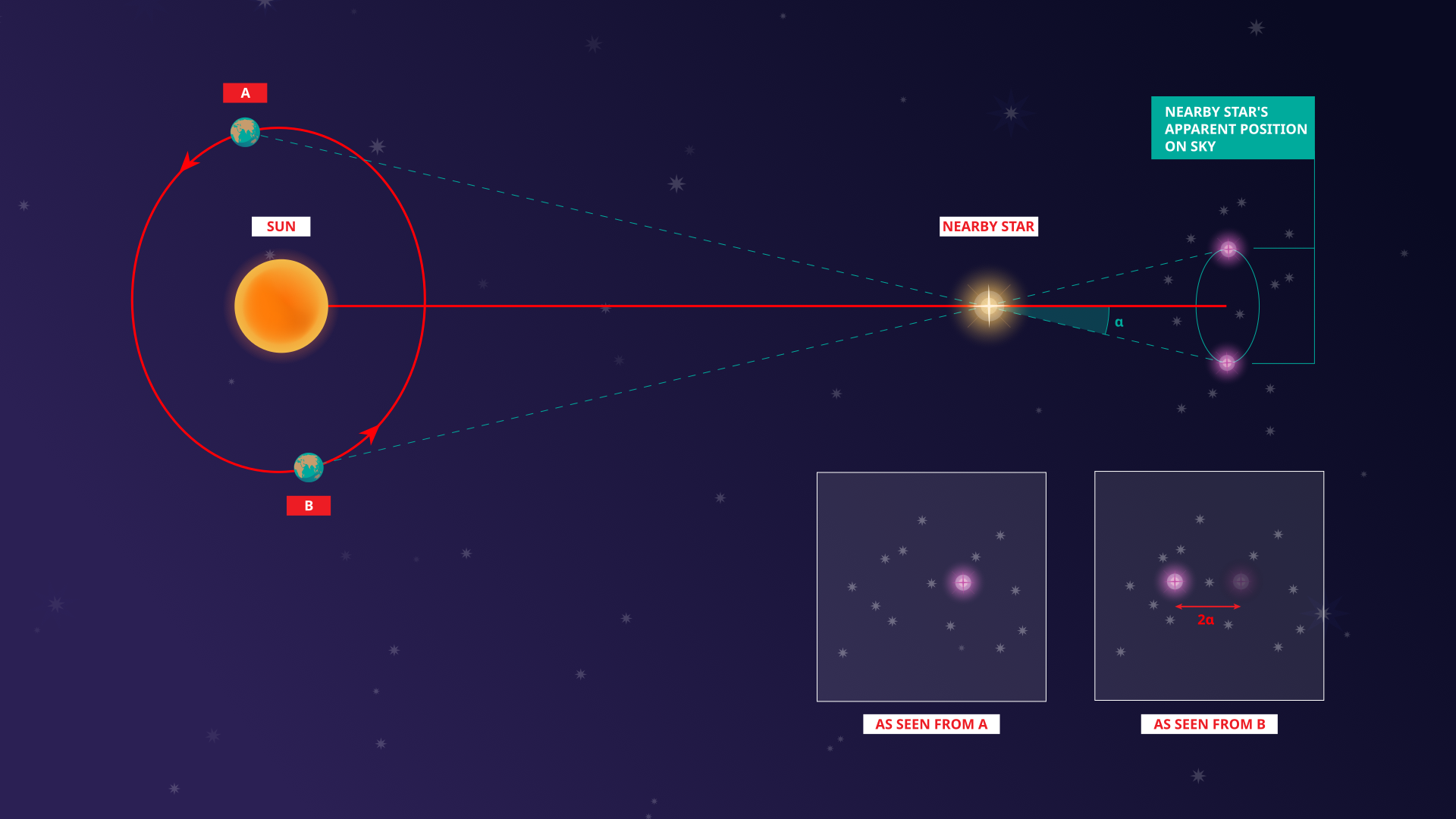
Caption: Distance determination has historically been a challenge for astronomy. One of the primary ways to measure distance is to use annual parallax. The Earth orbits around the Sun over the course of a year meaning that it moves from one side of the Sun (shown here as position A) to the other side of the Sun (position B) over the course of six months. It then moves back to its original position over the remaining six months. This movement subtly changes the perspective an observer on Earth sees the night sky from. This is similar to the change in viewing perspective you may get when viewing a scene from your left eye and then your right eye. The change of viewing perspective causes nearby objects to shift in position in your vision. The annual motion of the Earth around the Sun changes the perspective of the observer enough to shift the observed positions of celestial objects. How big this effect is depends on the distance to the celestial object. Nearby stars will have bigger shifts in observed position than more distant stars.
The positional shift is known as the trigonometric or annual parallax (which we will call α here) and is defined as the shift in position of a star compared to what an observer at the center of the Solar System (the Sun) would see. In this diagram we see the star viewed from perspectives six months apart (positions A and B). When observed from position A the star’s shift in position will be α while when observed at position B it will be –α. Thus the relative difference in the stars position between being observed at position A and position B will be 2α.
The size of the trigonometric or annual parallax in arcseconds is approximately 1 divided by the distance in parsecs. An arcsecond (often represented by a ″ symbol) is the angular diameter a one-metre-long stick would have when viewed from 206 km away. A parsec (often abbreviated to pc) is 3.26 light years or 30.86 trillion kilometres. This is 206,265 astronomical units (the typical distance between the Earth and the Sun). No other star is closer than 1 pc to the Sun so all stars in the sky have trigonometric parallaxes less than one arcsecond.
While trigonometric parallaxes have long been used to measure the distances to objects in our Solar System or nearby stars, recent advances have pushed the boundaries of these distance measures further. The Gaia satellite has pushed the boundaries of parallax measurements to over a thousand parsecs. Arrays of radio telescopes can also very accurately measure the positions of very distant objects and thus their trigonometric parallax.
Note the Earth and Sun are not to scale here and the Earth’s axial tilt is not accurately represented.
Credit: Aneta Margraf/IAU OAE
Termes del glossari:
Angular Diameter , Annual Parallax , Astronomical Unit , Parallax
Categories:
Observational Astronomy
License: Creative Commons Reconeixement 4.0 Internacional (CC BY 4.0) Creative Commons Reconeixement 4.0 Internacional (CC BY 4.0) icons
Arxiu
( image
1.43 MB)
PDF File
(PDF file
248.89 kB)
Also available in black and white
Arxiu
( image
1.43 MB)
PDF File
(
248.89 kB)

Seasons
image
Created for the OAE
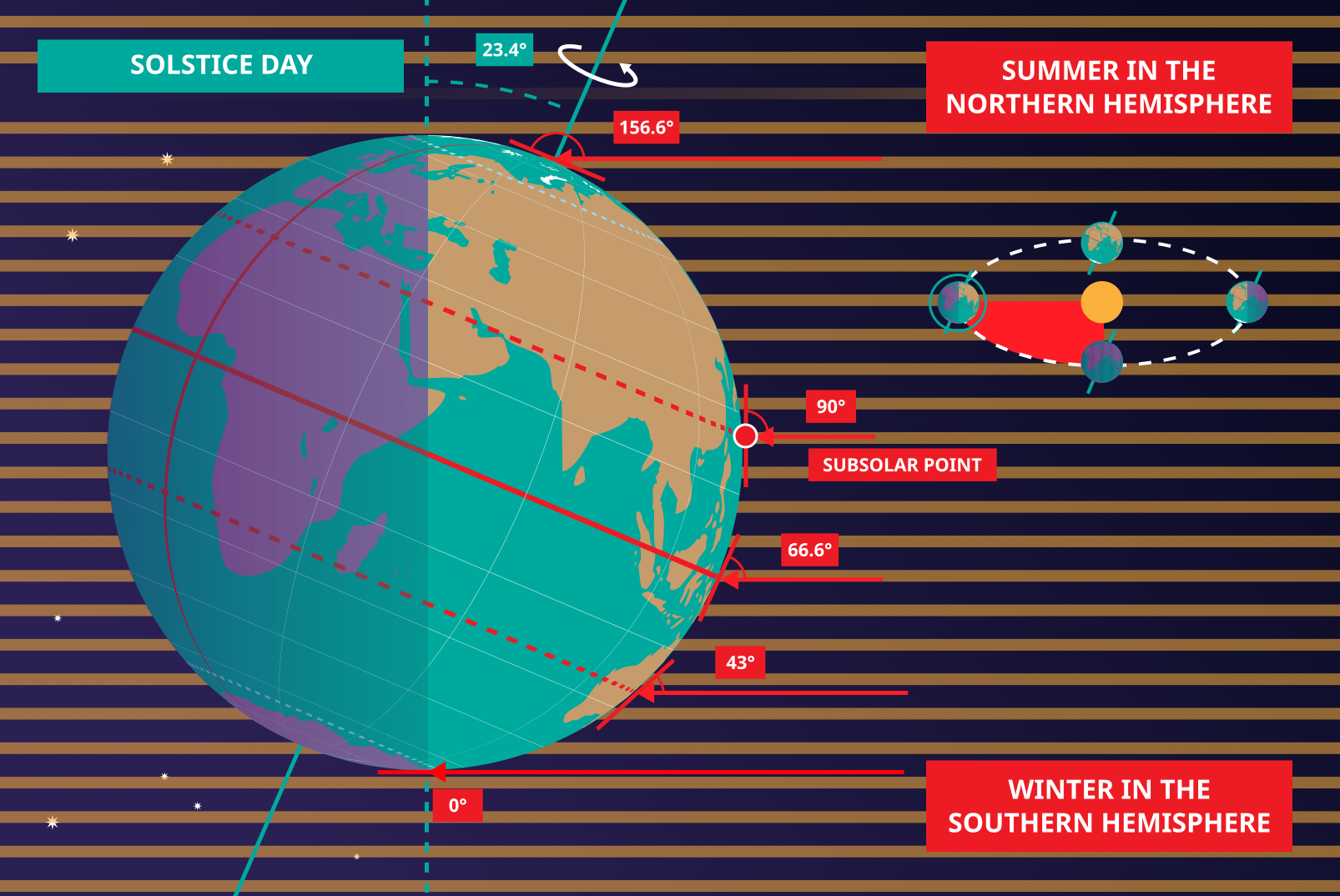
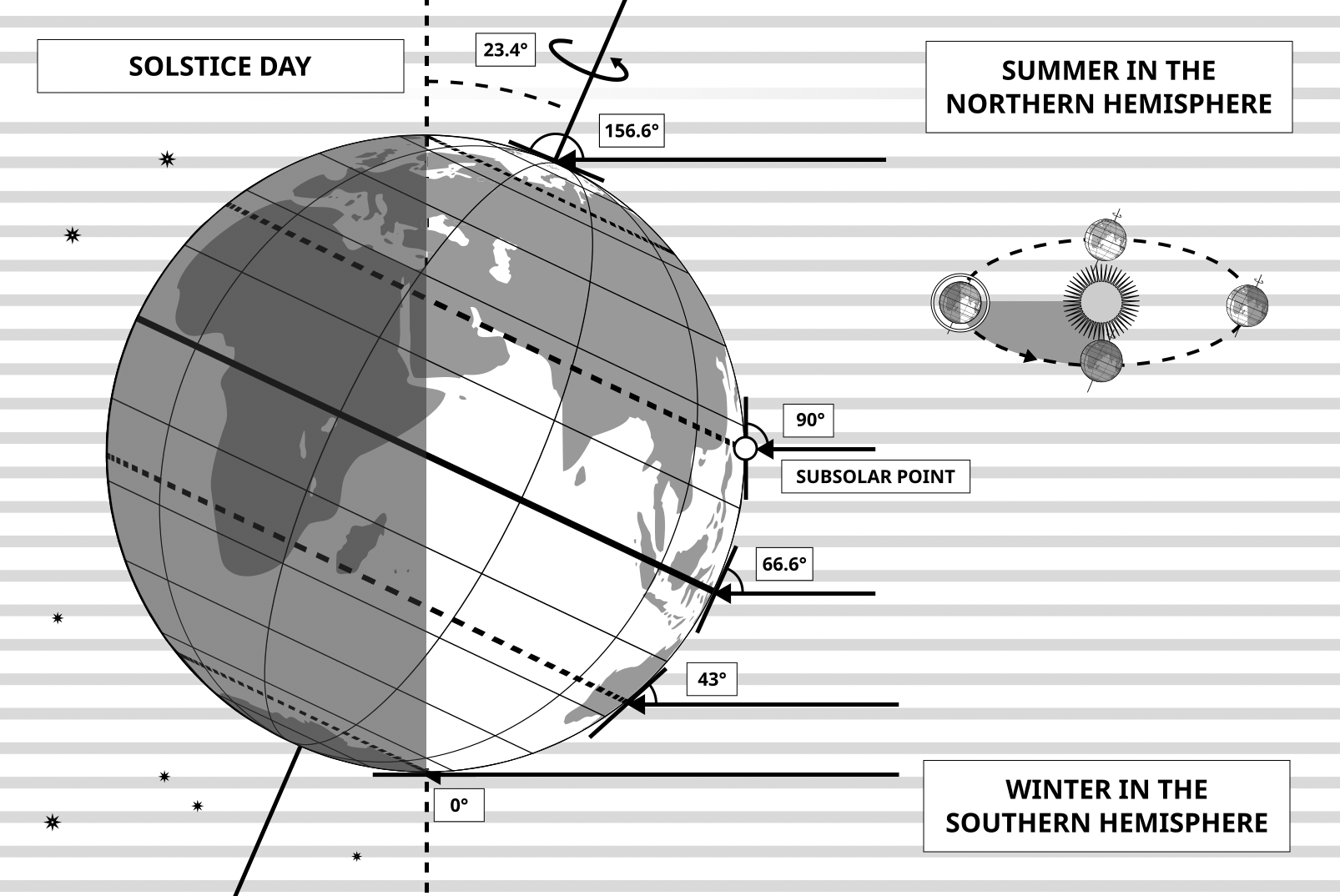
Caption: This diagram shows the Earth at the June solstice which is known as the summer solstice in the Northern Hemisphere and the winter solstice in the Southern Hemisphere. The Earth’s axis of rotation is tilted from the axis of the Earth’s orbit around the Sun by 23.4°. Here we see light from the sun represented as parallel lines, in the diagram the Sun would lie far off the right-hand edge. Five lines are marked with angles. These lines hit the Earth at special latitudes. From top to bottom these lines hit the Earth at the North Pole, the Tropic of Cancer, the Equator, the Tropic of Capricorn and the Antarctic Circle. The lines are shown hitting the Earth at the longitude where it is currently noon. For the last four lines, the angles marked show the angle above the horizon (the altitude) which the Sun appears in the sky at at local noon.
At the June solstice, the Sun will appear directly overhead at local noon on every point on the Tropic of Capricorn. By contrast the Sun reaches a maximum altitude of 0° at local noon on every point in the Antarctic Circle. This means the Sun never rises and every point south of the Antarctic Circle experiences a long Polar Night. By contrast the Sun never sets on this day north of the Arctic Circle and the regions here experience a Polar Day. The at the North Pole the Sun will remain at a constant altitude all day. This altitude will be the angle 180°-156.6° (23.4°).
The altitude the Sun appears at is important as it defines how spread out the Sun’s rays are on the Earth’s surface. Look at the thick, faint parallel lines in the background. Notice how at the Tropic of Cancer the area the lines intersect with the Earth’s surface perpendicularly and the line only covers a small part of the Earth’s surface. Now look at a line near the Tropic of Capricorn and see that this intersects with the Earth at a grazing angle and the line is spread out, covering a much wider area of the Earth’s surface. This means that a given amount of light from the Sun that hits the Tropic of Cancer is more concentrated and the same amount of light hitting the Tropic of Capricorn would be more spread out. This leads to more energy per unit area from the Sun hitting the Tropic of Cancer and less energy per unit area hitting the Tropic of Capricorn. This means it will be warmer at the Tropic of Cancer than at the Tropic of Capricorn. It is thus summer at the Tropic of Cancer and winter at the Tropic of Capricorn.
Six months later this situation will be reversed and it will be summer at the Tropic of Capricorn and winter at the Tropic of Cancer.
Credit: Maria Cristina Fortuna/IAU OAE
Termes del glossari:
Equator , Solstice , Summer Solstice , Winter , Winter Solstice , Arctic Circle , Antarctic Circle , Tropic of Cancer , Tropic of Capricorn , North Pole
License: Creative Commons Reconeixement 4.0 Internacional (CC BY 4.0) Creative Commons Reconeixement 4.0 Internacional (CC BY 4.0) icons
Arxiu
( image
1.09 MB)
Also available in black and white
Arxiu
( image
400.17 kB)
PDF File
(
477.01 kB)

Solstices and Equinoxes
image
Created for the OAE
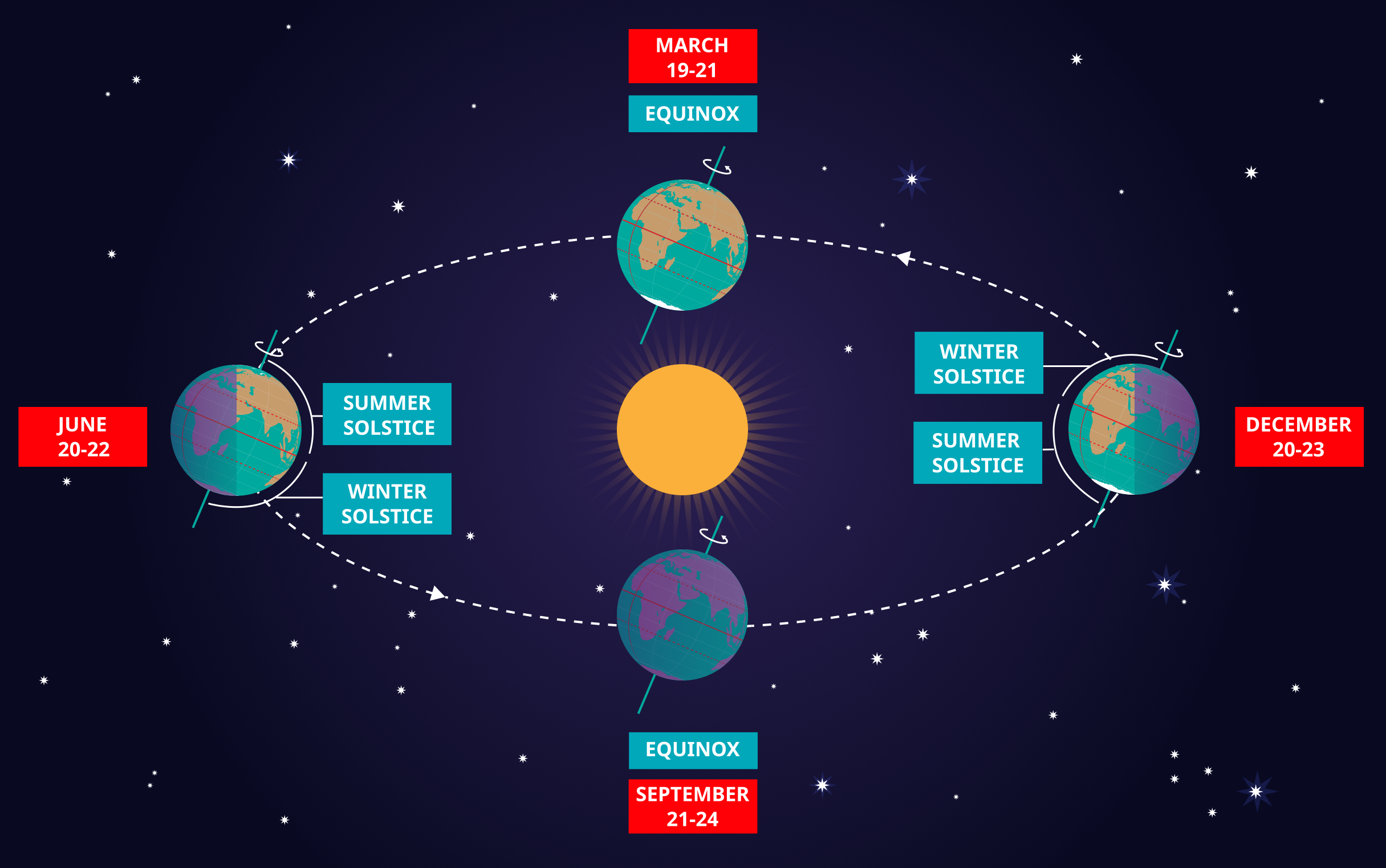
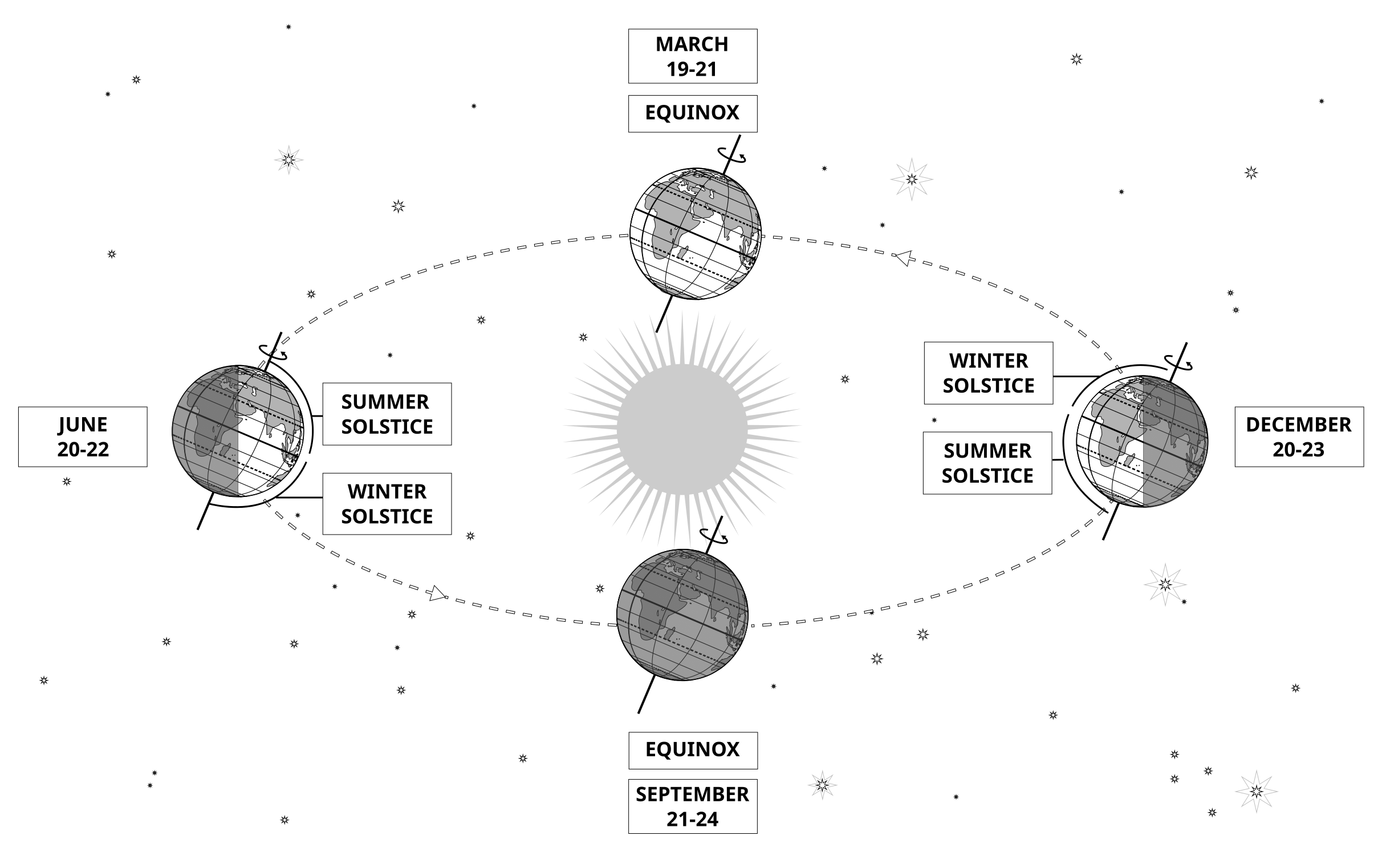
Caption: This diagram demonstrates the relative positions of the Earth and Sun at the two solstices and two equinoxes. The Earth’s rotation axis is tilted by 23.4° from the axis of its orbit. This means that for half the Earth’s annual orbit around the Sun, the Southern Hemisphere is tilted towards the Sun and the Northern Hemisphere is tilted away from the Sun. During this time the Sun appears to lie below the celestial equator. Due to this at any particular point in the Southern Hemisphere the Sun will appear to be higher above the horizon at a particular time of day and the days will be longer. Conversely during this time, the Sun appears lower in the sky at any particular point in the day in the Northern Hemisphere and the days are shorter.
This effect is most pronounced in late December when the Sun appears at its most southerly point in the sky, corresponding to the longest day of the year in the Southern Hemisphere. This normally occurs on the 21st or 22nd of December (UTC), depending on when the most recent leap year was, but can very occasionally occur on the 20th or 23rd of December. This event is known as the December solstice. As the Sun’s rays hit the Southern Hemisphere at a more perpendicular angle during this time, the Southern Hemisphere is typically warmer in this time of year than at other times of year. This is often referred to as summer in temperate and antarctic regions of the Southern Hemisphere and thus the December solstice is known as the summer solstice. South of the Antarctic Circle at this time the Sun never sets and a Polar Day can last several months. Conversely in the Northern Hemisphere, the Sun’s rays hit the Earth at a more grazing angle than at other times of year so it is colder and this solstice is known as the winter solstice. North of the Arctic Circle the Sun never rises during this time and the Polar Night can last several months.
As the year progresses the Earth moves in its orbit and the tilt of the Earth’s axis moves so it appears more side-on to the Sun. From the perspective of an observer on Earth this means that the Sun moves north in the sky, eventually reaching the celestial equator in late March, This usually occurs on the 20th of March (UTC) but can sometimes occur on the 19th or 21st of March. During this time all places on Earth will experience night and day that is approximately 12 hours long. The Sun’s rays now hit the Southern hemisphere at a more shallow angle than they did in December and hit the Northern Hemisphere at a more perpendicular angle. This means that the Northen Hemisphere will have warmed since December and the Southern Hemisphere cooled. This leads to the March equinox being referred to as the autumn equinox in the Southern Hemisphere and the spring or vernal equinox in the Northern Hemisphere.
As the year progresses further the Sun moves further north on the sky, the Northern Hemisphere days lengthen and the Southern Hemisphere days shorten. By June the Earth’s orbit has progressed to the point where the Northern Hemisphere points towards the Sun and the Southern Hemisphere away from the Sun. At one point between the 20th and 22nd of June (UTC) the Sun reaches its most northerly point in the sky, this is known as June solstice. It is now summer in northern temperate and artic regions so this is known as the summer solstice in the Northern Hemisphere and the winter solstice in the Southern Hemisphere. This is the longest day of the year in the Northern Hemisphere and the shortest day of the year in the Southern Hemisphere. During this time regions north of the Arctic Circle experience a long Polar Day and regions south of the Antarctic Circle experience polar night.
The year progresses further and the Earth moves in its orbit so that the tilt of the Earth’s axis again appears side-on for the Sun. The Sun moves south in the sky and again crosses the celestial equator between the 21st and 24th of September (UTC). At this time all places on the Earth experience equal lengths of day and night. This is known as the September equinox, also called the spring or vernal equinox in the Southern Hemisphere and the autumn equinox in the Northern Hemisphere.
Note the sizes of the Earth, Sun and the Earth’s orbit around the Sun are not to scale in this diagram.
Credit: Maria Cristina Fortuna/IAU OAE
Termes del glossari:
Equinox , Celestial Equator , Seasons , Solstice , Summer Solstice , Winter Solstice , Spring Equinox , Autumn Equinox , Earth's Axis , Arctic Circle , Antarctic Circle , Polar Day , Polar Night
Categories:
Naked Eye Astronomy
License: Creative Commons Reconeixement 4.0 Internacional (CC BY 4.0) Creative Commons Reconeixement 4.0 Internacional (CC BY 4.0) icons
Arxiu
( image
2.02 MB)
PDF File
(PDF file
335.83 kB)
Also available in black and white
Arxiu
( image
485.38 kB)
PDF File
(
388.16 kB)

Nucleon
image
Created for the OAE
Caption: A nucleon is a constituent of an atomic nucleus. For normal matter, nucleons can be either protons or neutrons. The number of nucleons defines the mass number of a nucleus while the number of protons defines the atomic number. Atomic nuclei of a particular chemical element all have the same atomic number but can have different mass numbers. Nuclei with the same atomic number but different mass numbers are known as isotopes. Most elements have more than one isotope that occurs in nature although a few only have one isotope that is stable over long periods of time.
This diagram shows the nuclei of isotopes of the first six chemical elements (from left to right: hydrogen, helium, lithium, beryllium, boron and carbon). Beside each chemical element symbol are two numbers. The upper number is the mass number, the number of nucleons. The lower number for each is the atomic number, the number of protons.
Credit: Maria Cristina Fortuna/IAU OAE
Termes del glossari:
Isotope , Neutron , Nucleon , Nucleus , Proton
Categories:
Chemistry
, Physics
License: Creative Commons Reconeixement 4.0 Internacional (CC BY 4.0) Creative Commons Reconeixement 4.0 Internacional (CC BY 4.0) icons
Arxiu
( image
2.33 MB)
PDF File
(PDF file
24.20 kB)
Also available in black and white
Arxiu
( image
198.07 kB)
PDF File
(
22.36 kB)