Documents & Resources - Search Results
Search results

The Hunter in the Forest
image
Created for the OAE
Caption: Honourable mention in the 2022 IAU OAE Astrophotography Contest, category Still images of celestial patterns.
Taken in December 2016, this image shows a clear and starry sky over the Masaya Volcano National Park in Nicaragua.
The constellation Orion is the most prominent pattern in this image. Orion is associated with a great hunter according to Greek culture, and is seen here right in the middle. The reddish star in the centre is Betelgeuse, the second-brightest in this constellation and one of the brightest in the night sky. Above and to the right of Betelgeuse we find Bellatrix, another bright star, forming the right shoulder of the hunter. Extending a line from Bellatrix to the right, we find a crookedly aligned group of faint stars comprising Orion’s bow. We can also easily see a group of three aligned bright stars forming the belt of the hunter, an asterism recognised by many different cultures. Just below his belt we can see the silverish glittering that was interpreted as the metal of Orion’s sword or knife by the Greco-Roman tradition. It was alternatively interpreted as a fish roasted on a campfire by some cultures in Australia. In its centre, with binoculars we can see the Small and the Great Orion Nebula, together forming a giant cloud of dust and gas where new stars are being formed. To the lower-left of the silverish compound of tiny stars and nebulae, there is a bright star called Saiph, the Arabic term for “Sword” or “Sabre” because it was considered the tip of a huge knife with a curved upper part. To the right of this, there is the bright bluish star Rigel, an Arabic term which designates it as The Foot of Orion.
Orion’s Belt points up towards Aldebaran at the edge of the photograph and down towards Sirius among the branches of the trees; it is the brightest star in the night sky and is located in the constellation Canis Major. Earth’s atmosphere makes the bright Sirius twinkle in all colours. Seen from space it is pure white, but as its light travels through the air, it is scattered and distorted by the molecules. Therefore, the star appears to change colour like a diamond.
A line connecting the two shoulders of Orion points to another bright star in the lower-left corner of the photograph. This is Procyon, located in the constellation Canis Minor. Procyon has been used by the ancient Babylonians to indicate the heliacal rise of Cancer (whose stars are faint, and invisible in twilight) and to predict the rising of Sirius. Thus, for a very long time in ancient history Procyon was considered a single-star asterism. Perhaps only in Roman times were more stars used to create a constellation in this area of the sky, although this constellation has never been clearly recognisable.
Credit: René Antonio Urroz Álvarez/IAU OAE
Termes del glossari:
Constellation , Orion
Categories:
Naked Eye Astronomy
, Stars
License: Creative Commons Reconeixement 4.0 Internacional (CC BY 4.0) Creative Commons Reconeixement 4.0 Internacional (CC BY 4.0) icons
This file on Zenodo ( image 2.04 MB)
Equatorial Milky Way
image
Created for the OAE
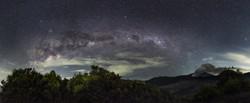
Caption: Honourable mention in the 2022 IAU OAE Astrophotography Contest, category Still images of celestial patterns: Equatorial Milky Way
Taken in Bromo-Tengger-Semeru National Park, Java Island, Indonesia, in March 2016, this image captures regions of the southern Milky Way and, at its left edge, the two planets Mars and Saturn. Mars appears orange and is similar in colour to the star Antares, whose Greek name — anti Ares — references this. Saturn is a little bit fainter than Mars, but clearly visible among the stars of Ophiuchus, above the Pipe Nebula and forming an isosceles triangle with Mars and Antares.
Mars is on the top and Saturn is vertically below. Visible to the naked eye, both planets have significance in many cultures around the world. In Roman mythology Mars is the god of war and fertility, and Saturn the god of sowing and agriculture. Its Greek equivalent, the god Kronos, is also considered the regent of completion. Indigenous Australians, including the Kamilaroi and Wailan people, associate Saturn with “wunygal”, a small bird. Mars is called Iherm-penh (something burnt in flames) by the Anmatyerre people of the Central Desert, while the Kokatha people of the Western Desert associate Mars and the star Anatres with the red-tailed black cockatoo (Kogolongo).
In the middle of this photograph, the most famous southern constellations are clearly recognisable: the Southern Cross (Crux), the pointer stars, Alpha and Beta Centauri, the dark Coalsack Nebula and the red Eta Carina Nebula, which is not visible to the unaided eye but is prominent in modern photographs. In the 19th century, the star eta Carinae had been the second-brightest star in the sky for some time, but since it varies irregularly, it has hardly been recognisable in recent decades, and its future visibility is unpredictable.
Triangulum Australe is visible between the pointer stars and the Scorpion, and in the constellation of Centaurus, the bright globular star cluster Omega Centauri is clearly displayed. It was considered a “nebulous star” since antiquity and, thus, was listed in star catalogues for at least 2000 years. Only within the last century did astronomers discover that globular star clusters are in the halo of our galaxy and that this one consists of roughly 10 million stars.
The dark regions in the Milky Way, which are cool, dense clouds of dust and gas, form the head and body of the Celestial Emu Tchingal. Together with the Southern Cross and the pointer stars, they appear in the Dreamtime stories of many Indigenous Australians. One story associated with the Djab Wurrung and the Jardwadjali people is part of a Dreamtime Story involving Tchingal, the Bram-bram-bult brothers (the pointer stars), their mother Druk (Delta Crux), and Bunya the hunter, who gets transformed into a possum (Gacrux, the red star at the top of the Southern Cross).
Credit: Giorgia Hofer/IAU OAE
Termes del glossari:
Dust , Mars , Milky Way , Saturn , Scorpius , Southern Cross , Dust Cloud , Interstellar Extinction , Alpha Centauri
Categories:
Milky Way and Interstellar Medium
, Naked Eye Astronomy
License: Creative Commons Reconeixement 4.0 Internacional (CC BY 4.0) Creative Commons Reconeixement 4.0 Internacional (CC BY 4.0) icons
This file on Zenodo ( image 1.61 MB)
Portrait of a Bat
image
Created for the OAE
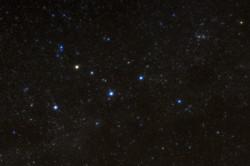
Caption: Honourable mention in the 2022 IAU OAE Astrophotography Contest, category Still images of celestial patterns.
Taken in November 2019 from the Doi Inthanon National Park, Chiang Mai, Thailand, this image captures the notable northern constellation Cassiopeia, in the shape of the letter M. Although the official constellation name is the Latinised version of the name of queen “Kasseipeia” from Greek mythology, these five bright stars were considered a constellation in many cultures around the world and they are associated with diverse stories. In Thailand, for example, the constellation represents a Bat, while in Hawaiian culture it is called 'Iwa Keli'i, the chief frigate bird.
For the Navajo in North America, the bright stars are the central part of the celestial mother (of all stars and humans) revolving around the celestial pole together with her husband, the celestial father (of all stars and humans) seen in the constellation of Ursa Major. For the Maya it was part of the huge constellation of the Hole-Backed Caiman, and for the Inuit a Lamp Stand and a Blubber Container.
In ancient China, the bottom-left star was associated with the mythological general Wangliang who drove four horses, represented by the two bright and two fainter stars of the M’s next stroke (from upper-left to lower-middle). The remaining two bright stars and a couple of the other fainter ones are considered a Flying Corridor, a sort of highway, next to the Emperor’s Forbidden Palace that is located at the northern polar region.
On the island of Tonga in the South Pacific, this asterism is considered the Wing of Tafahi and it is not clear if this refers to the shape of the island of Tafahi, or if it is based on an error and originally referred to a wing of the Polynesian hero Tafaki.
The various colours of the stars indicate their temperatures, with redder stars being relatively cooler on their surface than blue and white stars.
Credit: Thanakrit Santikunaporn/IAU OAE
Termes del glossari:
Color , Constellation , Asterism
Categories:
Naked Eye Astronomy
License: Creative Commons Reconeixement 4.0 Internacional (CC BY 4.0) Creative Commons Reconeixement 4.0 Internacional (CC BY 4.0) icons
This file on Zenodo ( image 9.65 MB)

To guard the Stars and the Sea Together
image
Created for the OAE
Caption: Winner in the 2022 IAU OAE Astrophotography Contest, category Still images of celestial patterns.
This image composition is amazing. In the far background of the landscape we see a chain of mountains that seems to mirror the structure of the Milky Way in the sky above. The strong daylight-like colours of the landscape are caused by the Moon, the bright light at the top of the image.
Taken in Kinabalu, Malaysia, in February 2019, this image shows the alignment of planets and the Moon, conveying the idea of the ecliptic as the central line of the Zodiac, the plane within which all planets orbit the Sun. The ecliptic is the central line of the Zodiac, so the region of about five to 10 degrees either side of the ecliptic is where the constellations of the Zodiac are located. Starting from the horizon towards the bottom left of the image we can see the planets Venus, Saturn and Jupiter. The planets have different cultural significance for people around the world, and are deeply embedded in social, religious and practical aspects of life. For example, Wardaman traditions of Indigenous Australians associate the planets with ancestor spirits who traverse the Celestial Road (ecliptic). The appearance and disappearance of planets in the sky are associated with various ceremonies. For example, when Venus starts being the “Morning star” after having been the “Evening star”, this marks the Banumbirr ceremony for the Yolnu people of Arnhem Land, in Australia.
The image also shows the constellations Scorpius, Aquila, Lupus and Triangulum Australe, the asterism of the Teapot, and the two pointer stars Alpha and Beta Centauri. The constellations, asterisms and individual stars within them have significance in many different cultures.
Malaysia, being close to the equator, has had connections to the north as well as to the south and almost the whole sky is visible over the course of the year. The star Antares is seen by the Kokatha people of the Western Desert as Kogolongo, the red tailed black cockatoo, while the Boorong refer to it as Djuit, the red-rumped parrot. The two stars which form the stinger of Scorpius (Shaula and Lesath), are called Karik Karik, the Australian Kestrel.
Credit: Likai Lin/IAU OAE
Termes del glossari:
Constellation , Jupiter , Moon , Saturn , Scorpius , Venus , Zodiac , Asterism , Alpha Centauri
Categories:
Naked Eye Astronomy
License: Creative Commons Reconeixement 4.0 Internacional (CC BY 4.0) Creative Commons Reconeixement 4.0 Internacional (CC BY 4.0) icons
This file on Zenodo ( image 3.77 MB)

Milky Way Arch over La Palma
image
Created for the OAE
Caption: Winner in the 2022 IAU OAE Astrophotography Contest, category Still images of celestial patterns.
This image, which shows the majestic band of the Milky Way and a range of culturally significant patterns, was taken in May 2022 at a very high altitude from the Roque de los Muchachos Observatory in La Palma, from which one can see the clouds below. Some prominent star patterns include Scorpius, Sagittarius, Lyra, Cygnus, Aquila, the Summer Triangle asterism, and the Teapot asterism.
As the Canary Islands used to be a starting point for European sailors to explore the world, we use this place to point to the many indigenous cultures they encountered. Most notably it is the dark patterns within the band of the Milky Way that hold significance for many Indigenous cultures around the world. The dark patterns are in fact dense, cool clouds of gas and dust that block the light from stars. Indigenous people see caves, waterways and various patterns associated with the dark regions of the Milky Way.
The constellations and patterns hold different cultural significance and interpretations for different people. For example, the constellation Scorpius is referred to by Polynesian people as the demigod Maui’s Fishhook. The Yolnu people of Arnhem Land associate Scorpius with a crocodile called Ingalpir. Some Indigenous Australian groups associate stories with individual stars within Scorpius, most notably Antares, the orange-red star in the top right of the image above the band of the Milky Way. Next to the Scorpion and above the bright centre of the Milky Way, there is a prominent dark cloud that is called the Pipe Nebula by modern astrophotographers. The smoke of this pipe goes up to rho Ophiuchi. This and all the other dark clouds in the Milky Way together form the backbone of heaven for some tribes, and an animal with black-and-white skin for South African Zulu people.
The nomenclature of bright stars also has cross-cultural roots. For example, Vega (the bright blue star towards the top of the image) comes from the Arabic waqi, from al-nasr al-waqi, the Eagle who throws himself down (in order to hunt). This contrasts with the Flying Eagle, Altair, also derived from Arabic. Antares is a Greek word meaning “the one similar to Mars”, referring to its colour. The star name Shaula in the stinger of the Scorpion is a modern version of the Babylonian or even Sumerian star name.
Credit: Amirreza Kamkar/IAU OAE
Termes del glossari:
Constellation , Dust , Milky Way , Scorpius , Asterism , Dust Cloud , Interstellar Extinction , Sagittarius
Categories:
Milky Way and Interstellar Medium
, Naked Eye Astronomy
, Telescopes, Instruments and Observatories
License: Creative Commons Reconeixement 4.0 Internacional (CC BY 4.0) Creative Commons Reconeixement 4.0 Internacional (CC BY 4.0) icons
This file on Zenodo ( image 3.31 MB)





