Documents & Resources - Search Results
Search results
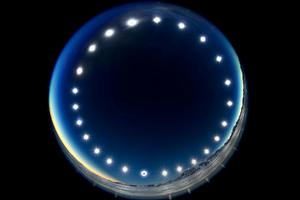
The Eclipse Clock-Eclipse on a Polar Day
image
Created for the OAE
Caption: First place winner in the 2023 IAU OAE Astrophotography Contest, category of Still images of day arcs of the Sun and Solargraphs.
Constructed by combining multiple images over the course of a 24-hour period, the image was captured in Union Glacier, Antarctica, during the total solar eclipse of 4 December 2021, and showcases the day arc of the Sun. It illustrates the unique phenomenon of a polar day, during which the Sun travels around the sky without setting. During polar days, areas within the polar circles experience 24 hours of continuous daylight, and the Sun doesn’t set for an extended period. The image also offers a rare perspective of a solar eclipse, where the Moon passes between the Sun and Earth, and as viewed from Earth. This can be seen in the lower image of the Sun, where the Moon covers the solar disc.
Credit: Stephanie Ziyi Ye/IAU OAE (CC BY 4.0)
Termes del glossari:
Sun Path (Day Arc) , Total Solar Eclipse , Polar Circle
Categories:
Naked Eye Astronomy
, Solar System
Tags:
astrophotography
License: Creative Commons Reconeixement 4.0 Internacional (CC BY 4.0) Creative Commons Reconeixement 4.0 Internacional (CC BY 4.0) icons
This file on Zenodo ( image 1.23 MB)
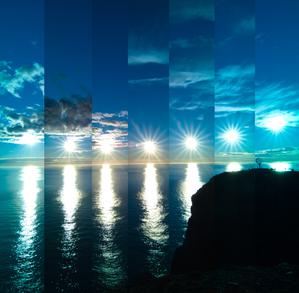
When the Sun Bounces
image
Created for the OAE
Caption: First place winner in the 2023 IAU OAE Astrophotography Contest, category of Still images of sunrise and sunset location over the year.
This image was taken at Norway's North Cape. Owing to the latitude of this location, the Sun never truly sets during the summer months, from around April to August. This results in the unique spectacle of continuous daylight, known as a polar day. This captivating series of images, taken in 2022, showcases the Sun's relentless journey across the horizon every 30 minutes. At its lowest point in the sky, the Sun does not set, but appears to bounce off the horizon. The globe on the far right in the photo stands as a sentinel, marking the northernmost point of the European continental mainland.
Credit: Milos Obert/IAU OAE (CC BY 4.0)
Termes del glossari:
Sun Path (Day Arc) , Polar Circle , Arctic Circle , Polar Day
Categories:
Naked Eye Astronomy
Tags:
astrophotography
License: Creative Commons Reconeixement 4.0 Internacional (CC BY 4.0) Creative Commons Reconeixement 4.0 Internacional (CC BY 4.0) icons
This file on Zenodo ( image 3.54 MB)
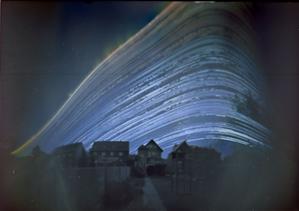
The Path of the Sun
image
Created for the OAE
Caption: Second place winner in the 2023 IAU OAE Astrophotography Contest, category of Still images of day arcs of the Sun and Solargraphs.
This enchanting image, captured in Germany between 21 June 2018 and 21 December 2018, is a poetic blend of art and science, showcasing nature's rhythm and the passage of time. It combines images taken at different times of day over the course of six months. Each curve tracks the Sun’s path (or arc) across the sky on a particular day. The sweeping arc of the Sun is distorted here by the projection, making it appear like a curve. The position of the daily arc across the sky changes with the Sun’s seasonal movement in the sky. Captured using a simple pinhole camera fashioned from a coffee can, it shows the Sun's journey over the course of six months, and the gradual shift of the daily arc from the summer, when it is higher in the sky, to its lowest arc at the winter solstice. Gaps in the Sun’s path represent days or times of day when the Sun was obscured by clouds. This image is a vivid testament to the changing seasons, revealing the Sun's dance in the sky as days grow shorter or longer.
Credit: Frank Niessen/IAU OAE (CC BY 4.0)
Termes del glossari:
Equinox , Solstice , Summer Solstice , Sun Path (Day Arc) , Winter Solstice
Categories:
Naked Eye Astronomy
Tags:
astrophotography
License: Creative Commons Reconeixement 4.0 Internacional (CC BY 4.0) Creative Commons Reconeixement 4.0 Internacional (CC BY 4.0) icons
This file on Zenodo ( image 465.46 kB)
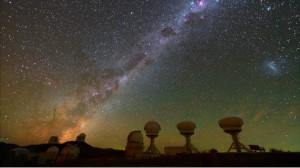
Southern Sky Over La Silla
video
Created for the OAE
Caption: First place winner in the 2023 IAU OAE Astrophotography Contest, category of Time-lapses of rotation of Big Dipper or Southern Cross.
This video shows the Milky Way’s sprawling brilliance across the celestial expanse. Among the stars’ grand theatre, the Southern Cross constellation claims its place in the scene, distinguished by its distinctive cross shape as seen in the top of this video and slightly to the right just over the Milky Way, slowly disappearing as the video progresses. This celestial marker, a prominent feature in the southern hemisphere, holds cultural and navigational significance, having served as a navigational guidepost for centuries. Accompanying the Milky Way’s grandeur are the two Magellanic clouds, celestial companions seen dancing in the distant sky. The Carina Nebula adds its ethereal glow to the cosmic panorama, painting a radiant hue against the darkness. In the midst of this celestial ballet, a gentle green hue envelops the atmosphere, a phenomenon known as airglow, adding a touch of subtle luminescence to the night sky. The terrestrial also makes an appearance, with planes flying overhead and vehicles driving between observatory buildings. This time-lapse, taken from the La Silla Observatory in Chile, is a window to the captivating dance of stars, offering a glimpse into the awe-inspiring beauty of our galaxy and the celestial landmarks that grace the southern sky.
Credit: José Rodrigues/IAU OAE (CC BY 4.0)
Termes del glossari:
Celestial Pole , Celestial Sphere , Earth's Rotation , Observation , Sky , Southern Cross
Categories:
Naked Eye Astronomy
Tags:
astrophotography
License: Creative Commons Reconeixement 4.0 Internacional (CC BY 4.0) Creative Commons Reconeixement 4.0 Internacional (CC BY 4.0) icons
This file on Zenodo ( video 1.07 GB)
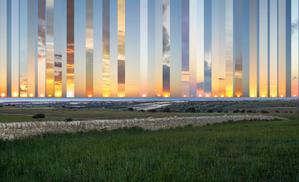
Occasive Amplitude
image
Created for the OAE
Caption: Second place winner in the 2023 IAU OAE Astrophotography Contest, category of Still images of sunrise and sunset location over the year.
Captured from Gatto Corvino village in Sicily, this composite showcases the Sun setting at various points over the sea from the winter to the summer solstice (2016–2017). The centre frame marks due west. As Earth orbits the Sun, the position of the setting (and rising) Sun changes from being northward of due west (east) in summer to southward of due west (east) in winter. During the equinoxes — when day and night are of equal length — the Sun rises directly in the east and sets directly in the west. The changing location of the Sun on the horizon is due to Earth’s axial tilt as it orbits the Sun. In temperate regions of Earth, the Sun’s height above the horizon at noon is at its highest and lowest points in the sky on the summer and winter solstices respectively.
Credit: Marcella Giulia Pace/IAU OAE (CC BY 4.0)
Termes del glossari:
Equinox , Solstice , Summer Solstice , Sun Path (Day Arc) , Winter Solstice
Categories:
Naked Eye Astronomy
Tags:
astrophotography
License: Creative Commons Reconeixement 4.0 Internacional (CC BY 4.0) Creative Commons Reconeixement 4.0 Internacional (CC BY 4.0) icons
This file on Zenodo ( image 11.49 MB)


