Documents & Resources - Search Results
Search results
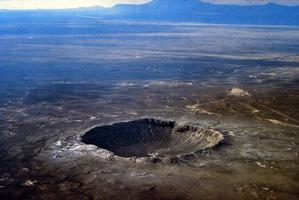
Meteoroids, Meteors and Meteorites astroEDU educational activity (links to astroEDU website) Description: Unveiling the mystery of "shooting stars": meteors, meteorites and meteroids
Termes del glossari:
Asteroid , Comet , Crater , Earth , Meteorite , Meteoroid , Shooting Star
Categories:
Planet Earth
, Solar System
Tags:
Geology
Age Ranges:
6-8
, 8-10
, 10-12
, 12-14
Education Level:
Middle School
, Primary
Areas of Learning:
Interactive Lecture
Costs:
Low Cost
Duration:
1 hour 30 mins
Group Size:
Group
Skills:
Analysing and interpreting data
, Asking questions
, Communicating information
, Engaging in argument from evidence
Authors: Christian Eistrup, Jorge Rivero González, Ronan Smith
License: Creative Commons Reconeixement 4.0 Internacional (CC BY 4.0) Creative Commons Reconeixement 4.0 Internacional (CC BY 4.0) icons

Solar System Model on a City Map astroEDU educational activity (links to astroEDU website) Description: Build a scale model of the Solar System on your city map
Termes del glossari:
Solar System
Categories:
Mathematics
, Solar System
Tags:
Distances
, Hands-on
, Scales
, city map
, scale model
Age Ranges:
12-14
, 14-16
Education Level:
Middle School
Areas of Learning:
Modelling
Costs:
Low Cost
Duration:
2 hours
Group Size:
Group
Skills:
Analysing and interpreting data
, Asking questions
, Communicating information
, Developing and using models
Authors: Mayte Vasquez
License: Creative Commons Reconeixement 4.0 Internacional (CC BY 4.0) Creative Commons Reconeixement 4.0 Internacional (CC BY 4.0) icons
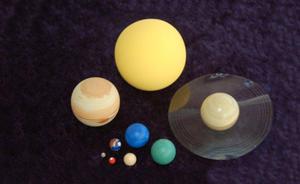
Solar System Model astroEDU educational activity (links to astroEDU website) Description: Make a model of the Solar System planets using household materials.
Termes del glossari:
Solar System , Sun
Categories:
Solar System
, The Sun
Tags:
Hands-on
, Model
, Planets
Age Ranges:
4-6
, 6-8
, 8-10
Education Level:
Pre-school
, Primary
Areas of Learning:
Modelling
Costs:
Low Cost
Duration:
30 mins
Group Size:
Group
Skills:
Analysing and interpreting data
, Asking questions
, Communicating information
, Developing and using models
Authors: Syeda Lammim Ahad
License: Creative Commons Reconeixement 4.0 Internacional (CC BY 4.0) Creative Commons Reconeixement 4.0 Internacional (CC BY 4.0) icons
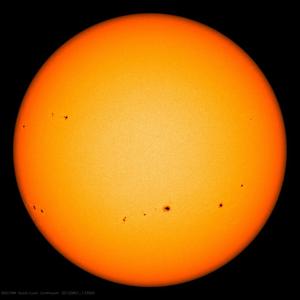
Sunspots
image
Caption: In this image the sun peppered with groups of sunspots over almost nine days between July and August 2012. The sunspots seen in this image have been sources of the solar flares and coronal mass ejections (CME). In this image particulary, the sun is approaching solar maximum in its cycle (solar cycle), where we see many spots forming along the suns' equator. These sunspots and activity are seen in the southern hemisphere, before then most of the activity was on the northern hemisphere.
Credit: NASA/SDO/HMI
Credit Link
Termes del glossari:
Sun , Sunspot , Stellar Activity
Categories:
The Sun
License: Public Domain Public Domain icons
Arxiu
( image
153.32 kB)
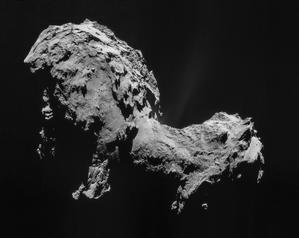
Comet 67P/Churyumov-Gerasimenko
image
Caption: Comet 67P/Churyumov–Gerasimenko's nucleus is a "dirty snowball" made of a mixture of frozen materials and dust. It is shaped like two large lobes: one 4.1 km × 3.3 km × 1.8 km, the other 2.6 km × 2.3 km × 1.8 km. These lobes are connected by a small bridge. When a cometary nucleus such as this nears the Sun its frozen, icy material is heated, turning into gas. This, combined with the embedded dust, provide the material for the comet's characteristic coma and tail.
Credit: ESA/Rosetta/NAVCAM
Credit Link
Termes del glossari:
Comet , Comet Nucleus
Categories:
Solar System
License: Creative Commons Reconeixement-CompartirIgual 3.0 Organització Intergovernamental Creative Commons Reconeixement-CompartirIgual 3.0 Organització Intergovernamental icons
Arxiu
( image
4.75 MB)