Documents & Resources - Search Results
Search results

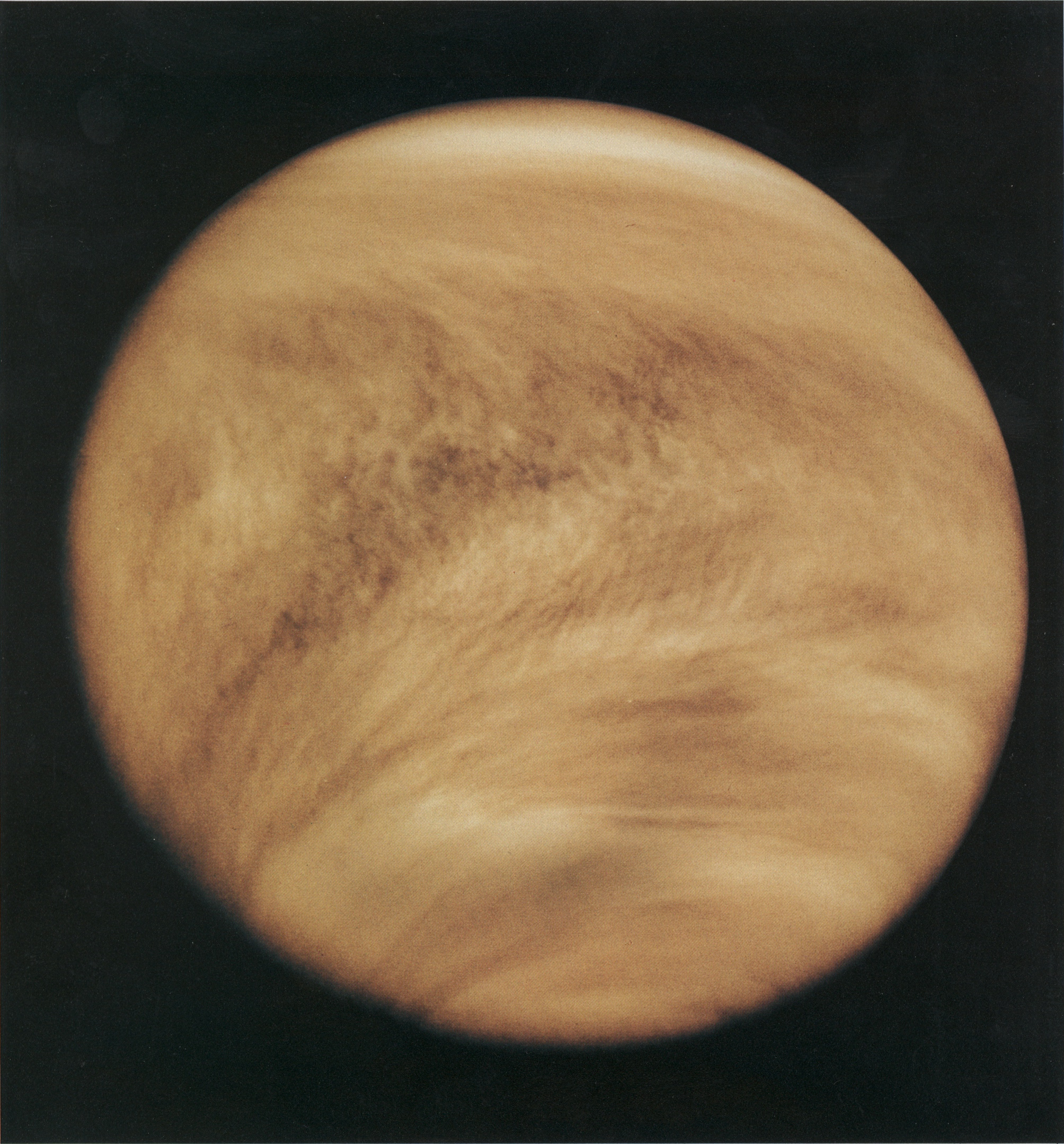
Atmosphere of Venus
image
Caption: This image of Venus was captured in ultraviolet light by the Pioneer Venus Orbiter and highlights features of the planet’s thick atmosphere that are not visible in ordinary light. Venus has a dense, cloudy atmosphere composed mainly of carbon dioxide. In ultraviolet wavelengths, patterns in the upper cloud layers become visible, revealing swirling structures and bright and dark bands caused by differences in the composition and motion of the atmosphere. These ultraviolet features help scientists map wind patterns, atmospheric circulation, and cloud dynamics high above Venus’s surface.
Unlike Earth’s atmosphere, which is relatively transparent in visible light, Venus’s atmosphere is so thick that no direct view of the surface is possible from space without special instruments. The extreme pressure and temperature near Venus’s surface are consequences of this dense gaseous envelope, making Venus a dramatic example of how different planetary atmospheres can be. This image demonstrates how observing a planet’s atmosphere in different wavelengths, such as ultraviolet, reveals details about its structure and behaviour.
Credit: NASA
Credit Link
Termes del glossari:
Atmosphere , Venus
License: Public Domain Public Domain icons
Arxiu
( image
8.09 MB)

Meet our neighbours: Venus astroEDU educational activity (links to astroEDU website) Description: Ever dreamed of building a tactile version of planet Venus?
Termes del glossari:
Venus
Categories:
Solar System
Age Ranges:
6-8
, 8-10
, 10-12
Education Level:
Primary
Areas of Learning:
Fun activity
, Modelling
Costs:
Low Cost
Duration:
1 hour
Group Size:
Group
Skills:
Analysing and interpreting data
, Developing and using models
Authors: Lina Canas
License: Creative Commons Reconeixement 4.0 Internacional (CC BY 4.0) Creative Commons Reconeixement 4.0 Internacional (CC BY 4.0) icons

Meet our neighbours: Jupiter astroEDU educational activity (links to astroEDU website) Description: Jupiter, the gas giant of the Solar System in a tactile version.
Termes del glossari:
Gas Giant , Jupiter
Categories:
Solar System
Age Ranges:
6-8
, 8-10
, 10-12
Education Level:
Primary
Areas of Learning:
Fun activity
, Modelling
Costs:
Low Cost
Duration:
1 hour
Group Size:
Group
Skills:
Analysing and interpreting data
, Developing and using models
Authors: Lina Canas
License: Creative Commons Reconeixement 4.0 Internacional (CC BY 4.0) Creative Commons Reconeixement 4.0 Internacional (CC BY 4.0) icons

Venus Transit from Tempe, AZ, USA , June 5, 2012
image
Caption: While the planet Venus regularly passes between the Sun and the Earth, most of the time it passes above or below the Sun when observed from Earth. On rare occasions, the planet Venus passes directly in front of the Sun for observers on Earth. The last such Venus transits were in 2004 and 2012, respectively. The next such transit will be in 2117. The picture was taken at 18:54 PDT on June 5, 2012, from Tempe, Arizona, US. The telescope used was an 8" Schmidt-Cassegrain with ND5 filter; the camera was a Sony NEX5N with the APS sensor placed at prime focus. Clearly visible are the disk of the Sun, Venus as a prominent round spot. Several sun spots also appear on the solar disk.
Credit: Stephen Rector
Credit Link
Termes del glossari:
Transit , Venus
Categories:
Solar System
License: Creative Commons Reconeixement-CompartirIgual 3.0 No adaptada Creative Commons Reconeixement-CompartirIgual 3.0 No adaptada icons
Arxiu
( image
4.60 MB)

Meet our neighbours: Mars astroEDU educational activity (links to astroEDU website) Description: Build a tactile version of the red planet!
Termes del glossari:
Mars
Categories:
Solar System
Age Ranges:
6-8
, 8-10
, 10-12
Education Level:
Primary
Areas of Learning:
Fun activity
, Modelling
Costs:
Low Cost
Duration:
1 hour
Group Size:
Group
Skills:
Analysing and interpreting data
, Developing and using models
Authors: Lina Canas
License: Creative Commons Reconeixement 4.0 Internacional (CC BY 4.0) Creative Commons Reconeixement 4.0 Internacional (CC BY 4.0) icons