Documents & Resources - Search Results
Search results
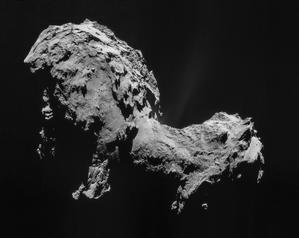
Comet 67P/Churyumov-Gerasimenko
image
Caption: Comet 67P/Churyumov–Gerasimenko's nucleus is a "dirty snowball" made of a mixture of frozen materials and dust. It is shaped like two large lobes: one 4.1 km × 3.3 km × 1.8 km, the other 2.6 km × 2.3 km × 1.8 km. These lobes are connected by a small bridge. When a cometary nucleus such as this nears the Sun its frozen, icy material is heated, turning into gas. This, combined with the embedded dust, provide the material for the comet's characteristic coma and tail.
Credit: ESA/Rosetta/NAVCAM
Credit Link
Termes del glossari:
Comet , Comet Nucleus
Categories:
Solar System
License: Creative Commons Reconeixement-CompartirIgual 3.0 Organització Intergovernamental Creative Commons Reconeixement-CompartirIgual 3.0 Organització Intergovernamental icons
Arxiu
( image
4.75 MB)
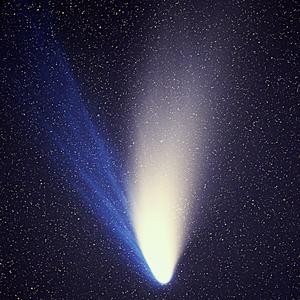
Comet Hale-Bopp
image
Caption: Image of comet C/1995 O1 (Hale-Bopp), taken on 4 April 1997, with an exposure time of 10 minutes. The field shown is about 6.5°x6.5°. Two tails extend from the bright coma: one white-yellowish dust tail and a bluish gas tail, always pointing away from the Sun.
Credit: E. Kolmhofer, H. Raab; Johannes-Kepler-Observatory, Linz, Austria
Credit Link
Termes del glossari:
Comet , Cometary Tail
Categories:
Solar System
License: Creative Commons Reconeixement-CompartirIgual 3.0 No adaptada Creative Commons Reconeixement-CompartirIgual 3.0 No adaptada icons
Arxiu
( image
882.93 kB)


