Documents & Resources - Search Results
Search results
OAE Node Greece Logo
image
Created for the OAE
Arxiu ( image 140.71 kB)
Mini-Review on Exoplanet Detection Methods
PDF file document
Created for the OAE
Description: A brief review on the classical two ways of detecting exoplanets: the radial velocity method that makes use of the minute changes in a star's radial velocity when it is orbited by an exoplanet, and the transit method, which infers the presence of the exoplanet from the minute dips in stellar brightness as, from the perspective of an observer on Earth, the exoplanet passes in front of its host star, shielding some of the star's light.
Termes del glossari:
Doppler Effect , Exoplanet , Radial Velocity , Transit
Categories:
Exoplanets & Astrobiology
Language: English
Script: Latin
Arxiu
(PDF file
83.42 kB)
Prompts for JEDI in Education
PDF file document
Created for the OAE
Description: Thought starters for designing accessible and welcoming educational activities from the OAE Justice, Equity, Diversity and Inclusion Working Group
Authors: Samantha Brown-Sevilla, Silvia Casu, Stefano Sandrelli, Gloria Tirabassi, Rachele Toniolo, Stefania Varano
Language: English
Script: Latin
Arxiu
(PDF file
524.49 kB)
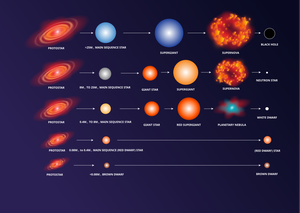
Stellar Evolution
image
Created for the OAE
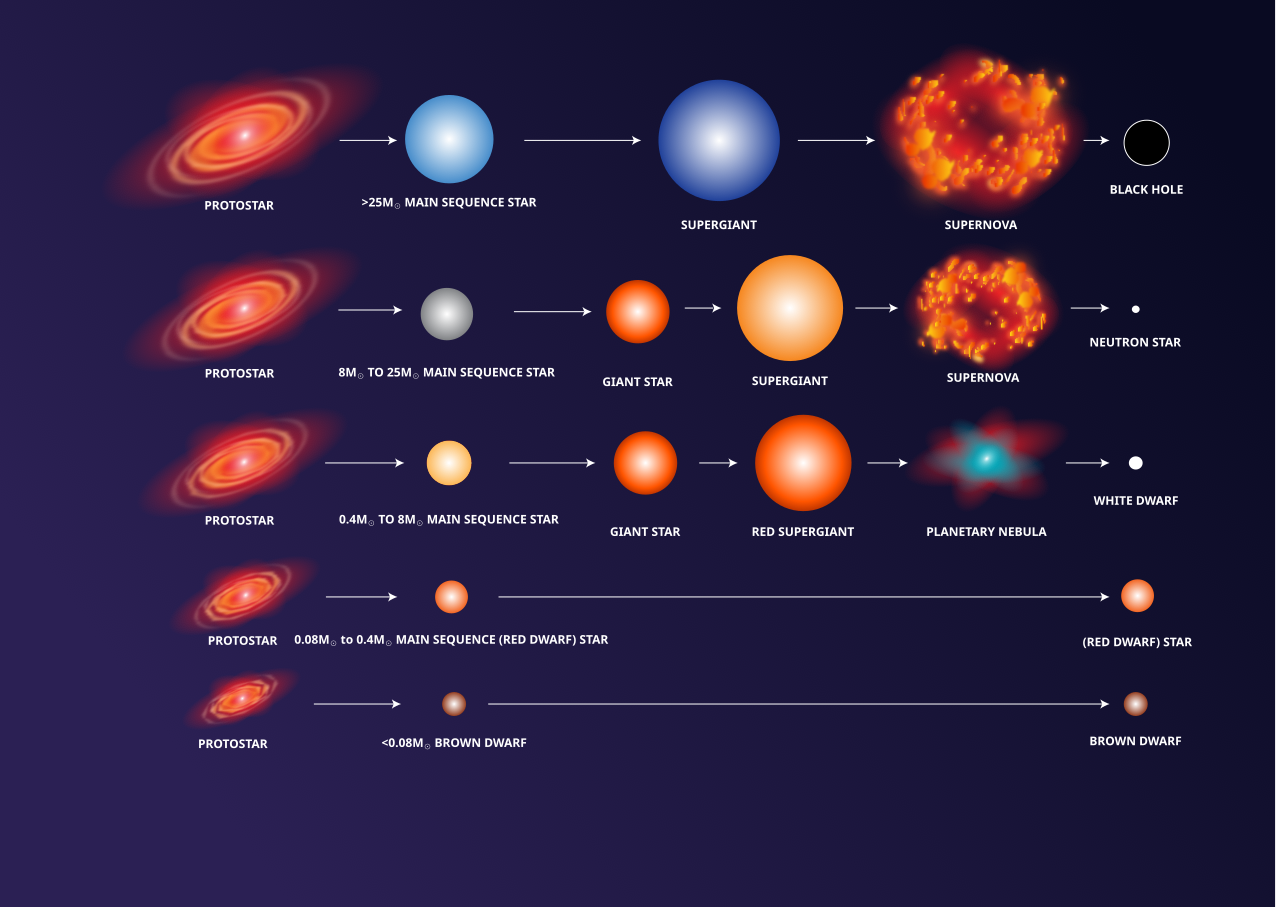
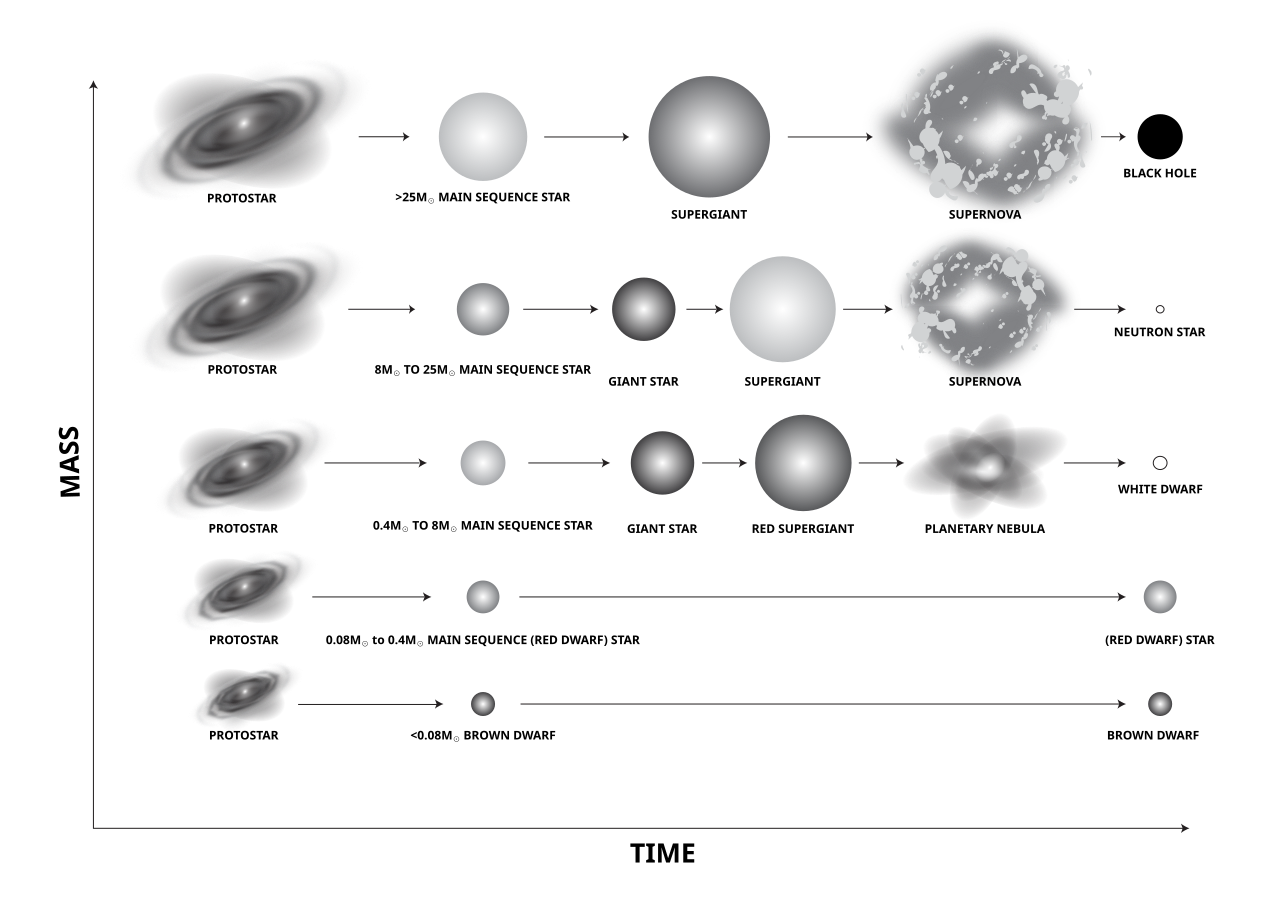
Caption: This diagram shows the life cycle of stars of different masses. The mass of the different types of star increases from bottom to top with time going from left to right.
The life cycle of a star depends on its mass, with lower mass stars have longer lifetimes. All stars form from clouds of gas that collapse under their own gravity. As the star collapses, its core becomes hotter and denser. If the star has a mass greater than 0.08 solar masses (0.08 times the mass of the Sun), the pressure of the star’s mass pushing down on its core creates a high enough core temperature for hydrogen fusion to ignite. This burns hydrogen into helium in the star’s core, providing a heat source to power the star and to stop its core from collapsing further. If the collapsing object has a mass below 0.08 solar masses then it does not ignite hydrogen fusion in its core. It continues to cool and slowly contract. Such substellar objects are known as brown dwarfs, shown here in the lowest row.
After stars have formed, they burn hydrogen in their cores and begin their so-called main sequence phase. The most massive stars (>25 solar masses, shown here at the top) have very high core temperatures and thus burn through their hydrogen fuel more quickly. This means they may only spend a few million years on the main sequence burning hydrogen in their cores. Once the hydrogen in the core is exhausted the star’s core contracts, becomes hotter and helium burning starts in the core. While the core contracts, the outer layers of the star expand and it becomes a supergiant. For the most massive stars strong stellar winds strip off the cooler outer layers, leading to the star being very large and very hot, a blue supergiant. Once helium is exhausted in the core, carbon is burned, and then heavier elements. Eventually the star ends with an iron core. Fusing iron into heavier elements does not generate energy so at this point fusion stops in the core. Once this core of iron is massive enough, it and the surrounding matter suddenly collapses to form a black hole and the outer layers are flung off in a supernova explosion.
Slightly lower mass stars (between 8 and 25 solar masses, seen here second top) evolve in a similar way although they do not have strong enough winds to push their outer layers away and become blue supergiants, instead it evolves into a red supergiant. While such stars also collapse and create supernova explosions. The remnant of the star’s core is not massive enough to collapse into a black hole. Instead, its electrons and protons combine to form neutrons and it is supported by a quantum mechanical effect called neutron degeneracy pressure. This results in the remnant of the star being a tiny neutron star, several solar masses in mass but only a few kilometres across.
For stars similar in mass to the Sun (between 0.4 and 8 solar masses, seen here in the middle row), the star burns hydrogen in its core until the hydrogen in its core is exhausted. At this point a hydrogen burning shell forms around the core. Eventually the core will become hot enough to burn helium into carbon and oxygen. After this the star is left with a carbon and oxygen core surrounded by shells burning helium and hydrogen. These shells are unstable producing thermal pulsations that convulse the star. Eventually these pulsations become so extreme that the star’s outer layers are thrown off. This leaves the carbon and oxygen core as a white dwarf supported by electron degeneracy pressure. The outer layers of the star form what is known as a planetary nebula (which doesn’t actually have anything to do with planets despite the name).
The lowest mass stars (seen here in the second bottom row) are so low in mass that their evolutionary timescales are much longer than the age of the universe. This means that none have evolved beyond the main-sequence. Low mass stars are fully convective meaning material in the core is constantly being mixed with material above. This means that all the hydrogen in the star would eventually be burned in the core, but this will take trillions of years.
Credit: Danielle Futselaar/IAU OAE
Termes del glossari:
Black Hole , Hydrogen Fusion , Neutron Star , Star Formation , Stellar Evolution , Stellar Remnants , Supergiant Star , Supernova , White Dwarf
License: Creative Commons Reconeixement 4.0 Internacional (CC BY 4.0) Creative Commons Reconeixement 4.0 Internacional (CC BY 4.0) icons
Arxiu
( image
987.57 kB)
PDF File
(PDF file
954.32 kB)
Also available in black and white
Arxiu
( image
441.43 kB)
PDF File
(
650.73 kB)
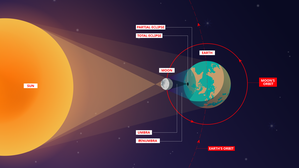
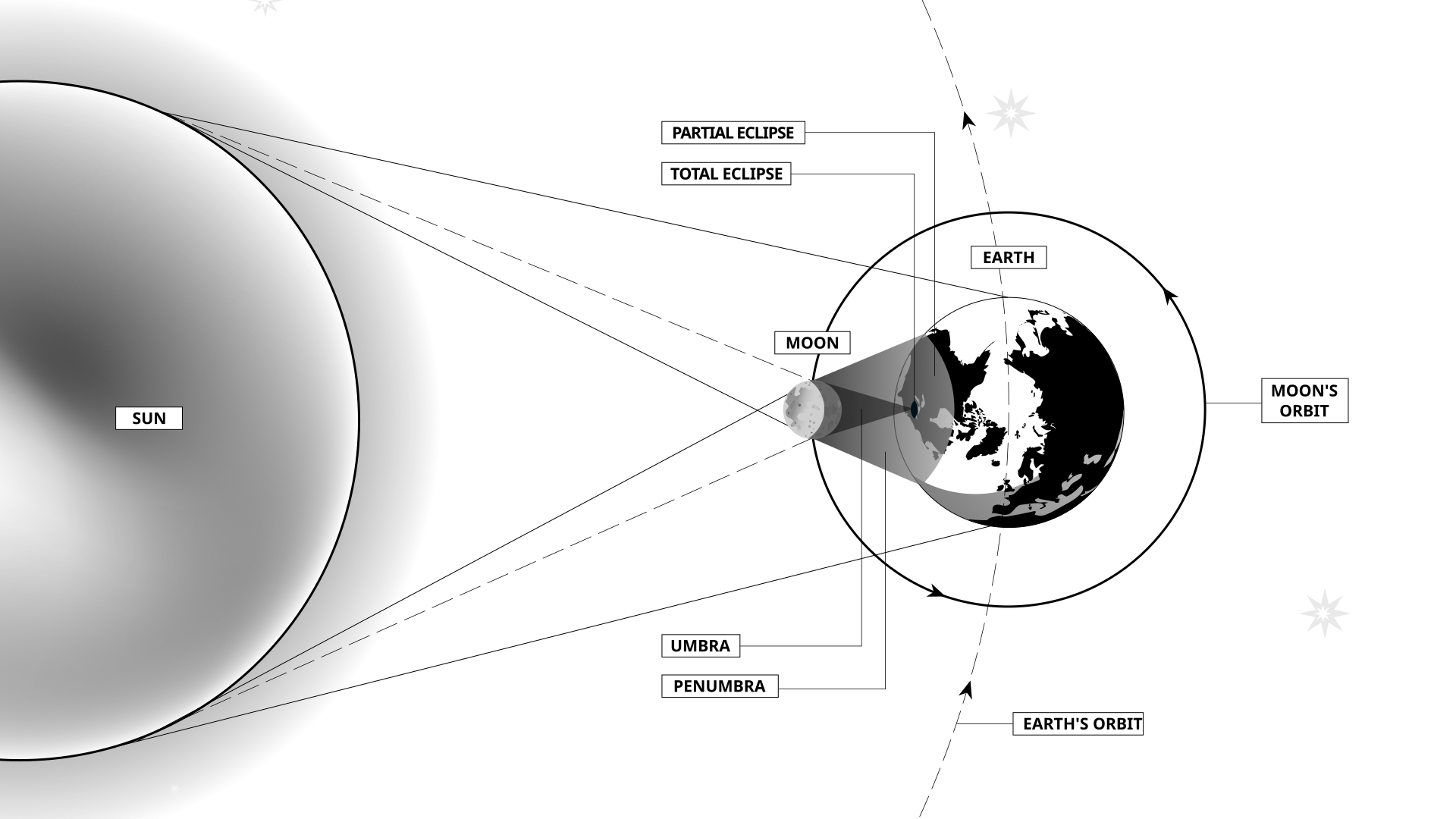
Total Solar Eclipse
image
Created for the OAE
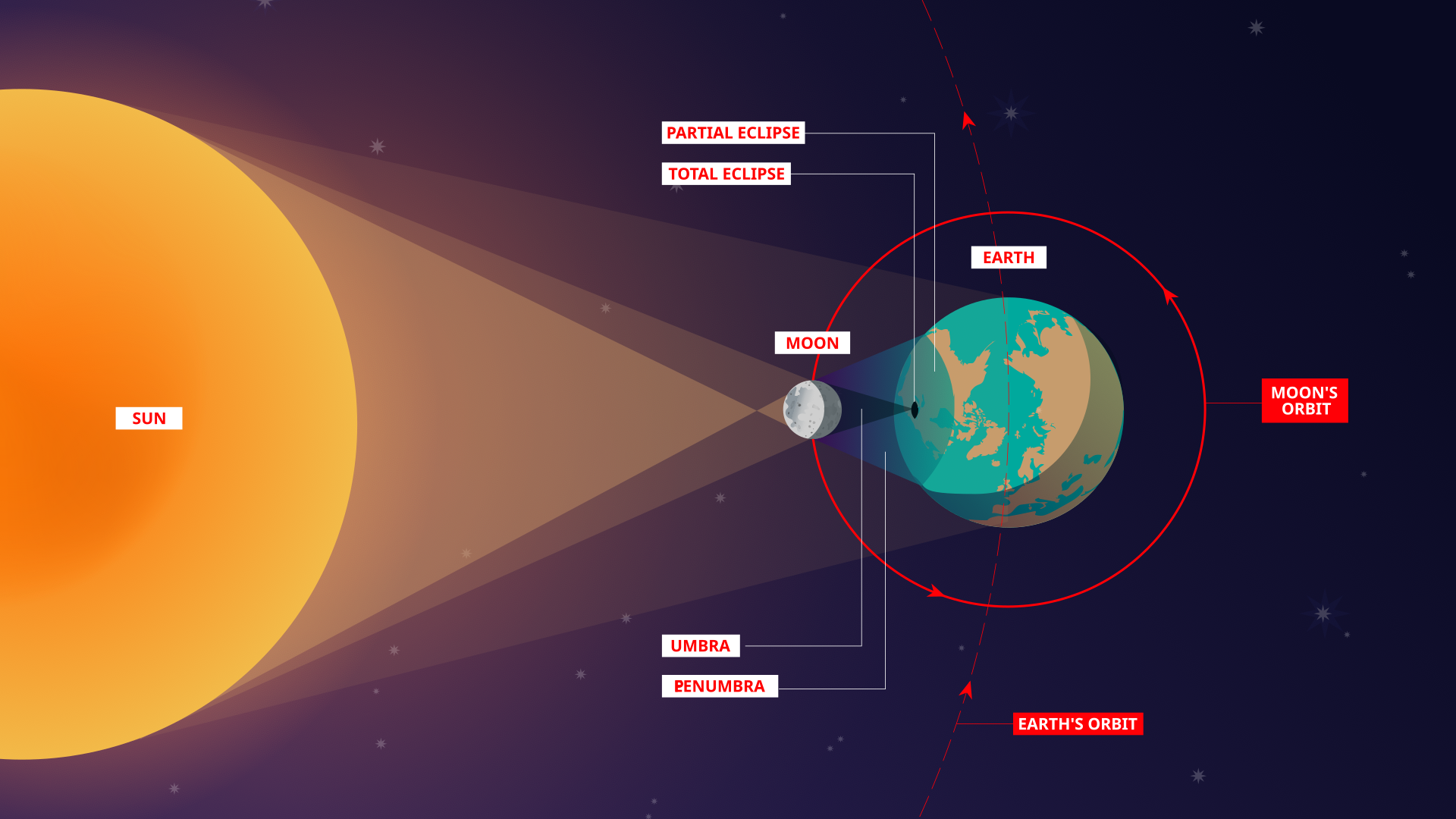
Caption: This not to scale diagram shows what happens during a total solar eclipse. The Moon orbits the Earth, but its orbit is slightly tilted with respect to the Earth’s orbit around the Sun. During the new moon lunar phase, the Moon lies between the Earth and the Sun, but due to the Moon’s tilted orbit around the Earth, the Moon normally lies above or below the Sun at this point. However twice a year the Moon’s orbit lines up in such a way that the Moon can lie in a direct line between the Earth and Sun. During each of these periods (each of which last roughly a month) solar (and lunar) eclipses can occur. The Moon is about 400 times smaller than the Sun, but is 400 times closer to the Earth than the Sun. Hence the Sun and Moon have approximately the same angular size when viewed from the Earth. This means that it is possible for the Moon to completely cover the Sun when viewed from Earth. This is known as a total solar eclipse.
Here we see a schematic of such and eclipse. The Moon casts a shadow on the Earth known as the umbra. This is a roughly circular shadow a few hundred kilometres across although its shape can be severely distorted when the eclipse is at the edge of the illuminated part of the Earth. Any region within the umbra will see the Moon completely cover the Sun and thus will experience a total solar eclipse. Outside of the umbra there are regions where the Moon will cover part of the Sun. This partial shadow is known as the penumbra. Regions in the penumbra will experience a partial solar eclipse.
An eclipse is a dynamic event with the Moon moving in its orbit and the Earth rotating. Hence the umbra and penumbra move across the Earth’s surface together. The path the umbra takes across the Earth is known as the path of totality. Let’s consider one particular region that lies in the path of totality: except in rare cases where an eclipse begins at sunrise, a region that experiences totality will first see the Moon cover part of the Sun and gradually move across Sun until it is totally covered. From outside the Earth this would appear as the penumbra moving over this particular region followed by the umbra moving over this region. Once the Moon moves so that it no longer completely covers the Sun, totality ends and the umbra moves away from this particular region. The Moon will continue to uncover the Sun until (unless the Sun sets before the end of the eclipse) the Sun is completely uncovered. From outside the Earth this would appear as the umbra moving away from our particular region and the edge of the penumbra approaching and eventually passing over the region.
Outside of the path or totality there is a much broader region that will lie in the penumbra but will be missed by the umbra. Such regions will not experience a total solar eclipse during this event, only a partial solar eclipse.
Credit: Aneta Margraf/IAU OAE
Termes del glossari:
Lunar Phase , Moon , New Moon , Partial Solar Eclipse , Penumbra , Solar Eclipse , Sun , Total Solar Eclipse , Umbra
Categories:
Naked Eye Astronomy
License: Creative Commons Reconeixement 4.0 Internacional (CC BY 4.0) Creative Commons Reconeixement 4.0 Internacional (CC BY 4.0) icons
Arxiu
( image
2.06 MB)
PDF File
(PDF file
1.56 MB)
Also available in black and white
Arxiu
( image
468.46 kB)
PDF File
(
1.96 MB)