Documents & Resources - Search Results
Search results

TTP Poster 2025
PDF file document
Created for the OAE
Language: English
Script: Latin
Arxiu
(PDF file
923.74 kB)

A moment of codesign in the Sabir project. Credits: OAE Center Italy
image
Created for the OAE
Artists: Stefano Sandrelli Arxiu ( image 2.95 MB)

The participants to the sabir project in Milan. Credits: OAE Center Italy
image
Created for the OAE
Artists: Stefano Sandrelli Arxiu ( image 179.23 kB)

OAE Response to Attendee Feedback on the 2023 5th Shaw-IAU Workshop on Astronomy for Education
PDF file document
Created for the OAE
Description: At the conclusion of the 5th Shaw-IAU Workshop in 2023, we conducted a survey to gather feedback from attendees on their experience. We received an impressive 254 responses, representing 65 countries, with a nearly equal balance of male and female participants. This document outlines the OAE's response to the feedback provided by attendees.
Authors: Sophie Bartlett
Language: English
Script: Latin
License: Creative Commons Reconeixement 4.0 Internacional (CC BY 4.0) Creative Commons Reconeixement 4.0 Internacional (CC BY 4.0) icons
Arxiu
(PDF file
281.00 kB)
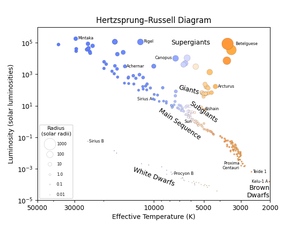
Hertzsprung-Russell diagram
image
Created for the OAE
Caption: This diagram shows the temperature and luminosity of different stars. The size of each point represents the star’s radius and its colour is the colour the human eye would see. The stars range in colour from a washed-out blue to a washed-out reddish-orange. No star has a pure colour like red, green or blue as stars’ spectra include light from lots of different colours. However the reddest stars are commonly referred to as red and the bluest stars as blue. The sample of stars used to make this diagram was chosen to show a wide range of stars of different types so the relative number of each type of star is not representative of how commonly each type is found.
From the top left to bottom right there is a long line of stars burning hydrogen in their cores. This is called the main sequence. On this line, one sees the stars Mintaka, Achernar, Sirius A, the Sun and Proxima Centauri. The objects around Proxima Centauri at the lower right end of the main sequence are known as red dwarfs. To the lower right of the red dwarfs are Teide 1 and Kelu-1 A. These two objects are brown dwarfs, objects too low in mass to have cores hot enough to fuse hydrogen for a sustained period of time. As they do not burn hydrogen, brown dwarfs are not considered main sequence stars. The name brown dwarf is unrelated to their colour.
Above the main sequence, we find subgiants, giants and supergiants. These are stars that have finished burning hydrogen in their core and have evolved into larger objects. A star’s brightness depends on its temperature and size so giant stars are brighter than stars with a smaller radius but the same temperature. In time these objects will move towards the end of their lives and undergo either a planetary nebula phase or become supernovae. Stars which end their lives with a planetary nebula phase become a type of stellar remnant called a white dwarf. Such objects are much smaller than stars of the same temperature and thus are fainter and are found significantly below the main sequence. Stars which end their lives as supernovae become either black holes or neutron stars. These are not shown on this plot.
Credit: IAU OAE/Niall Deacon
Termes del glossari:
Brown Dwarf , Color , Giant Star , Hertzsprung–Russell (HR) Diagram , Luminosity , Main Sequence , Stellar Evolution , Supergiant Star , White Dwarf , Effective Temperature , Subgiant Star , Luminosity Class
Categories:
Stars
License: Creative Commons Reconeixement 4.0 Internacional (CC BY 4.0) Creative Commons Reconeixement 4.0 Internacional (CC BY 4.0) icons
Arxiu
( image
66.05 kB)
PDF File
(PDF file
67.26 kB)





