Documents & Resources - Search Results
Search results

To guard the Stars and the Sea Together
image
Created for the OAE
Caption: Winner in the 2022 IAU OAE Astrophotography Contest, category Still images of celestial patterns.
This image composition is amazing. In the far background of the landscape we see a chain of mountains that seems to mirror the structure of the Milky Way in the sky above. The strong daylight-like colours of the landscape are caused by the Moon, the bright light at the top of the image.
Taken in Kinabalu, Malaysia, in February 2019, this image shows the alignment of planets and the Moon, conveying the idea of the ecliptic as the central line of the Zodiac, the plane within which all planets orbit the Sun. The ecliptic is the central line of the Zodiac, so the region of about five to 10 degrees either side of the ecliptic is where the constellations of the Zodiac are located. Starting from the horizon towards the bottom left of the image we can see the planets Venus, Saturn and Jupiter. The planets have different cultural significance for people around the world, and are deeply embedded in social, religious and practical aspects of life. For example, Wardaman traditions of Indigenous Australians associate the planets with ancestor spirits who traverse the Celestial Road (ecliptic). The appearance and disappearance of planets in the sky are associated with various ceremonies. For example, when Venus starts being the “Morning star” after having been the “Evening star”, this marks the Banumbirr ceremony for the Yolnu people of Arnhem Land, in Australia.
The image also shows the constellations Scorpius, Aquila, Lupus and Triangulum Australe, the asterism of the Teapot, and the two pointer stars Alpha and Beta Centauri. The constellations, asterisms and individual stars within them have significance in many different cultures.
Malaysia, being close to the equator, has had connections to the north as well as to the south and almost the whole sky is visible over the course of the year. The star Antares is seen by the Kokatha people of the Western Desert as Kogolongo, the red tailed black cockatoo, while the Boorong refer to it as Djuit, the red-rumped parrot. The two stars which form the stinger of Scorpius (Shaula and Lesath), are called Karik Karik, the Australian Kestrel.
Credit: Likai Lin/IAU OAE
Glossary Terms:
Constellation , Jupiter , Moon , Saturn , Scorpius , Venus , Zodiac , Asterism , Alpha Centauri
Categories:
Naked Eye Astronomy
License: Creative Commons Attribution 4.0 International (CC BY 4.0) Creative Commons Attribution 4.0 International (CC BY 4.0) icons
This file on Zenodo ( image 3.77 MB)

Milky Way Arch over La Palma
image
Created for the OAE
Caption: Winner in the 2022 IAU OAE Astrophotography Contest, category Still images of celestial patterns.
This image, which shows the majestic band of the Milky Way and a range of culturally significant patterns, was taken in May 2022 at a very high altitude from the Roque de los Muchachos Observatory in La Palma, from which one can see the clouds below. Some prominent star patterns include Scorpius, Sagittarius, Lyra, Cygnus, Aquila, the Summer Triangle asterism, and the Teapot asterism.
As the Canary Islands used to be a starting point for European sailors to explore the world, we use this place to point to the many indigenous cultures they encountered. Most notably it is the dark patterns within the band of the Milky Way that hold significance for many Indigenous cultures around the world. The dark patterns are in fact dense, cool clouds of gas and dust that block the light from stars. Indigenous people see caves, waterways and various patterns associated with the dark regions of the Milky Way.
The constellations and patterns hold different cultural significance and interpretations for different people. For example, the constellation Scorpius is referred to by Polynesian people as the demigod Maui’s Fishhook. The Yolnu people of Arnhem Land associate Scorpius with a crocodile called Ingalpir. Some Indigenous Australian groups associate stories with individual stars within Scorpius, most notably Antares, the orange-red star in the top right of the image above the band of the Milky Way. Next to the Scorpion and above the bright centre of the Milky Way, there is a prominent dark cloud that is called the Pipe Nebula by modern astrophotographers. The smoke of this pipe goes up to rho Ophiuchi. This and all the other dark clouds in the Milky Way together form the backbone of heaven for some tribes, and an animal with black-and-white skin for South African Zulu people.
The nomenclature of bright stars also has cross-cultural roots. For example, Vega (the bright blue star towards the top of the image) comes from the Arabic waqi, from al-nasr al-waqi, the Eagle who throws himself down (in order to hunt). This contrasts with the Flying Eagle, Altair, also derived from Arabic. Antares is a Greek word meaning “the one similar to Mars”, referring to its colour. The star name Shaula in the stinger of the Scorpion is a modern version of the Babylonian or even Sumerian star name.
Credit: Amirreza Kamkar/IAU OAE
Glossary Terms:
Constellation , Dust , Milky Way , Scorpius , Asterism , Dust Cloud , Interstellar Extinction , Sagittarius
Categories:
Milky Way and Interstellar Medium
, Naked Eye Astronomy
, Telescopes, Instruments and Observatories
License: Creative Commons Attribution 4.0 International (CC BY 4.0) Creative Commons Attribution 4.0 International (CC BY 4.0) icons
This file on Zenodo ( image 3.31 MB)

Dreamlike Starry Sky and Airglow
image
Created for the OAE
Caption: Winner in the 2022 IAU OAE Astrophotography Contest, category Still images of celestial patterns.
This spectacular image shows a range of prominent constellations visible in the night sky over the desert of inner Mongolia, taken in August 2019. The yellowish star in the bottom left side is Arcturus, one of the brightest stars in the night sky, and the brightest in the constellation Boötes. The handle of the Big Dipper points towards this bright star and the Dipper is also visible above Boötes. The Northern Dipper (Bei Dou) is a traditional Chinese constellation. It is considered a chariot in which the Judges for Nobility are sitting. Arcturus is considered a single-star asterism, named the Horn, which forms part of the Chinese super-constellation for the spring, the Azure Dragon of the East. The front of the Northern Dipper points towards the star at the top of the photograph which is now called Polaris, the northern Pole Star. In ancient China, there was no bright star at the pole, so the stars in the nearest vicinity of the pole were considered to belong to the emperor and his family in the constellation the Purple Forbidden Palace. At least as early as mediaeval times, Polaris was considered part of the constellation of the Great Emperor of Heaven.
Corona Borealis is also visible in the top right corner of this image, although not in its completeness. It is called the Coiled Thong in China. With its characteristic semi-circular shape, this is one of the smaller constellations of the 88 modern ones, but also can be traced back at least three or four millennia through the Roman “Crown”, the Greek wedding “Wreath”, and the Babylonian “Asterism of Dignity”. The modern name literally means “Northern Crown” in Latin.
At the upper-right edge of the image, we find the part of the modern constellation Cassiopeia that is considered the Flying Corridor and an Auxiliary Road in ancient China. The W-shape of Cassiopeia is cut off by the edge of the photograph but the constellations to its south and southeast, Andromeda and Perseus, are clearly recognisable. Prominently we see the Andromeda galaxy, the most distant object that is visible to the unaided eye. It is located at the outermost outliers of the band of the Milky Way, which could explain why it has not been mentioned explicitly in ancient star catalogues, as it was mistakenly thought to be part of the Milky Way. The photograph also shows clearly reddish parts of the Milky Way that don’t appear bright to the naked eye, and also open clusters that are formed from the same molecular cloud, i.e., groups of stars with similar ages. This region is part of many big and small asterisms in traditional Chinese uranology.
Credit: Likai Lin/IAU OAE
Glossary Terms:
Big Dipper , Circumpolar Stars , North Celestial Pole (NCP) , Polaris , Asterism
Categories:
Naked Eye Astronomy
License: Creative Commons Attribution 4.0 International (CC BY 4.0) Creative Commons Attribution 4.0 International (CC BY 4.0) icons
This file on Zenodo ( image 9.42 MB)
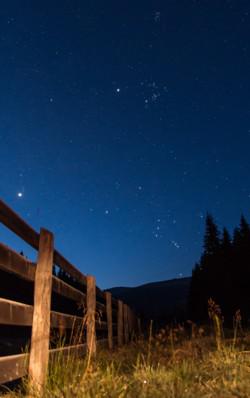
Romanian Orion
image
Created for the OAE
Caption: Winner in the 2022 IAU OAE Astrophotography Contest, category Still images of celestial patterns.
Taken in Romania in August 2012, this image shows two of the most recognisable constellations in the sky, Orion and Taurus.
Orion, the Hunter, is found near the horizon. The most prominent star visible in this image is Betelgeuse, while the asterism of Orion’s belt is formed by three aligned bright stars. Just above Orion we can find Taurus, one of the constellations of the Zodiac. As the Zodiac is inherited from Babylon, The Bull of Heaven represents a mighty but dangerous creature that was defeated by King Gilgamesh and his friend Enkidu. They cut the Bull in half and sacrificed the animal to the gods in order to protect their people. Taurus is also home to the star cluster Pleiades, also known as the Seven Sisters. Two planets are visible: Venus, the bright spot near the fence, and Jupiter, the bright spot at the top, next to the Bull’s face.
Different cultures have included the stars of these constellations in their own mythology. The Romanians, for instance, after Christianisation identified four other constellations using some of the stars of Orion and others surrounding it. One such constellation is called Trisfetitele (the Three Saints), which is associated with the three stars comprising Orion's Belt, representing the Three Hierarchs Basil, Gregory and John. This same asterism is also called Three Wise Men, Kings from the East or just Three Kings — all of these names being rooted in the Christian religion.
The agricultural calendar, in contrast, led farmers to define two other constellations, the Little Plough and the Sickle. Both are seen in the southern half of the Orion rectangle; the Little Plough is drawn by connecting the southern quadrilateral with Orion’s left shoulder, and the Sickle is formed by connecting Orion’s left foot (Rigel) with the belt stars, forming an arch and completing the form of a hoe. In the cultural calendar, these constellations were used to announce the harvest of wheat/grain. Finally, the fourth Romanian constellation is the Great Auger, where Orion’s belt represents the handle of the auger, and Betelgeuse is the tip, facing towards Pollux in Gemini. This constellation is associated with treasure, as Romanian peasants believe that the Auger points to the treasure when they approach the end of the world.
Most of the official star names in Orion are Arabic; Mintaka (meaning “belt”) is at the waist; Alnitak (meaning “girdle”) and Alnilam (meaning “string”) are at the belt; and Rigel (meaning foot) is at the left foot. The star on the left shoulder is named Bellatrix, the Latin term for a female warrior. The star at the right leg is called Saiph, for the sword or sabre of the Arabic Orion.
Credit: Alex Conu/IAU OAE
Glossary Terms:
Constellation , Gemini , Jupiter , Taurus , Venus , Asterism , Orion , Pleiades
Categories:
Naked Eye Astronomy
License: Creative Commons Attribution 4.0 International (CC BY 4.0) Creative Commons Attribution 4.0 International (CC BY 4.0) icons
This file on Zenodo ( image 6.37 MB)

Watchtower and Paddy Fields Under the Starry Sky
image
Created for the OAE
Caption: Winner in the 2022 IAU OAE Astrophotography Contest, category Still images of celestial patterns.
This image, taken in April 2022, shows the sky over a plantation field around a century-old watchtower guarding a village in the province of Guangdong, China. Throughout the ages, the sky has been used as a tool for navigation and also as a calendar. By watching the apparent movement of the stars, it is possible to follow the passing of time, thereby understanding the change of the seasons which in turn helps to plan out the best timings of agricultural work.
The most prominent constellations in this image are Orion and Canis Major, the Great Dog. Commonly associated with a giant hunter in Greek mythology, Orion is followed by his hound in the shape of the constellation Canis Major.
In China, the seven bright stars of the constellation Orion are paradoxically called Three Stars (Shen) and this is one of the 28 Lunar Mansions. The Babylonian pre-zodiac, the so-called “Path of the Moon”, had 17 constellations and included Orion (therein named “True Shepherd of the Heavens”). This is not really surprising because, even in the system of the 88 modern constellations, the Moon sometimes stands in the constellation Orion. The modern constellation boundaries were defined in the 1920s in such a way that the area of Orion ends a half degree south of the ecliptic, in order to avoid the Sun entering it. Still, the Moon and the planets do occasionally. Therefore, Orion is part of the Zodiac (a stripe 5 to 10 degrees around the ecliptic), part of the path of the Moon and, of course, also used by many cultural calendars all over the world.
Sirius, the bright star in the left half of the photograph, is the brightest star in the night sky, and has been used by many indigenous cultures to determine their calendars; the Egyptians awaited the Nile flood with Sirius’s heliacal rise, while the Romans connected its reappearance after its invisibility in daylight with the hottest summer time. In Old China, Sirius was considered a single-star asterism called The Wolf. The adjacent area was called The Market for Soldiers and the area in the southern part of Canis Major was imagined as the Bow with an Arrow.
The reddish bright star in the top right corner is Betelgeuse, a red supergiant and one of the largest stars that can be seen with the naked eye. Orion’s Great Nebula below Orion’s Belt should be mentioned, but also the fainter huge red arc that is called Barnard’s Loop is clearly shown in this photograph. This galactic nebula and the circular red nebula around Orion’s not-so-bright head are both parts of star-forming regions, while the red nebula to the upper left of Orion is the Rosette Nebula in the unrecognisable constellation of Monoceros.
Credit: Likai Lin/IAU OAE
Glossary Terms:
Color , Constellation , Red Supergiant , Star , Orion
Categories:
Naked Eye Astronomy
, Stars
License: Creative Commons Attribution 4.0 International (CC BY 4.0) Creative Commons Attribution 4.0 International (CC BY 4.0) icons
This file on Zenodo ( image 19.99 MB)