Documents & Resources - Search Results
Search results

The Lenticular Galaxy NGC 2787
image
Caption: The lenticular galaxy NGC 2787. This galaxy is a disk galaxy but lacks the large, dominant spiral arm structure seen in the disks of spiral galaxies. Its core is very bright compared to the core of a spiral galaxy. Thin rings of dust can be seen in the galaxy's disk.
Credit: NASA/ESA and The Hubble Heritage Team
Credit Link
Glossary Terms:
Disk Galaxy , Galaxy , Lenticular Galaxy
Categories:
Galaxies
License: Creative Commons Attribution 4.0 International (CC BY 4.0) Creative Commons Attribution 4.0 International (CC BY 4.0) icons
File
( image
1.91 MB)

The giant elliptical galaxy ESO 325-G004
image
Caption: The giant elliptical galaxy ESO 325-G004 sits in the Abell S0740 galaxy cluster. This huge galaxy has a mass of approximately a hundred billion solar masses. ESO 325-G004 is brightest in its core with its brightness decreasing further from its center. This galaxy has no visible spiral structure or dust lanes. ESO 325-G004 and many of the smaller galaxies around it are members of the galaxy cluster Abell S0740.
Credit: Cropped from the original by NASA, ESA, and The Hubble Heritage Team (STScI/AURA); J. Blakeslee (Washington State University)
Credit Link
Glossary Terms:
Elliptical Galaxy , Galaxy Cluster
Categories:
Galaxies
License: Public Domain Public Domain icons
File
( image
108.45 kB)

NGC 5264 - An irregular island
image
Caption: The dwarf irregular galaxy NGC 5264 is located 15 million light years away. It is only about 11,000 light years across, much smaller than our Milky Way, and consists of approximately a billion stars. It lacks the spiral structure of our home Galaxy. The small blue patches in NGC 5264 mark groups of young hot blue stars. This suggests that stars formation in this galaxy is still on-going.
Credit: ESA/Hubble and NASA
Credit Link
Glossary Terms:
Dwarf Galaxy , Irregular Galaxy
Categories:
Galaxies
License: Creative Commons Attribution 4.0 International (CC BY 4.0) Creative Commons Attribution 4.0 International (CC BY 4.0) icons
File
( image
28.87 MB)

A visible light image of the Andromeda Galaxy
image
Caption: The Andromeda Galaxy viewed in visible light. Like our Milky Way, Andromeda is a barred spiral galaxy. Here we can see its bright core and spiral disk. The glow from the stars in the disk is interrupted by lanes of dust that form part of its spiral structure.
Andromeda is the largest galaxy in the Local Group of galaxies that includes the Milky Way.
To the left of the core and just above the disk we see the dwarf galaxy M32 and to the right and below the disk we see the dwarf galaxy M110. These are both satellite galaxies of the Andromeda Galaxy.
Credit: Torben Hansen
Credit Link
Glossary Terms:
Andromeda Galaxy , Disk Galaxy , Dwarf Galaxy , Messier Object , Spiral Galaxy , Galactic Bar
Categories:
Galaxies
License: Creative Commons Attribution 2.0 Generic Creative Commons Attribution 2.0 Generic icons
File
( image
1.10 MB)
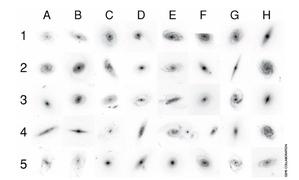
Coma Cluster of Galaxies astroEDU educational activity (links to astroEDU website) Origin: astroEDU Description: The basics of galaxy classification, using Hubble Space Telescope images.
Glossary Terms:
Galaxy
Categories:
Galaxies
, Stars
Tags:
Coma Cluster
Age Ranges:
14-16
, 16-19
, 19+
Education Level:
Secondary
, University
Areas of Learning:
Guided-discovery learning
Costs:
Low Cost
Duration:
1 hour
Group Size:
Group
Skills:
Analysing and interpreting data
, Communicating information
, Constructing explanations
, Planning and carrying out investigations
Authors: Keely Finkelstein
License: Creative Commons Attribution 4.0 International (CC BY 4.0) Creative Commons Attribution 4.0 International (CC BY 4.0) icons





